
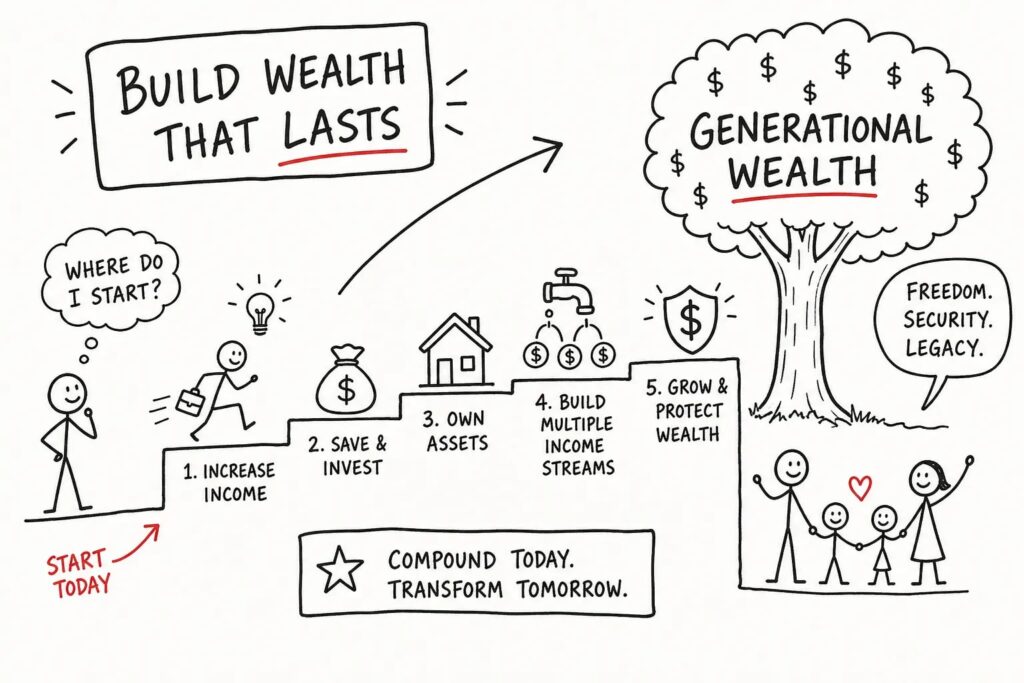
If you’re asking what is the fastest way to build generational wealth in the U.S., the answer depends on your starting point, but some strategies reliably accelerate progress more than others. Most families who built lasting wealth didn’t stumble into it. They made one strategic move, executed it consistently, and let time do the compounding. That’s an observation drawn from personal practice, not a motivational platitude, and it’s a pattern that repeats across the client files I’ve worked through over more than two decades in mortgage lending.
Working with first-generation homebuyers every day at Isabelle Mortgages, the clearest truth I can share is this: generational wealth rarely starts with a perfect plan. It starts with one well-placed decision, made at the right time, with the right structure behind it. The families who build real, lasting wealth are the ones who stopped waiting for the ideal moment and started with the best available option.
This guide ranks the fastest, most accessible pathways to building intergenerational wealth in the U.S. by speed of impact and realistic risk. The goal isn’t to overwhelm you with every option, but to help you identify where to start, so you can move forward with clarity instead of paralysis.
What “fastest” actually means when building family wealth
No single strategy turns zero into generational wealth in two years. Anyone telling you otherwise is selling something you don’t need. The realistic framing: several strategies, particularly homeownership in appreciating markets and successful small-business ownership, can produce six-figure net worth uplifts in five to ten years when started early and executed consistently. That’s not slow, but it does require honest expectations from the beginning.
Speed in wealth-building is less about picking the right vehicle and more about when you start and whether you stay committed. For this article, “generational wealth” means assets that outlive the person who built them: property, investment accounts, business equity, or insurance proceeds that pass real financial advantage to children or grandchildren.
Not every strategy works for every family at the same stage. Income, credit profile, risk tolerance, and existing assets all shape which path makes the most sense right now. Throughout this guide, each strategy is evaluated across three dimensions: accessibility (can most families realistically do this?), speed of impact (when does real wealth begin accumulating?), and durability (does this wealth transfer cleanly to the next generation?).
What is the fastest way to build generational wealth in the U.S.?
Before ranking the specific strategies, it helps to understand what makes some paths faster than others. Leverage, tax advantages, and consistency of execution separate the strategies that build wealth in a decade from those that take three. The sections below cover each pathway in order of accessibility, starting with the one that most families can act on first.
Real estate: the most accessible wealth accelerator
Homeownership remains the single most accessible entry point into intergenerational wealth for most American families, and the data supports it. According to National Association of Realtors reporting, the typical U.S. homeowner gained approximately $147,000 in housing wealth over the five-year period from 2019 to 2024, with high-appreciation metros like Miami-Fort Lauderdale reaching $300,000 in that same window. Over ten years nationally, equity gain from price appreciation combined with principal paydown has averaged over $240,000.
The mechanics behind these numbers matter. Leverage, principal paydown, and price appreciation work together in homeownership in a way no other broadly accessible asset replicates. A renter’s monthly payment builds zero equity and leaves nothing to inherit. A homeowner’s payment builds an asset that grows, can be borrowed against, and can be transferred directly to children. That structural difference, compounded over decades, is why homeownership sits at the foundation of most generational wealth conversations.
Fastest path to equity accumulation for first-time buyers
For families who are the first in their household to navigate the mortgage process, the barriers are real: non-traditional income documentation, credit profiles that don’t fit standard underwriting boxes, and down payment strategies that many loan officers aren’t equipped to address. The Gen-First Mortgage Method™ is Isabelle Mortgages‘ proprietary framework designed specifically for this situation. It addresses those barriers directly so that the first purchase is structured for wealth-building, not just approval.
Once a primary home is established, a rental property becomes the natural next layer. A second property adds cash flow, a second appreciating asset, and a portfolio that creates real options for the next generation. Isabelle Mortgages also supports existing homeowners with investment property financing, helping families expand from a single home into a multi-property portfolio at the right time and pace.
Investment accounts that grow wealth across generations
Real estate builds equity through leverage and appreciation. Investment accounts build wealth through compounding, and the two work best when used in parallel. The main vehicles worth understanding are a 401(k) for tax-deferred growth, a Roth IRA for tax-free inheritance, and a taxable brokerage account for flexibility when the other two are maxed out.
The Roth IRA stands out as the most powerful generational transfer vehicle among these options. The original account holder pays tax on contributions upfront, the money grows tax-free, and most heirs can inherit the account and receive distributions tax-free as well. There are no required minimum distributions during the original owner’s lifetime, meaning the account can compound untouched for decades. Per IRS guidance, the 2026 contribution limit is $7,500 per year, modest, but consistent contributions over time produce meaningful results.
The math makes this concrete. Five hundred dollars per month invested at a 9% average annual return, compounded monthly, over twenty years grows to approximately $330,000. That’s a tangible, transferable asset built through consistency rather than complexity. Diversified equity index funds have historically returned 9% to 10% annualized over twenty-year periods, which is why early contributions carry disproportionate power compared to larger contributions started later.
Life insurance as a stealth generational wealth tool
Life insurance doesn’t generate the excitement of real estate or the growth potential of index funds. What it provides is something the others don’t: a generally reliable, guaranteed death benefit that transfers wealth to heirs once the policy is in force, subject to standard contestability periods and policy exclusions. For families building wealth from scratch, that structural certainty has real value, particularly in the years before other assets have had time to compound.
The two main options are term and permanent insurance. Term insurance is straightforward, affordable protection for a set period. Permanent insurance, including whole life and universal life policies, builds cash value over time that can be accessed during the policyholder’s life or passed to heirs. For most first-generation families, a large term policy paired with aggressive investing into the accounts described above often outperforms a standalone permanent policy. The right answer depends on estate size, tax exposure, and how the policy fits the broader financial picture.
For families with growing estates, an irrevocable life insurance trust (ILIT) is worth understanding early. Placing a policy inside an ILIT keeps the death benefit outside the taxable estate entirely, which matters more as wealth accumulates. In 2026, the federal estate and gift tax exemption sits at $15 million per person ($30 million for married couples), with a 40% tax rate above that threshold. Most families are far below that level, but understanding the tool before you need it is smart planning, not reactive tax management.
Business equity: the highest upside, and the highest risk
Business ownership is the fastest path to net worth acceleration on this list, and the riskiest. A business valued at a 3x to 4x profit multiple can produce $600,000 to $800,000 in enterprise value once it stabilizes, a pace that no index fund can match in a comparable short-term window. The compounding through retained earnings and growing equity multiples creates wealth quickly when the business is managed with discipline.
The failure rate, however, is not a footnote. According to SBA research, roughly 50% of businesses don’t survive year five. That statistic does not mean entrepreneurship is a bad bet; it means business equity must be paired with other wealth-building strategies rather than treated as the sole plan. The families who build lasting wealth through business ownership are typically the ones using business income to fund real estate purchases, retirement accounts, and life insurance simultaneously, so wealth accumulates in parallel rather than sitting entirely inside a single illiquid asset.
For self-employed readers and 1099 earners specifically: non-traditional income does not disqualify you from the mortgage process. The right lender knows how to work with business bank statements, profit-and-loss documentation, and variable income structures. Buying a home while running a business is achievable, and combining both pathways accelerates the wealth-building timeline significantly.
Estate planning: turning wealth into a legacy
Wealth transfer and estate planning: how to pass wealth to children
Every strategy on this list can be undone without proper planning to transfer it. Real estate equity, investment accounts, and business value can all be caught in probate, taxed unnecessarily, or distributed in ways the original owner never intended. Estate planning is what converts short-term gains into long-term family advantage.
The core estate-planning stack for most families starts with a revocable living trust, which avoids probate and keeps asset distribution smooth and private. A will catches any assets outside the trust and names guardians for minor children. Beyond the trust structure, annual gifting, at the 2026 IRS exclusion of $19,000 per recipient, transfers wealth now, tax-free, without touching the lifetime exemption. A married couple can gift $38,000 per recipient per year using gift-splitting, which moves meaningful assets out of the estate while the family is still building.
A 529 education savings plan deserves a specific mention as a generational wealth tool that often gets overlooked. Contributions are treated as gifts for tax purposes, earnings grow tax-free when used for qualified education expenses, and the plan can be front-loaded using the annual gift exclusion for a larger immediate impact. Removing the cost of education from a child’s financial starting point is itself a form of wealth transfer, one that compounds through every financial decision that child makes afterward, with less debt and more options.
Where to start when everything feels urgent
The fastest way to build generational wealth in the U.S. is not one strategy. It’s the right first strategy, executed consistently, protected with proper planning, and expanded as capacity grows. The families who succeed are not the ones who found a shortcut, they’re the ones who made a real decision and didn’t reverse it.
For most families, especially those who are the first in their household to build this kind of wealth, real estate is the most accessible and impactful starting point. Homeownership creates equity, provides stability, and establishes the financial foundation from which every other strategy becomes more achievable. The mortgage structure matters as much as the decision to buy, which is exactly why starting with the right guidance changes the entire trajectory.
At Isabelle Mortgages, the Gen-First Mortgage Method™ exists precisely for families starting their wealth journey without a roadmap handed down from the generation before them. If you’re ready to take that first step, or the next one, reach out and let’s build the plan together. The strategies covered in this guide work best when they’re tailored to your specific situation, your income structure, and where you want your family to be in twenty years.
Frequently asked questions about building generational wealth in the U.S.
What is the fastest way to build generational wealth in the U.S.?
For most families, the fastest way to build generational wealth in the U.S. combines homeownership with consistent investment account contributions. Real estate provides leverage and appreciation that few other accessible assets can match, while a Roth IRA stacks tax-free growth on top. Starting both simultaneously, even at modest levels, produces compounding that accelerates meaningfully over a ten-to-twenty-year horizon.
Can you build generational wealth without starting with a lot of money?
Yes. The strategies with the strongest track record, homeownership, index fund investing, and term life insurance, are specifically accessible to families without significant existing capital. A first home purchased with a modest down payment can generate six figures in equity within a decade in most markets. The leverage built into homeownership is the most powerful wealth-building tool available to families at the beginning of their journey.
How does a Roth IRA help with generational wealth transfer?
A Roth IRA grows tax-free and, under current IRS rules, most heirs can inherit the account and take distributions tax-free as well. There are no required minimum distributions during the original owner’s lifetime, which means the account can compound for decades without being touched. It is one of the cleanest generational transfer vehicles in the U.S. tax code.
Is real estate or the stock market a faster way to build generational wealth?
Real estate tends to produce faster results in the early years because leverage amplifies gains, a 10% increase on a $400,000 home represents $40,000 in equity on a much smaller initial investment. Index funds operate without that leverage but offer more liquidity and less management overhead. The strongest approach uses both in parallel: real estate for leveraged appreciation and a Roth IRA or brokerage account for compounding market returns.
What role does estate planning play in building generational wealth?
Estate planning is what ensures the wealth you build actually reaches the next generation intact. Without a revocable living trust, a will, and a clear gifting strategy, assets can be lost to probate, subject to unnecessary taxes, or distributed in ways you never intended. Estate planning isn’t a step for wealthy families only, it’s the structure that converts any level of accumulated wealth into a lasting family advantage.