You find a house that feels right. The layout, the neighborhood, the price range, it all lines up. Then your real estate agent asks one question: “Do you have a preapproval letter?” And just like that, the excitement hits a wall. If you’re wondering how to get pre approved for a mortgage as a first time buyer, you’re not alone, many buyers don’t realize how critical that letter is until the moment they need it, which is exactly the wrong time to start figuring out how to get one.
A mortgage preapproval is the step that separates serious buyers from browsers. It tells sellers you’ve already cleared a major financial hurdle, and it tells you exactly how much house you can actually afford. The process feels complicated because most people navigate it without any family roadmap or prior experience. That’s the gap Isabelle Mortgages was built to close, especially for first-generation buyers who deserve the same confidence at the negotiating table as anyone else.
This guide walks you through the entire first-time homebuyer preapproval process: what lenders verify, which documents to gather, how to strengthen your profile, and what to do the moment your letter arrives.
How to Get Pre Approved for a Mortgage as a First Time Buyer, Step by Step
Before diving into documents and lender requirements, it helps to understand the two terms that trip up nearly every first-time buyer: prequalification and preapproval. They sound similar. Lenders treat them very differently.
Prequalification vs. Preapproval: Why the Difference Matters More Than You Think
Many first-time buyers treat these two terms as the same thing. Lenders absolutely do not. Mixing them up can cost you a home you were ready to buy.
What Prequalification Actually Gets You
Prequalification is a surface-level estimate based on information you provide verbally or through a short online form. The lender takes your self-reported income, debts, and assets at face value and gives you a ballpark number. Typically, no documents are verified and no formal commitment is issued, though some lenders may run a soft credit pull depending on their process. It’s a useful starting point for understanding your general range, but it holds no weight with sellers or listing agents.
Why Preapproval Carries Real Weight with Sellers
Preapproval is a different process entirely. The lender verifies your income documents, tax returns, and bank statements, and pulls a hard credit inquiry. The result is a conditional written commitment stating exactly how much the lender will loan you. In competitive markets, sellers frequently favor offers that include a preapproval letter, because it signals you’ve already cleared the first major underwriting hurdle. Skipping this step doesn’t just slow you down; it can take you out of the running entirely.
What Lenders Actually Evaluate Before Issuing a Preapproval
Before you submit a single document, it helps to understand the four financial factors lenders assess. Knowing where you stand on each one tells you whether you’re ready to apply or whether 30 to 60 days of preparation first will put you in a significantly stronger position.
Credit Score Minimums by Loan Type
Different loan programs carry different credit thresholds, and knowing which one fits your score helps you target the right product from the start:
- Conventional loans require a minimum 620, with scores of 740 and above unlocking the best available rates.
- FHA loans allow scores as low as 580 with a 3.5% down payment, or as low as 500 with 10% down.
- VA loans carry no official minimum, but most lenders still require around 620.
- USDA loans typically require 640 to 680 depending on the loan type.
If your score falls below these thresholds, the path forward is straightforward: spend several weeks to a few months paying down balances and correcting any errors on your report before applying. Even consistent, on-time payments over 60 to 90 days can move your score meaningfully in the right direction.
Debt-to-Income Ratio: What It Is and Why It Matters
Your debt-to-income ratio, or DTI, measures what percentage of your gross monthly income goes toward debt payments. For conventional loans, the preferred target is a back-end DTI around 36%, with 43 to 45% representing the more common upper limit, though some automated underwriting systems allow up to 50% with strong compensating factors such as significant cash reserves or a high credit score. FHA is more flexible, allowing up to 57% when those same compensating factors are present, which is why it remains an accessible path for buyers carrying student loans or car payments. Knowing your DTI before applying gives you the chance to pay down balances and improve your borrowing power before the clock starts.
Employment History and Income Consistency
Lenders want two years of steady employment in the same field. A recent job change is not automatically disqualifying, but switching industries right before applying raises flags. Moving to a commission-based or contract role within the last two years requires additional documentation and, in some cases, waiting until you have at least 12 months of earnings history in the new role. Income consistency matters more to lenders than income size. A buyer earning $60,000 with a two-year track record is a stronger candidate than one earning $90,000 who just started a new job last month.
Mortgage Preapproval Documents Checklist for First-Time Buyers
Incomplete files are the single biggest reason preapprovals take longer than they should. Lenders don’t start the formal review until your package is complete. Gathering everything upfront cuts days off your timeline.
Income and Employment Verification
You’ll need pay stubs covering the most recent 30 days, W-2s from the past two years, and complete federal tax returns including all schedules. Self-employed borrowers need to add two years of business tax returns, a year-to-date profit and loss statement, and business bank statements showing consistent deposits. The goal is simple: prove your income is real, consistent, and likely to continue.
Asset Statements and Identity Verification
Bank statements from the past two to three months are required for all checking, savings, and investment accounts. Lenders are looking for documented funds covering your down payment, closing costs, and reserves. You’ll also need a valid government-issued photo ID and your Social Security number. If any portion of your down payment is a gift from family, a signed gift letter documenting the source is required before the lender will count those funds toward your file.
Extra Documentation for FHA and Down Payment Assistance Programs
If you’re applying for an FHA loan or pairing it with a state or local down payment assistance program, expect additional paperwork. Florida alone offers more than 100 DPA programs in 2026, including the Florida Hometown Heroes program (up to $35,000 for eligible professions) and the Florida Assist program (up to $10,000 for general buyers). Most of these programs require proof you haven’t owned a home in the past three years, income verification against program caps, and a certificate of completion from a HUD-approved homebuyer education course. Working with an advisor who knows which programs you qualify for before you start saves you from chasing documents you don’t need.
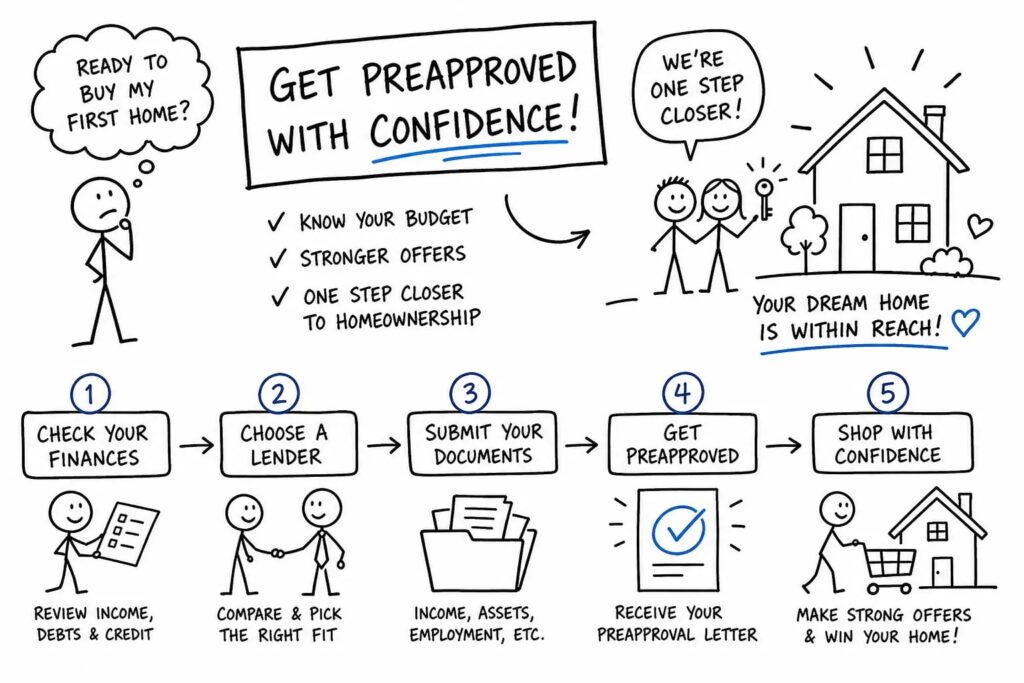
The First-Time Homebuyer Preapproval Process: Stage by Stage
With your documents organized, the process follows a clear sequence. Understanding each stage removes the guesswork and sets realistic expectations for how long it takes.
Step 1: Check Your Credit and Resolve Any Errors
Pull your credit reports from all three bureaus before any lender does. Look for errors, outdated collection accounts, or accounts incorrectly reported as delinquent. Disputing and resolving these errors before your application prevents surprises and protects your score from an unnecessary hit. Even 30 to 60 days of consistent on-time payments and reduced credit card balances can move your score meaningfully in the right direction.
Step 2: Choose the Right Lender and Submit Your Application
Not all lenders are equally suited to first-time buyers. Some large banks may move more slowly and offer less flexibility when your situation doesn’t fit a standard W-2 mold. Dedicated mortgage advisors and independent lenders, especially those familiar with FHA programs and down payment assistance, often communicate more clearly and adapt more readily to complex situations. Once you select a lender, you’ll complete a Uniform Residential Loan Application (Form 1003), submit your document package, and authorize a hard credit inquiry. Rate shopping across multiple lenders within a 14 to 45-day window counts as a single inquiry for scoring purposes, so don’t hesitate to compare.
Step 3: Underwriting Review and Conditional Approval
The lender’s underwriting team reviews your full file: income, credit, assets, and DTI. Most preapproval decisions on clean files come back within one to three business days, though complex situations can take up to five to ten business days. Underwriters often issue a conditional approval requesting one or two follow-up documents, such as a letter explaining a gap in employment or documentation for a large bank deposit. Respond to these requests immediately. Fast document turnaround is the most effective thing you can do to keep the process moving.
How to Protect Your Application from the Most Common Denials
Preapproval is a conditional commitment, not a guaranteed loan. The wrong financial move between approval and closing can revoke your letter entirely. These are the traps first-time buyers fall into most often.
Credit Habits That Keep Your Score Stable
Avoid opening any new credit accounts after your preapproval is issued. New inquiries and new balances both impact your score and your DTI in ways lenders will catch during the final review before closing. Keep credit card utilization below 30%, pay every bill on time without exception, and resist financing new furniture or appliances until after you’ve signed closing documents. The goal is to look exactly the same, or better, at closing than you did on the day your letter was issued.
Financial Moves That Can Cost You the Loan
Changing jobs or reducing your hours between preapproval and closing is one of the fastest ways to lose your loan. Lenders re-verify employment status right before closing, and any change in income stability can restart the entire process. Large, unexplained deposits in your bank account also raise flags during final underwriting, so keep your financial activity as clean and consistent as possible from preapproval day through closing day. If a significant life change does happen, notify your lender immediately. Transparency keeps your options open; hiding changes eliminates them.
Your Preapproval Letter: What It Means and What Comes Next
Receiving your preapproval letter is a real milestone, but a few details are worth understanding before you start submitting offers.
How Long Your Letter Stays Valid
Most preapproval letters expire in 60 to 90 days, though some lenders issue them for as few as 30 or as many as 120. The expiration date is always printed on the letter. If yours expires before you find a home, most lenders can refresh it with updated pay stubs, bank statements, and a new credit check, no need to restart from scratch. What can void your letter before it expires: a drop in your credit score, new debt obligations, a job change, or selecting a property that exceeds your approved amount or fails FHA property standards.
Why a Dedicated Advisor Changes the Entire Experience
For most first-time buyers, the hardest part of the preapproval process isn’t the paperwork. It’s not knowing what to expect next, not having someone to call when something looks wrong, and not being sure whether your lender is actually working in your interest. At Isabelle Mortgages, you have a single point of contact who knows your file, explains each step in plain language, and flags issues proactively before they become problems. The Gen-First Mortgage Method was built around buyers who are navigating this process without a family roadmap, because that guidance gap is real, and it shouldn’t hold anyone back from building generational wealth through homeownership.
Start the Process with Confidence, Not Guesswork
Preapproval is the foundation every other part of the homebuying process is built on. When you know which documents to gather, understand what lenders are evaluating, and protect your financial profile through closing, you walk into every offer with a real competitive edge. The process is far more manageable when someone explains it to you clearly from the start.
Ready to learn how to get pre approved for a mortgage as a first time buyer? You don’t have to figure this out alone. Whether your income is traditional or non-traditional, whether you’re navigating this process for the first time or starting fresh, Isabelle Mortgages is ready to guide you through every step. Reach out today to get started on your preapproval with a process built around your specific situation, not a one-size-fits-all template.
Frequently Asked Questions
How do I get pre approved for a mortgage as a first time buyer?
Start by checking your credit reports and resolving any errors. Then gather your income documents (pay stubs, W-2s, tax returns), bank statements, and ID. Choose a lender experienced with first-time buyer programs, submit your application, and authorize a hard credit pull. Most decisions on clean files come back within one to three business days.
What credit score do I need for preapproval?
It depends on the loan type. Conventional loans require at least 620. FHA loans allow as low as 580 with 3.5% down, or 500 with 10% down. VA loans have no official minimum but most lenders want 620. USDA loans typically require 640 to 680.
How long does mortgage preapproval take?
Most preapprovals on complete, straightforward files take one to three business days. Complex situations, self-employment, multiple income sources, or conditional approval requests, can take up to five to ten business days.
How long is a preapproval letter valid?
Most letters are valid for 60 to 90 days. If yours expires before you find a home, your lender can typically refresh it with updated documents without restarting the process from the beginning.
What documents do I need for first-time buyer preapproval?
You’ll need pay stubs from the last 30 days, two years of W-2s, federal tax returns, two to three months of bank statements, a government-issued ID, and your Social Security number. FHA and down payment assistance programs may require additional documentation.
What is the difference between prequalification and preapproval?
Prequalification is a rough estimate based on self-reported information with no document verification. Preapproval involves full document review and a hard credit check, and results in a conditional written commitment from the lender. Sellers and agents treat them very differently.