
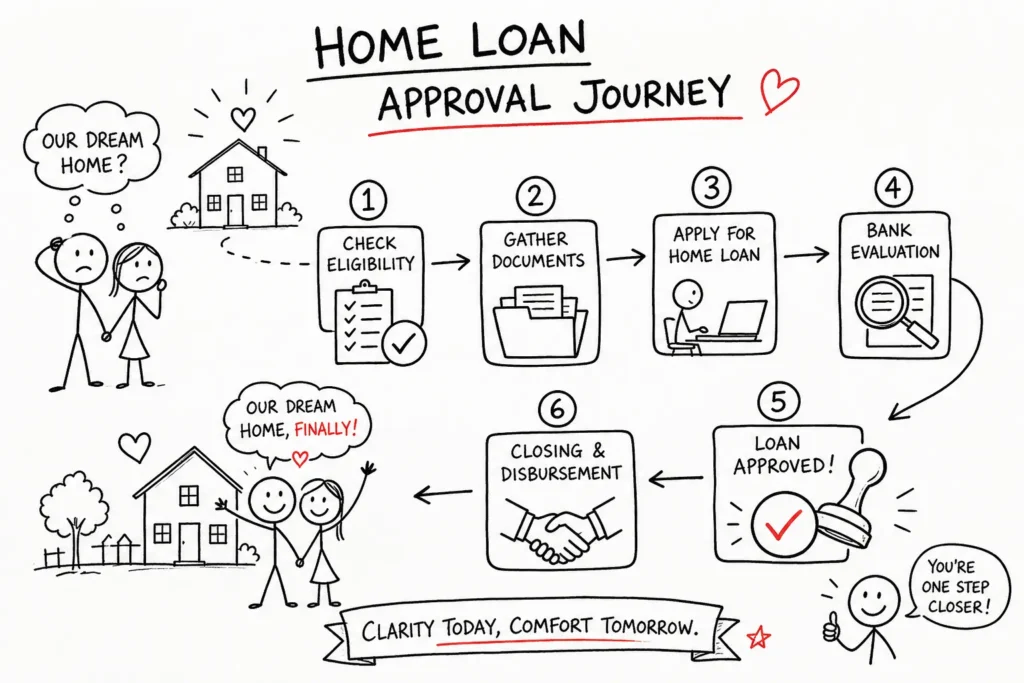
Most buyers assume the home loan approval process is one long waiting game. You apply, you wait, you get an answer. But there are actually several distinct stages between “I want to buy a home” and “here are your keys,” and confusing those stages can cost you time, derail offers, and send you back to square one. The buyers who move smoothly through the process are almost always the ones who knew what to expect before they started.
This article is your roadmap from the very first conversation with a lender to the day you sign at the closing table. You’ll learn what each stage of home loan approval requires, how long it realistically takes, and what causes applications to get denied so you can avoid every one of those traps. Start here, and you’ll walk in prepared.
Prequalification vs. preapproval: why the difference matters more than you think
These two terms get used interchangeably, but they represent very different stages with very different weight in the eyes of sellers and real estate agents. Getting clear on the distinction early saves you from wasting energy on a step that won’t move your offer forward.
What prequalification actually tells you
Prequalification is a quick, informal estimate of what you might be able to borrow based entirely on numbers you provide. The lender asks a few questions about your income, debts, and assets, runs a soft credit check or no credit check at all, and gives you a ballpark figure. No documents are reviewed. Nothing is verified. While prequalification is useful for early budgeting, it carries almost no weight with sellers because anyone can claim any income and get a number.
What lenders verify during a real preapproval
Preapproval is a different process entirely. The lender typically pulls a hard credit inquiry, commonly a tri-merge pull covering all three bureaus, reviews your actual income documents, and analyzes your debt obligations. The result is a specific loan amount tied to a specific loan program, and a preapproval letter you can attach to an offer. A preapproval letter signals to sellers that your financing is likely to close, which is why sellers often expect one and may strongly favor offers that include it.
Which stage you need before making an offer
In competitive markets, preapproval is a requirement, not a courtesy. A seller choosing between two offers will almost always favor the buyer with a verified preapproval over one with a prequalification estimate. That said, neither stage is a binding loan commitment. Final approval comes after the seller accepts your offer, a specific property is attached to the loan, and a full underwriting review is completed.
The credit score and DTI numbers that decide your home loan approval
Lenders evaluate two numbers more than any other during the approval process: your credit score and your debt-to-income ratio. Understanding where you stand on both before you apply gives you the ability to fix problems in advance instead of discovering them at the worst possible moment.
Credit score minimums for conventional and FHA loans
For conventional loans, the minimum credit score is 620, but that number comes with a catch. Scores between 620 and 639 often mean higher interest rates and larger down payment requirements. A score of 740 or above unlocks the best rate tiers. For FHA loans, you can qualify with a 580 score and a 3.5% down payment, or with a 500 score if you can put down 10%. One more thing worth knowing: individual lenders frequently set “overlays,” meaning they require higher scores than the program minimums even if you technically qualify at the federal level.
How debt-to-income ratio affects your loan options
Your debt-to-income ratio (DTI) is calculated by dividing your total monthly debt payments by your gross monthly income. For example, if you earn $6,000 per month and pay $2,000 toward debts and housing, your DTI is 33%. Conventional loans generally cap DTI at 43%, though strong compensating factors like high credit scores or significant cash reserves can push that to 50%. FHA loans follow a similar structure. Most lenders prefer to see a DTI below 36% because it signals financial breathing room and reduces repayment risk.
Steps to improve your numbers before applying
If your credit score or DTI isn’t where it needs to be, both are fixable with time and a clear strategy. Paying down revolving debt lowers your DTI and shrinks your credit utilization at the same time, which pushes your score up. Avoid applying for new credit or making large purchases before you apply. Also, pull your credit reports and check for errors, inaccurate negative marks are more common than most buyers expect. Moving from a 650 to a 700 score can translate to thousands of dollars in savings over the life of your loan, since even a half-point rate difference on a $300,000 mortgage adds up to more than $30,000 in total interest over 30 years.
Documents to gather before your mortgage application
Lenders aren’t being nosy when they ask for what feels like your entire financial history. Every document they request serves a specific purpose in verifying your ability to repay the loan. Understanding the “why” behind the list makes it feel less overwhelming and helps you organize it efficiently.
Income verification documents lenders require
Your lender will ask for the most recent 30 to 60 days of pay stubs, federal tax returns with W-2 forms for the past two years, and employer contact information so they can verify your employment directly. If you receive income from pensions, disability benefits, child support, or alimony, bring documentation for those sources as well. What lenders are evaluating isn’t just how much you earn, they’re looking for stability and consistency in your income history.
Bank and asset statements for underwriting review
You’ll need checking, savings, and investment account statements for the past two to three months. Lenders require all pages, including blank ones, because they’re tracing the origin of every dollar that will be used for your down payment and closing costs. If part of your down payment is a gift from a family member, you’ll need a signed gift letter and the donor’s bank statements to verify the funds are legitimate.
Recent loan statements for auto loans, student loans, and credit cards are also required so the underwriter can accurately calculate your DTI. Every debt obligation that shows up on your credit report needs a matching statement in your file.
Extra documentation for self-employed borrowers
Self-employed buyers face a longer document checklist, but that doesn’t mean home loan approval is out of reach. Lenders will ask for two years of business and personal tax returns, a year-to-date profit-and-loss statement, a current balance sheet, and business bank statements to verify cash flow. Experienced advisors who specialize in non-traditional income know how to present self-employed documentation in a way that makes the strongest possible case for approval rather than leaving the underwriter guessing.
The mortgage approval timeline from preapproval to closing day
One of the biggest sources of stress in the mortgage process is not knowing how long things take or what’s happening behind the scenes. Here’s an honest, stage-by-stage look at what to expect from start to finish.
Stage 1: preapproval and application (days 1, 5)
When your documents are organized, a lender can issue a preapproval within one to three business days. Once your offer is accepted, you submit your formal loan application. From there, your loan officer orders the appraisal, title search, and employment verifications. Having a complete, organized document package at the start is one of the biggest factors in keeping this stage fast. Delays here almost always trace back to missing paperwork.
Stage 2: underwriting and appraisal (weeks 2, 4)
This is the heart of the home loan approval process. The underwriter reviews your full loan file, income, credit, assets, and property value. Initial mortgage underwriting typically takes five to ten business days, and appraisal scheduling adds another one to two weeks on top of that. You’ll likely receive a conditional approval, which means the underwriter needs a few additional items before issuing a final decision. Respond to those requests as quickly as possible because every day of delay extends your closing date.
FHA and VA loans typically add three to five days due to additional program requirements. Keep that buffer in mind when you’re negotiating closing dates with a seller.
Stage 3: clear to close and closing day
“Clear to close” is the milestone every buyer is waiting for. It means every condition has been satisfied and the loan is fully approved. Federal law then requires a mandatory three-day waiting period after you receive your Closing Disclosure before you can sign. Closing itself is typically scheduled three to five days after the clear to close is issued. The total timeline from preapproval to closing runs 25 to 45 days for most transactions, though complex files can stretch to 60 days. Buyers who come in organized consistently land on the shorter end of that range.
Common reasons home loan approval gets denied and how to recover
A denial is not a dead end. Most mortgage denials come down to a short list of fixable issues, and buyers who understand what went wrong and address it directly often get approved when they reapply.
The top two reasons lenders say no
High DTI is cited in nearly half of all mortgage denials, making it the most common obstacle in the process. The fix isn’t just improving your credit score, it’s paying down debt or increasing income to bring that ratio into an acceptable range. Low or damaged credit is the second most frequent reason, driven by missed payments, collections accounts, and high credit card balances. When a lender denies your application, they’re legally required to send you an adverse action letter explaining the specific reason. Most buyers don’t read it carefully enough, but that letter is your recovery roadmap.
Property and documentation problems that stall or kill approvals
Sometimes the issue isn’t the borrower at all, it’s the property. If the home appraises for less than the purchase price, your options are to renegotiate the price, dispute the appraisal with comparable sales data, or walk away. Documentation problems are equally common: a missing page from a bank statement, an unexplained large deposit, or income figures that don’t align with tax returns can all trigger underwriting conditions or outright denials. Changing jobs, going self-employed, or reducing your work hours after you’ve been preapproved is another fast way to change your qualification status mid-process.
What to do after a denial before reapplying
Start by requesting and carefully reading your adverse action letter. Identify whether the issue is DTI, credit, documentation, or a property problem, and then build a specific plan to address that exact issue. Some fixes take weeks; others take months. Working with an advisor who can map out a realistic timeline prevents you from reapplying too soon and facing a second denial for the same reason. Many buyers who correct the primary issue cited in their denial go on to secure approval on their next application.
Why working with a mortgage advisor prevents most of these surprises
Everything in this article is knowable in advance, and that’s the whole point of walking through it. The buyers who get tripped up aren’t failing because of bad luck; they’re failing because they walked into a complex process without a guide who could catch the problems before they became denials.
What a knowledgeable advisor catches before underwriting does
A good mortgage advisor reviews your full file before it ever reaches an underwriter and flags the DTI issues, credit red flags, and documentation gaps that would otherwise generate conditions or denials. This front-end review is where working with an experienced advisor makes a real, practical difference, the goal is to identify problems at the start of the journey, not after the underwriter has already found them and put your closing date at risk.
The advantage of consistent communication throughout the process
Mortgage timelines slip when borrowers don’t understand what’s being asked of them, why it matters, or how quickly they need to respond. At Isabelle Mortgages, advisors keep clients informed at every stage so you always know where your file stands and what action, if any, is needed from you. For first-generation buyers navigating this process without family guidance, and for self-employed borrowers with more complex documentation, that level of access and clarity changes the entire experience from overwhelming to manageable.
Take the next step with a guide who knows every stage
Home loan approval isn’t complicated once you understand the stages: prequalification, preapproval, formal application, underwriting, conditional approval, and closing. Each stage has specific requirements, realistic timelines, and common pitfalls you can avoid when you know they’re coming. Most of the problems that delay or deny applications are fixable well before you ever submit paperwork to a lender.
The key is going in prepared, and going in with the right support. Whether you’re a first-generation buyer, a self-employed borrower, or a family building toward long-term ownership, the process works the same way. What changes is how clearly and confidently you move through it.
Reach out to Isabelle Mortgages to start your home loan approval and preapproval process with an advisor who knows every step and can catch potential problems before they slow you down. The result is a faster, less stressful path to owning the home you’re working toward.
Frequently asked questions about home loan approval
How long does home loan approval take?
For most buyers, the full home loan approval process, from preapproval to closing day, takes between 25 and 45 days. Straightforward files with complete documentation tend to close on the shorter end; complex files or those with conditional approval requirements can stretch closer to 60 days.
What documents speed up home loan approval?
Having two years of tax returns, 30 to 60 days of pay stubs, two to three months of bank statements (all pages), and employer contact information ready before you apply is the fastest way to keep the process moving. Missing or incomplete documents are the most common cause of delays during the mortgage approval timeline.
What is mortgage underwriting?
Mortgage underwriting is the stage where a lender’s underwriter verifies every piece of information in your loan file, income, credit history, assets, and the property’s appraised value, before issuing a final approval decision. It typically takes five to ten business days, plus additional time if the underwriter issues conditions that need to be resolved.
What credit score do I need for home loan approval?
For conventional loans, a minimum score of 620 is required, though scores of 740 and above qualify for the best interest rates. FHA loans allow scores as low as 580 with a 3.5% down payment, or 500 with a 10% down payment. Individual lenders may set higher minimums through their own overlay requirements.
What DTI ratio do lenders want to see?
Conventional loans generally cap DTI at 43%, and FHA loans follow a similar structure. Most lenders prefer to see a DTI below 36% because it provides more financial cushion and reduces repayment risk. Strong compensating factors, like a high credit score or significant cash reserves, can sometimes allow higher DTI ratios.
Can I get home loan approval after a denial?
Yes. A denial is not permanent. Read your adverse action letter carefully to identify the specific reason, build a plan to address it, and work with an advisor to determine a realistic timeline before reapplying. Many buyers who correct the primary issue cited in their denial go on to secure approval on the next application.