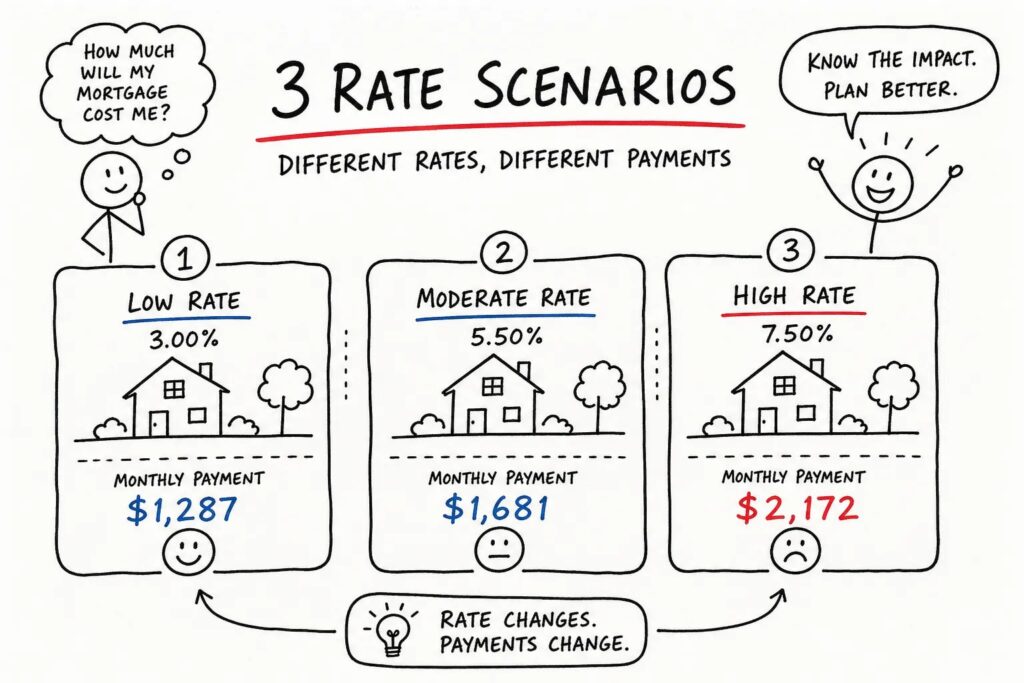
Interest rates have a direct and measurable impact on what you pay each month and what you pay in total over the life of a loan. Many buyers focus on purchase price but underestimate how much the rate they lock in shapes what they actually pay every single month for the next three decades.
The three scenarios below make this tangible with real numbers. We walk through what happens when rates move by 0.25%, 0.50%, and a full 1%, so you can see exactly how each shift affects your payment and your long-term costs. By the end, you’ll know the levers you can pull to work in your favor before you close.
Key takeaways
- Rate vs. APR: Your monthly payment is calculated using the interest rate, not the APR. APR helps you compare loan offers but doesn’t appear in the payment formula.
- Current rate range: As of November 2026, Bankrate reports a national average of 7.19% for a 30-year fixed mortgage, while Zillow reports 7.49%.
- Fixed vs. ARM: A fixed-rate loan keeps your payment stable for the entire term. An adjustable-rate mortgage resets periodically and can push payments higher when market rates rise.
- Levers you control: Down payment size, discount points, loan term, and refinancing timing all move your payment in meaningful ways.
Why even a quarter-point rate difference adds up faster than you think
The simple formula behind every monthly payment
A fixed mortgage payment comes down to three inputs: the loan principal, the interest rate, and the loan term. These three numbers feed into a standard amortization formula, which spreads repayment across equal monthly installments over the life of the loan. Each payment covers some interest and some principal, with the interest portion shrinking gradually as the balance drops.
One important distinction: your monthly payment is calculated using the interest rate, not the APR. According to the Consumer Financial Protection Bureau, APR is a broader measure that includes the interest rate plus certain fees such as origination charges or discount points. APR is the right tool for comparing loan offers side by side, but it doesn’t replace the interest rate in the payment formula. Confusing the two leads buyers to expect a lower monthly payment than they’ll actually receive.
How current mortgage interest rates shape your monthly payment right now
As of November 2026, Bankrate reports a national average of 7.19% for a 30-year fixed mortgage, and Zillow reports 7.49%. For 15-year fixed loans, the range runs from 6.60% to 6.88% across the same sources. Rates shift daily based on economic data, lender pricing, and bond market movement.
The three scenarios below use 6.00% as a baseline for clean arithmetic, but the dollar relationships scale predictably at any rate level. If you’re shopping at 7.49% right now, the same logic applies: every fraction of a point shapes your payment and your total long-term cost in a real way.
Scenario 1: What happens when your rate moves by 0.25%?
The dollar-by-dollar breakdown on a $300,000 loan
The shorter payoff timeline means less overall exposure to the rate difference, though the payments themselves are significantly higher than the 30-year equivalent.
Why $48 a month deserves more respect than buyers give it
The smallest rate shift modeled here already adds up to a meaningful sum, and the next scenario raises the stakes considerably.
Scenario 2: How a 0.50% difference scales with loan size
Same half-point, bigger loan: the multiplier effect
The relationship between loan size and rate sensitivity is direct: every additional dollar of principal amplifies the cost of a rate increase. A buyer who stretches to a higher purchase price is also increasing the financial consequence of every fraction of a point in their rate.
How to plan mortgage payments given today’s rates
Buyers shopping in November 2026 who are comparing lenders at 6.99% versus 7.49% are living inside Scenario 2 territory right now. The gap between lenders, or between locking this week versus waiting another month, can be this exact half-point. Reducing your rate by half a point can deliver monthly savings comparable to negotiating several thousand dollars off the purchase price, making the rate conversation at least as important as the price negotiation.
Scenario 3: Does a full 1% rate difference really cost tens of thousands?
The 30-year lifetime cost laid out clearly
But month after month for 30 years, it compounds into a figure that could fund a college education or a significant retirement contribution. Rate decisions are not just about monthly affordability. They are decisions about total cost of ownership over the entire life of the loan.
This is exactly where locking in at the right moment matters
A rate lock is a lender’s commitment to hold your quoted rate unchanged until closing, protecting you if market rates rise before you get to the table. Standard lock periods in 2026 run 30, 45, or 60 days, with some lenders offering 90 days or more for new construction or complex timelines. Many buyers who float a rate hoping for improvement end up worse off than those who lock at a temporary dip and capture a lower payment for the life of the loan.
This is precisely where working with an experienced mortgage advisor pays real dividends. At Isabelle Mortgages, we provide personalized rate guidance as part of our one-on-one client service, helping you identify the right window to lock so the decision is informed rather than a guess. That kind of guidance is built into every client relationship through the Gen-First Mortgage Method™.
Fixed-rate vs. adjustable: which one actually shields your payment?
Why fixed-rate loans offer payment certainty that ARMs don’t
A fixed-rate mortgage keeps the principal-and-interest payment unchanged for the entire loan term, regardless of what market rates do afterward. The borrower who locks in 7.00% today pays that rate in year 15, even if rates climb to 9%. According to the Consumer Financial Protection Bureau, this payment certainty is the defining feature of a fixed-rate loan.
An adjustable-rate mortgage (ARM) starts with a lower introductory rate but resets periodically based on a market index. If rates rise after the fixed period ends, the monthly payment rises with them. Most ARMs carry periodic and lifetime rate caps, but those limits don’t eliminate payment risk. A borrower who budgets around an introductory rate can face a materially higher payment years later.
Which option fits which buyer?
ARMs can make sense for buyers with a defined short-term plan. Those who expect to sell or refinance before the adjustment period activates can capture the lower starting rate without facing the reset. For buyers planning to stay in the home long-term, a fixed-rate mortgage removes rate exposure entirely and makes budget planning straightforward.
In a volatile rate environment, that certainty carries real value. We built the Gen-First Mortgage Method™ around helping first-generation buyers and long-term wealth builders understand exactly this tradeoff before committing to a loan structure, because the right choice today shapes financial security for years to come.
What buyers can do right now to lower their payment
Options that move the needle before you close
Several levers work directly on your payment before closing day arrives, each with a measurable impact. Understanding how they interact gives you real control over your long-term cost.
A larger down payment reduces the loan principal immediately. According to Zillow, every additional $10,000 down on a $300,000 loan cuts the monthly principal-and-interest payment by about $60 at 6%. News and World Report.
Discount points let you buy down the rate upfront. One point costs 1% of the loan amount and often lowers the rate by around 0.25 percentage points, though the exact reduction varies by lender and market conditions. The break-even period typically runs about five to seven years, so points only make financial sense if you plan to keep the loan past that threshold.
Loan term choice changes both the rate and the payment structure significantly. Using Freddie Mac’s November 12, 2026 average rates of 7.11% for a 30-year fixed and 6.45% for a 15-year fixed, the monthly principal-and-interest payment on a $300,000 loan is $2,020 on the 30-year versus $2,613 on the 15-year. The tradeoff is dramatically less total interest paid over the life of the loan. Run the actual numbers for both terms before defaulting to 30 years.
When refinancing makes the math work in your favor
Refinancing to a materially lower rate can reduce monthly payments, but closing costs typically run 2% to 6% of the loan amount, according to industry guidance from sources including CNBC. Calculating the break-even period, the number of months to recover the upfront cost from monthly savings, determines whether it’s worth pursuing. Extending the term during a refinance lowers the payment but adds years to the loan and increases total interest paid.
Refinancing into a shorter term at a lower rate is the most financially powerful option when rates and timing align. The key is running the actual numbers for your specific balance and remaining term rather than relying on general rules of thumb.
Common questions about mortgage rates and payments
How much will my monthly payment change if rates rise 0.25%?
The exact amount depends on your loan balance and term, so running the numbers with a mortgage payment calculator for your specific situation gives you the most accurate picture.
Do mortgage rates vary by state?
Yes. While national averages from sources like Bankrate and Zillow provide useful benchmarks, actual rates vary by state and even by county based on local market conditions, lender competition, and conforming loan limits. Your final rate also depends on your credit profile, down payment, and loan type, so the best number to work with is a personalized quote from a lender.
Should I lock my rate or float it?
Rate locks protect you from increases between application and closing. Standard lock periods run 30 to 60 days, with longer options available. Floating leaves room to benefit if rates fall but carries real risk if they rise. The decision depends on how close you are to closing and where rates appear to be trending, a conversation worth having with your mortgage advisor before you decide.
The bottom line on rate and payment
The three scenarios above show that rate differences of 0.25%, 0.50%, and 1.00% are not abstract percentages. They translate to real dollars every month and tens of thousands of dollars over the life of a loan. Buyers who understand this math make sharper decisions about when to buy, when to lock, and how to structure their loan before they ever sign anything.
Knowing the numbers is the first step. Acting on them at the right moment is the second. If you want guidance on reading today’s rate environment and locking in at a moment that works in your favor, get in touch with our team at Isabelle Mortgages. We’re built for exactly that conversation, and we’ll walk you through the numbers specific to your situation with the same clarity you’ve seen here. The goal isn’t just to get you to closing, it’s to make sure the loan you close on works for your finances for decades to come.
Frequently Asked Questions
How do discount points affect my monthly payment and when do they make sense?
Discount points lower your interest rate and can reduce your monthly payment. One point costs 1% of the loan amount and often lowers the rate by around 0.25 percentage points, and the typical break-even period runs about five to seven years, so points only make financial sense if you plan to keep the loan past that threshold.
How much will increasing my down payment lower my monthly payment?
A larger down payment reduces your loan principal and lowers your monthly principal-and-interest payment. For example, Zillow shows every additional $10,000 down on a $300,000 loan cuts the monthly principal-and-interest payment by about $60 at 6%, and that relationship scales predictably with different balances and rates.
What changes if I choose a 15-year loan instead of a 30-year loan right now?
A 15-year loan raises your monthly payment but cuts total interest paid dramatically. Using Freddie Mac averages from November 12, 2026, on a $300,000 loan the monthly principal-and-interest payment is $2,020 for a 30-year at 7.11% versus $2,613 for a 15-year at 6.45%, with the 15-year producing much lower total interest over the life of the loan.
What closing costs should I expect when refinancing and how do I know if it’s worth it?
Refinancing closing costs typically run about 2% to 6% of the loan amount. You determine whether it’s worth it by calculating the break-even period, the number of months to recover those upfront costs from your monthly savings, and note that refinancing into a shorter term at a lower rate is the most financially powerful option when timing and rates align.