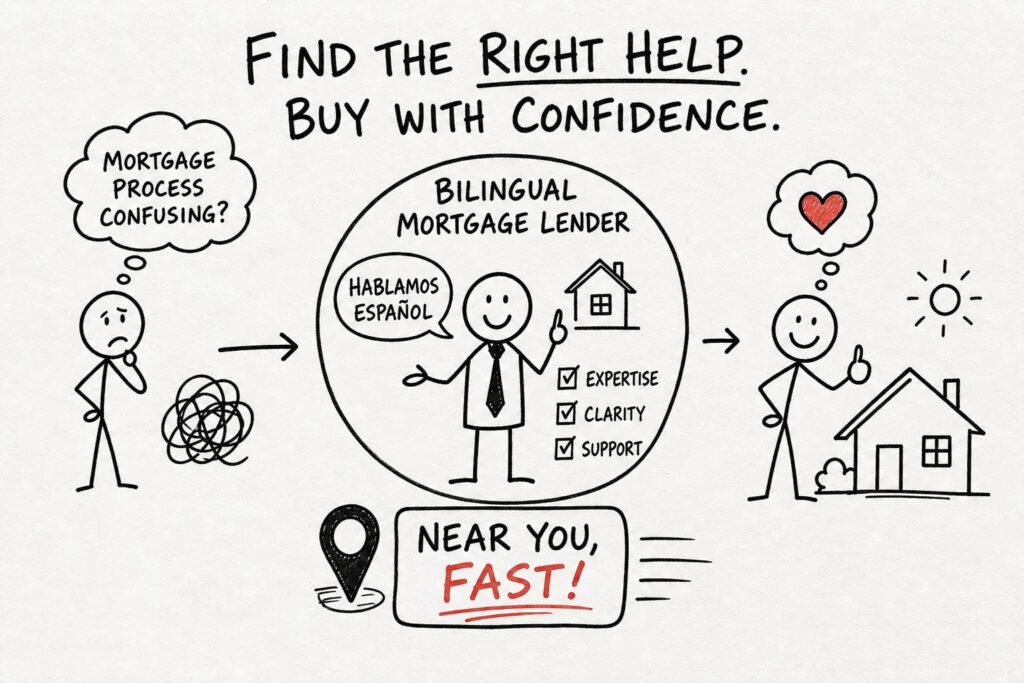
If you’re asking “how do I find a bilingual mortgage lender near me,” you’re asking the right question at exactly the right time. You’ve been saving, you’ve been researching, and you finally sit down with a loan officer only to realize that every term they use requires a follow-up question just to understand the question. Frustrating enough in your first language. When the conversation is happening in English and your comfort zone is Spanish, that frustration becomes a real financial risk.
This guide walks you through exactly how to locate a bilingual mortgage lender near you, how to verify their credentials, and how to ask the questions that protect you before you hand over a single document. The process doesn’t have to be overwhelming, but it does require more than a quick Google search. Finding the right bilingual loan officer near you is one of the most important decisions you’ll make in this entire process.
Lenders like Isabelle Mortgages have built their entire practice around exactly this need: guiding Spanish-speaking buyers from preapproval to closing in one language, with no translation gaps and no confusion at the closing table. That standard is achievable. You just have to know what to look for and where to find it.
Why the language barrier in mortgage lending is a real financial risk
The stakes are high enough to examine before moving into the search process. According to the Consumer Financial Protection Bureau’s 2024 Home Mortgage Disclosure Act data, Latino borrowers were denied mortgage loans at roughly 22% in 2024, compared to about 16.5% for white applicants. That gap has multiple causes, but poor communication and misunderstood documentation are consistently among them. This is a problem with a solution.
How misunderstood mortgage terms cost buyers money
There’s a meaningful difference between signing a document you fully understand and signing one you’re hoping is fine. Terms like APR, escrow, debt-to-income ratio, rate lock, and closing costs each carry real financial consequences when they’re misread or poorly explained. A buyer who doesn’t fully understand an adjustable rate structure can end up with a monthly payment that spikes significantly in year three. A buyer who doesn’t understand a balloon payment clause may face a lump sum they were never prepared for.
These aren’t theoretical scenarios. They happen to buyers who were nodding along throughout the process because asking a follow-up question felt embarrassing, or because the explanation was never clear to begin with. A genuinely bilingual lender doesn’t just translate vocabulary; they translate the logic of each step so you know why it matters, not just what it’s called.
When communication gaps appear at the worst moments
The closing table is not the place to discover that you and your loan officer have been on different pages for thirty days. Delays, unexpected fees, and incorrect loan structures all tend to trace back to early miscommunications that no one caught because the right questions were never asked in a shared language. A bilingual mortgage specialist bridges that gap not just in conversation but across the entire process: the timeline, the expectations, the paperwork sequence, and the decision points along the way.
How do I find a bilingual mortgage lender near me? Start with these search tools
Reliable search tools exist, and most are free. The key is knowing which ones actually filter by language rather than just location. Below are the main categories of tools worth using, followed by the referral sources most buyers overlook entirely.
Online lender directories with language and location filters
Three directories stand out for this purpose. The Zillow Lender Directory lets you enter a preferred language and the ZIP code of the home you want to buy or refinance. It only surfaces NMLS-licensed lenders in your state, which already eliminates a category of risk. Ensure Home Loans lets you search by ZIP code, state, language, or loan specialty, making it one of the more flexible tools for finding a bilingual mortgage broker near you. Loan Factory offers a similar directory where you can search by name, location, language, and licensed state.
When reviewing results from any of these directories, confirm that the lender is licensed in your state, not just advertising service there. Some lenders are licensed in only a handful of states. Licensing in your state is a baseline requirement, not a differentiator.
State housing agency and NMLS-verified lender lists
State housing finance agencies in states like Florida publish approved lender rosters for down payment assistance and first-time buyer programs. Florida Housing explicitly marks Spanish-speaking loan officers in its directory with a designation that identifies bilingual capability. While not every state agency formats its list this way, most link to individual lender profiles where bilingual services are noted.
For any loan officer you’re considering, run their name and license number through NMLS Consumer Access before you call them. This is the national licensing database, and it shows active license status, which states they’re licensed in, and any regulatory actions on file. Some lenders publish dedicated bilingual lending team pages with NMLS numbers included. That level of transparency is a good model for what a credible bilingual lender listing should look like.
Local referrals that most buyers overlook
Real estate agents who work heavily in Hispanic and Latino communities often maintain a short list of bilingual loan officers they trust. Ask your agent directly. If they can’t name one quickly, that tells you something too. Local Hispanic chambers of commerce, community organizations, and Spanish-language church networks are also reliable referral sources, especially in high-demand markets like Florida, Texas, and California where quality lenders are well known within the community.
National programs built for Hispanic and Latino homebuyers
The mortgage market has responded to demand here. Several national lenders have built bilingual infrastructure that goes beyond a Spanish option on a phone menu.
Movement Mortgage’s Comunidad program offers bilingual loan officers and processors, a Spanish-language digital mortgage experience from application through closing, and homebuying education resources. Rate’s Language Access Program delivers the full mortgage experience in Spanish, including processing, disclosures, and a nationwide bilingual processing team. CrossCountry Mortgage has launched a Spanish loan application and employs Spanish-speaking loan officers across the country. New American Funding’s Latino Focus initiative prioritizes bilingual hiring and Latino leadership representation within the company.
Size and reach, however, are not the same as quality of service. A large lender with a Spanish-speaking team doesn’t automatically mean you’ll have one dedicated person who knows your file. Many larger lenders route Spanish-speaking borrowers through call centers or translation services rather than a loan officer who is personally invested in your outcome. There’s a real difference between reaching a bilingual representative on your fourth call and having the same person guide you from application to closing.
This is where relationship-focused lenders like Isabelle Mortgages deliver something the big players often can’t match. The same person who walks you through preapproval is the person still answering your questions the week before closing. That continuity matters more than it sounds.
Questions to ask a bilingual loan officer before you commit
Use your first conversation as a screening call. The answers you get reveal more than the résumé does.
Testing language fluency and cultural communication
Ask the loan officer to explain APR, escrow, and closing costs in Spanish. A genuinely fluent loan officer explains these clearly without defaulting to English jargon halfway through the answer. Follow that with this question: “How do you handle a situation where a borrower uses wording that doesn’t match standard mortgage terminology?” The answer tells you whether they have cultural competency, not just vocabulary. There’s a real difference between someone who speaks Spanish and someone who understands how a first-generation buyer actually talks about money.
Also ask whether they have experience preparing and explaining Spanish-language loan documents, not just speaking Spanish in casual conversation. The Loan Estimate and the Closing Disclosure are dense, technical documents. A bilingual loan officer near you who can walk through them with accuracy and patience is worth finding.
Confirming mortgage experience and licensing
Request their NMLS number and verify it at NMLS Consumer Access before moving forward. Then ask them to walk you through the mortgage process from application to closing. A competent bilingual loan officer covers every stage without skipping steps. The goal is no surprises at closing. Ask specifically how they work with borrowers who have 1099 income, business bank statements, or variable earnings. If they only know how to work with a standard W-2 file, that’s an important limitation to know early.
What a genuinely bilingual lender brings beyond language
Language gets you in the door. Cultural competency determines whether the relationship actually works.
Cultural competency is different from fluency
A bilingual loan officer who doesn’t understand the financial reality of first-generation buyers will still miss the mark even if their Spanish is perfect. First-generation buyers often come without inherited credit history, may come from multi-income households, and may carry a well-founded distrust of large financial institutions. A culturally competent lender knows what a buyer may not have been told, understands that family dynamics often influence home-buying decisions, and builds trust through transparency rather than sales pressure.
This is not a soft skill. It directly affects whether a buyer understands what they’re signing, whether they feel safe asking questions, and whether they complete the process with confidence rather than anxiety.
Consistent communication from application to closing
The standard you should expect: updates by text, phone, or email at every stage of the loan process. No disappearing after the application is submitted. No scrambling at the closing table because the buyer was never told what to expect in the final week. Every question treated as a fair one, regardless of how basic it sounds to someone who has closed a hundred loans.
Isabelle Mortgages was built around exactly this standard. The Gen-First Mortgage Method™ was designed specifically for buyers who don’t have a family member who has done this before, buyers navigating the entire process without a roadmap. Every step is explained in Spanish, every update is timely, and the goal is always the same: you close on your home with full understanding of what you signed and confidence in the investment you made.
Take the next step with a lender who is ready for you
If you’re still wondering how do I find a bilingual mortgage lender near me, the answer comes down to a clear process. Use online directories with language filters. Verify NMLS licensing before any conversation. Ask vetting questions that test both fluency and mortgage competence, then look for cultural awareness alongside language skills. Each of those steps takes less than an hour. Skipping them can cost you significantly more.
Understanding every document you sign is not a luxury. It is the baseline standard for one of the largest financial decisions of your life. The right bilingual mortgage broker near you makes that standard achievable without requiring you to navigate the process in a second language or hope that everything was explained correctly.
If you’re ready to work with a bilingual mortgage specialist who will walk you through the entire process in Spanish, from preapproval to closing, reach out to Isabelle Mortgages and start the conversation. The right guidance is available. You just have to know where to find it.