
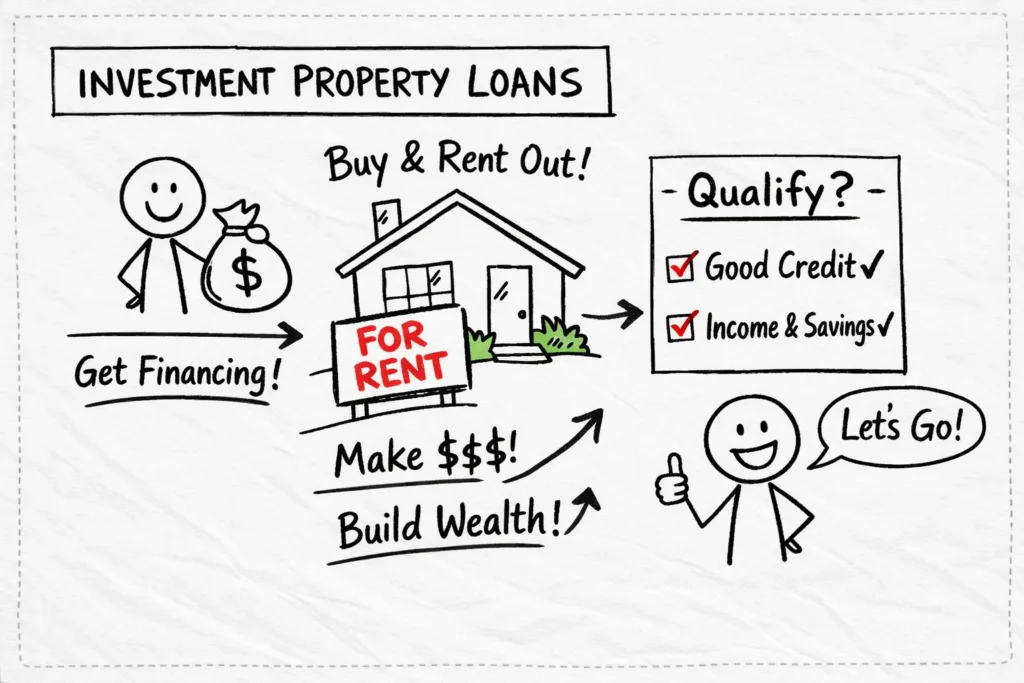
Securing an investment property loan is one of the most powerful moves a real estate investor can make, but it trips up more first-time buyers than almost any other part of the process. Rental properties can build long-term wealth through appreciation, cash flow, and tax advantages that many investors find compelling. The loan rules are stricter than what you’d encounter on a primary residence, the costs are higher, and some lenders don’t take the time to walk you through the reasons. Before you assume your homebuying experience translates directly to an investment purchase, it’s worth understanding what changes the moment a lender hears “non-owner-occupied.”
What follows covers four things every investor needs to understand: how investment property loans differ from a standard mortgage, what qualifications actually look like in 2026, what to expect from rates and fees, and how to find a lender who understands your goals. At Isabelle Mortgages, we work directly with real estate investors to decode these structures and map a clear path from first conversation to closing.
How investment property loans differ from a primary residence mortgage
The non-owner-occupied classification and what it means for you
When a lender sees that you won’t be living in the property, they classify it as non-owner-occupied, a designation defined in Fannie Mae and Freddie Mac underwriting guidelines that sits at the top of a three-tier occupancy risk scale. That classification affects every major loan term. Lenders view these loans as higher risk because your personal housing stability isn’t tied to the property. If the rental sits vacant and income dries up, the borrower faces a harder decision about which obligation to prioritize, a dynamic that default research on investment properties consistently reflects. That risk gets priced into the down payment requirement, the reserve mandate, and the interest rate itself.
Why lenders treat rental properties differently than second homes
The three-tier system works like this: primary residences carry the lowest risk and qualify for the best terms, second homes sit in the middle, and investment properties land at the top of the risk scale. That tiering shows up directly in your rate. Second homes typically carry a premium of 0.25% to 0.50% above primary residence rates. Investment properties add another layer on top of that, often running 0.50% to 1.00% or more above what you’d pay on a home you live in. On a $400,000 loan, that spread translates to a meaningful difference in monthly payment, not just a line item on a rate sheet.
Down payment and credit score requirements for rental property loans
What conventional lenders require for an investment property loan
The minimum down payment for an investment property on a single-unit conventional loan is 15%, but most lenders prefer 20% to 25%, particularly on multi-unit properties or when you want better rate pricing. Credit score requirements follow similar logic: you need a minimum of 620 with 25% or more down, but a 680 score is the practical floor for 15% down scenarios. One requirement many borrowers miss entirely is the Fannie Mae reserve mandate, six months of principal, interest, taxes, insurance, and HOA payments sitting in liquid accounts after closing. If you own additional financed properties, each one triggers additional reserve calculations on top of that baseline.
DSCR and portfolio loans: a different path for some investors
If qualifying on personal income is a challenge, a DSCR loan (debt-service coverage ratio) offers a real alternative. These loans evaluate whether the property’s rental income covers its debt obligations rather than relying on W-2 or 1099 earnings. Approval hinges on the property’s cash flow, which makes DSCR products especially useful for self-employed investors or those with complex income structures. These are sometimes called rental financing options or non-owner-occupied loans in lender product guides, and they sit outside the conventional underwriting framework entirely. Expect a down payment of 20% to 25% and a minimum credit score around 620. Rates run higher than conventional products, but for the right investor profile, the flexibility can outweigh the cost premium.
How lenders document rental income and calculate DSCR
The paper trail lenders want to see for rental income
For existing rentals, lenders typically want two years of Schedule E tax returns, a signed 12-month lease, and proof of actual rent payment through bank deposits, canceled checks, or electronic transfer records. For conventional loans, the appraisal generates supporting documentation through Form 1007 (single-family comparable rent schedule) or Form 1025 for small multi-unit properties. When you’re purchasing a property with no existing lease, lenders substitute the appraiser’s projected market rent as the qualifying figure.
One detail worth knowing: lenders add back depreciation when calculating net qualifying income from Schedule E, which often improves the number that shows up in your file. That add-back can make a meaningful difference for investors who carry significant depreciation deductions.
What DSCR means and what threshold most lenders use
DSCR is a straightforward calculation: monthly rental income divided by the monthly debt obligation on the property. Most lenders require a ratio between 1.0 and 1.25, with 1.2 being a common cutoff for standard approval. A DSCR of 1.25 or higher typically unlocks better pricing, higher loan-to-value ratios, and more flexible terms. Some portfolio lenders accept ratios as low as 0.75 for borrowers with strong credit and larger down payments, but those approvals come with higher rates and lower LTV caps. The practical test: if your expected rent covers the full mortgage payment with a small buffer, you likely meet the threshold.
What investment property mortgage rates look like in 2026
Current rate ranges for investment mortgages
As of early April 2026, 30-year fixed investment mortgage products are landing in the 7.07% to 7.57% range, with 15-year fixed options running approximately 6.43% to 6.93%. These figures reflect the typical premium of 0.50% to 1.00% layered on top of primary residence baseline rates. For a broader discussion of how much extra lenders typically charge for rental properties, see this overview of investment property mortgage rates. ARM products exist in this space, but published investment-specific ARM data is limited; any adjustable-rate quotes need direct lender confirmation before you rely on them. These are directional numbers: your actual rate depends on credit score, down payment, property type, and the lender you choose.
The factors that push your rate up or down
Credit score is the single biggest lever. A borrower at 720 or above qualifies for meaningfully better pricing than one at 620, and that gap widens further on investment loans than on primary residence products. Down payment size, property type (single-family versus multi-unit), and loan structure (conventional versus DSCR) all affect the final rate. Conventional investment loans also carry loan-level price adjustments (LLPAs) set by Fannie Mae and Freddie Mac, fees that stack based on credit score, LTV, and occupancy type. Most borrowers are surprised by how much the LLPAs add to total cost. Shopping multiple lenders is essential here because rate spreads between providers tend to be wider on investment loans than on standard purchase mortgages.
Finding the right lender for your investment goals
What separates a specialized investment lender from a general mortgage bank
Many large-bank lenders are built primarily around the straightforward primary residence loan and offer limited investor-specific products as a result. Investment property loan financing benefits from a lender who understands cash flow analysis, rental income documentation rules, DSCR structures, and the nuances of multi-unit properties or LLC-vested title. The practical advantage of a specialist is product flexibility: when a lender offers conventional, DSCR, and portfolio options side by side, they can match the loan to your actual situation rather than fitting your profile into the only product they carry. Features worth asking about include LLC titling flexibility, interest-only period options, and whether the lender has limits on the number of financed properties, some specialized lenders offer higher caps or none at all, though availability varies.
How personalized guidance shortens the path to approval
Investment loans have more moving parts than a standard purchase mortgage. Rental income documentation, DSCR thresholds, reserve calculations, and LLPA stacking all interact in ways that a checklist alone won’t resolve. This is where one-on-one support pays off directly. At Isabelle Mortgages, we work through each of these layers with investors personally, compare options across loan types, and build a clear picture of what approval actually requires before you commit to a purchase contract. The practical starting point: review your credit profile and liquid reserves, gather your rental income documentation, and get prequalified so you’re working with real numbers rather than estimates.
Getting started with your investment property loan
Investment property loans operate under stricter rules than primary residence mortgages, but the right loan structure exists for most investor profiles. The core benchmarks: 15% to 25% down, a credit score of 620 to 720 or higher, a DSCR of 1.0 to 1.25, and rates running 0.50% to 1.00% above what you’d pay on your primary residence. A buy-to-let mortgage or DSCR product offers a genuine alternative for investors who don’t qualify on personal income alone.
Getting prequalified is the move that turns research into a real plan. Every investor’s file is different, and the variables that seem complicated on paper often resolve quickly once a specialist reviews your actual numbers. For a consumer-facing view of current mortgage conditions and how rates are trending, you can explore current mortgage rates. This is a well-traveled path, and with the right lending partner, qualifying for a rental property loan becomes a structured process with a clear outcome. Reach out to Isabelle Mortgages to start that conversation.