
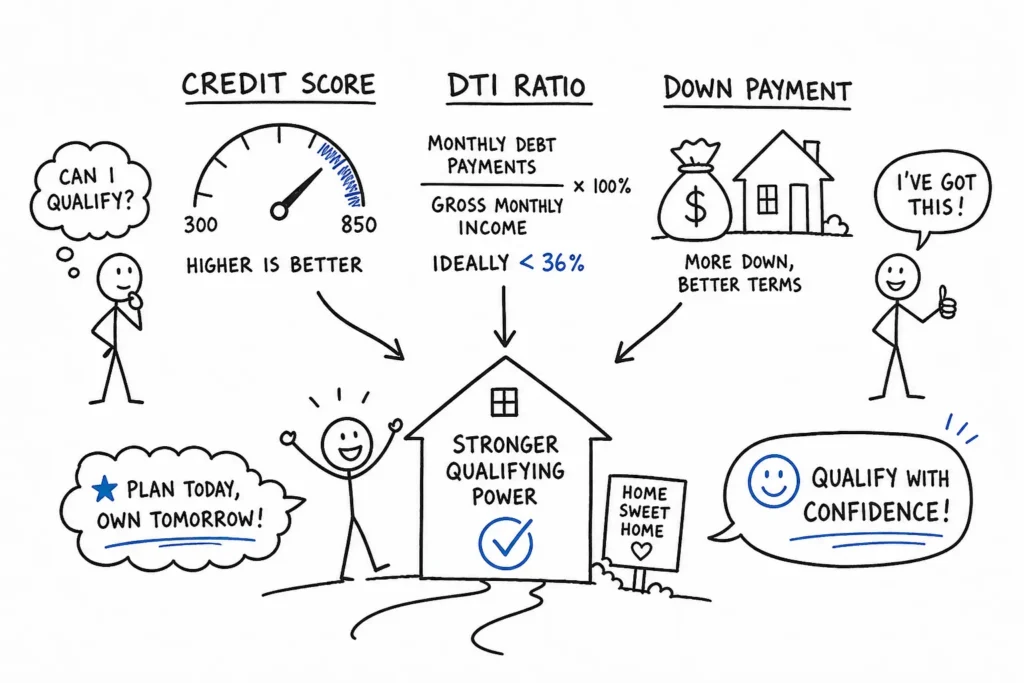
Understanding mortgage qualification is the first step to turning homeownership from a question mark into a plan. You’ve probably heard something like this: “You need a 700 credit score to buy a home.” Then someone else said 620 is fine. Your cousin swore debt is the real problem, and your coworker insisted it’s all about the down payment. The conflicting advice is exhausting, and it keeps a lot of buyers on the sidelines longer than necessary.
Here’s the truth: mortgage qualification isn’t a single pass/fail test. It’s a combination of four factors lenders weigh together, your credit score, your debt-to-income ratio, your income documentation, and your down payment. When you understand how each one works, you stop guessing and start preparing. That’s exactly what this guide is built to do. And if your financial picture is anything other than a straightforward W-2, the team at Isabelle Mortgages has experience helping buyers in complex situations find a clear path to approval.
Pre-qualification vs. pre-approval: two steps, very different weight
Most first-time buyers use these terms interchangeably, but they’re not the same thing. The difference matters a great deal once you’re competing for a home, so it’s worth understanding both before you start shopping.
What pre-qualification actually tells you
Pre-qualification is an informal estimate based entirely on numbers you report yourself: your stated income, approximate monthly debts, and how much you plan to put down. No documents change hands, no credit check runs, and the whole process can be completed online in under an hour. It’s a useful starting point for budgeting and narrowing your price range, but it gives a seller no confidence that you’re a serious, verified buyer.
Why sellers and agents treat pre-approval differently
Pre-approval involves a real underwriter reviewing verified income documents, pulling your credit, and confirming your assets. The result is a letter that carries real weight in a competitive market. Many sellers and listing agents in competitive markets prefer buyers with pre-approval letters before scheduling showings. The process typically takes one to ten business days, depending on how quickly you submit your documents and how complex your income is. Pre-qualification tells you where to start looking; pre-approval tells a seller you’re ready to buy.
Mortgage qualification and credit score requirements
Your credit score is the first number a lender looks at, not because it’s the only factor, but because it determines which loan programs you can access and what interest rate you’ll pay. A low score doesn’t automatically mean denial, but it does narrow your options and raise your costs.
Minimum scores by loan type (2026)
Here’s where the major loan programs currently stand:
| Loan Type | Minimum Score | Key Condition |
|---|---|---|
| Conventional | 620 | Most lenders still enforce 620 even after Fannie Mae dropped its official minimum in late 2025 |
| FHA (3.5% down) | 580 | Scores 500, 579 require 10% down per HUD/FHA guidelines |
| VA | No gov’t floor | The VA sets no official minimum; most lenders require ~620, though some accept scores around 580 with additional scrutiny |
| USDA | 640 | Below 640 requires manual underwriting |
How your score changes your monthly payment
As of July 2026, a borrower with a 620 score pays an average rate of 7.41% on a 30-year conventional loan. A borrower with a 780+ score gets 6.59%. That gap translates to over $400 more per month and more than $150,000 in additional interest over the life of a typical loan. Improving your credit score before you apply is one of the highest-return moves you can make as a borrower. Even moving from a 680 to a 740 can meaningfully reduce both your rate and your PMI premium.
Mortgage qualification and DTI: how lenders calculate your ratio
DTI measures whether your income is strong enough to carry your debt obligations. Lenders calculate two separate ratios, and both matter during underwriting.
Front-end ratio: housing costs vs. your income
The front-end ratio covers only your projected housing costs divided by your gross monthly income. Lenders include principal, interest, property taxes, homeowners insurance, PMI if applicable, and HOA fees (the full PITI + HOA figure). Utilities, groceries, and maintenance are excluded. Standard benchmarks are 28% for conventional loans, 31% for FHA, and 29% for USDA.
Back-end ratio: where most buyers run into trouble
The back-end ratio adds every other recurring monthly debt payment on top of housing costs, car loans, student loans, credit card minimums, alimony, and child support. This is where most buyers hit their ceiling. Program maximums in 2026 are 43%, 50% for conventional loans (the higher end requires strong compensating factors approved through Fannie Mae’s DU or Freddie Mac’s LPA systems), up to 57% for FHA with significant compensating factors, 41% as a general guideline for VA (though VA has no hard ceiling and places heavy emphasis on residual income analysis), and 41%, 46% for USDA. Most lenders prefer to see your back-end DTI below 43% for the best approval odds, even when higher limits are technically available.
Income documentation: what you’ll need to prove your earnings
Lenders don’t take your word on income. They verify it, and the documents required depend entirely on how you earn money. For W-2 employees, the process is relatively straightforward. For self-employed borrowers and 1099 workers, it requires more preparation.
Standard W-2 documentation checklist
If you’re a traditional employee, expect to provide two years of W-2s and signed federal tax returns, 30 days of recent pay stubs, two to three months of bank statements, and a government-issued ID. If you receive bonuses, rental income, or other supplemental earnings, documentation for those sources will be requested too. Having everything organized before you start the pre-approval process speeds things up considerably.
Non-traditional income: the self-employed path
Self-employed borrowers typically need two years of personal and business tax returns, a current profit-and-loss statement, and two to three months of business bank statements. Lenders average income across the two-year window, which can work against borrowers in a strong growth phase. A borrower who earned $60,000 two years ago and $120,000 last year qualifies on $90,000, not $120,000. Knowing this before you apply changes how you prepare. The team at Isabelle Mortgages works regularly with 1099 earners, business bank statement loans, and non-traditional income situations that standard lenders often mishandle.
Down payment size and how it shapes your loan options
Your down payment isn’t just an upfront cost. It determines your loan-to-value ratio, which controls which programs you qualify for, whether you pay PMI, and how your rate is priced. The math is straightforward: your LTV equals 100% minus your down payment percentage. If you’ve been wondering how much house you can afford, your down payment is one of the fastest variables to adjust.
LTV thresholds across common loan programs
VA and USDA loans allow 0% down at 100% LTV, making them the most accessible entry points for eligible borrowers. FHA loans require 3.5% down (96.5% LTV). Conventional loans accept as little as 3% down (97% LTV), though pricing at that level reflects the added risk. Jumbo loans and investment properties typically require 20%, 25% down, and lenders generally cap LTV at 75%, 80% for non-owner-occupied properties. Crossing the 20% threshold on a conventional loan eliminates PMI entirely, often the single most impactful cost reduction available.
What a bigger down payment actually buys you
Each 5% increase in your down payment can reduce your interest rate by roughly 25, 50 basis points, based on standard lender pricing tiers, treat this as an approximate rule of thumb rather than a guaranteed figure, since exact savings vary by lender and loan profile. On a $400,000 loan, that’s not a rounding error. A larger down payment also serves as a compensating factor when your DTI or credit score is close to the program limit: lenders view higher equity as lower risk, and borderline files often get approved when the down payment is strong. For real estate investors, 20%, 25% down isn’t optional, it’s the entry requirement.
Mortgage qualification checklist: steps to strengthen your position before you apply
Now that you understand the four levers, here’s how to move them in the right direction. None of these steps require a perfect starting point. They require a plan and enough runway to execute it.
Practical moves that improve your position
- Pull your credit report and dispute errors now. Disputes take 30, 90 days to resolve. Don’t wait until you’re ready to apply.
- Pay revolving credit balances below 30% utilization (below 10% for the best score impact). High utilization is one of the fastest things to fix and can move your score within 30, 60 days.
- Avoid opening new credit accounts in the six to twelve months before applying. New inquiries and new accounts both lower your score temporarily.
- Calculate your back-end DTI before a lender does. Add up every recurring monthly debt payment, add your estimated housing costs, and divide by your gross monthly income. If you’re above 43%, identify which debts you can pay off first.
- Document all income sources consistently, especially if you’re self-employed. Two years of clean, consistent returns give lenders confidence. A single strong year after a weak one creates complications.
- Build your down payment with a specific LTV target in mind: 5% to access more programs, 20% to eliminate PMI, and 25% if you’re buying an investment property.
When a mortgage advisor changes the outcome
For borrowers with non-traditional income, complex credit history, or no family homeownership experience to draw from, working with a knowledgeable advisor isn’t a luxury, it’s often the difference between a denial and an approval. The Gen-First Mortgage Method™ at Isabelle Mortgages is built specifically for buyers whose financial stories don’t fit inside a standard W-2 box. That includes first-generation homebuyers navigating the process without a family roadmap, self-employed borrowers with 1099 income or business bank statements, and real estate investors building long-term portfolios. With bilingual support in English and Spanish and one-on-one guidance from application through closing, Isabelle Mortgages treats each client as a long-term financial partner.
Frequently asked questions about mortgage qualification
What is mortgage qualification?
Mortgage qualification is the process lenders use to determine whether you’re eligible for a home loan and on what terms. It evaluates four core factors: your credit score, debt-to-income ratio, income documentation, and down payment. Understanding each factor helps you prepare strategically rather than applying and hoping for the best.
How do I know if I qualify for a mortgage?
A solid starting point is reviewing your credit score, calculating your back-end DTI (all monthly debts plus projected housing costs divided by gross monthly income), and confirming you have adequate documentation for your income type. Many lenders and brokers offer a free mortgage affordability calculator on their websites to help you estimate loan eligibility requirements before you formally apply.
What credit score do I need to qualify for a mortgage?
It depends on the loan type. Conventional loans typically require a 620 minimum; FHA loans accept 580 for 3.5% down (or 500, 579 with 10% down per HUD guidelines); VA loans have no government-set floor but most lenders look for around 620; and USDA loans generally require 640. Higher scores unlock better rates and lower costs.
Can I qualify for a mortgage if I’m self-employed?
Yes, but the documentation requirements are more involved. Expect to provide two years of personal and business tax returns, a profit-and-loss statement, and business bank statements. Lenders average your income over two years, so a growth trajectory that looks strong on paper may qualify you on a lower figure than your most recent year suggests.
Where to go from here
Mortgage qualification comes down to four things: your credit score, your DTI ratio, your income documentation, and your down payment. When you understand how each factor works and how lenders weigh them together, you shift from guessing to preparing. Not every borrower starts with a clean profile, and that’s completely normal. The goal isn’t perfection, it’s clarity about where you stand and what to address before you apply.
Whether you’re ready to apply now or need six months to strengthen your position, the best next move is a conversation with an advisor who can read your specific situation honestly. Reach out to the team at Isabelle Mortgages and get a clear picture of where you stand today and exactly what it takes to get you to closing.