
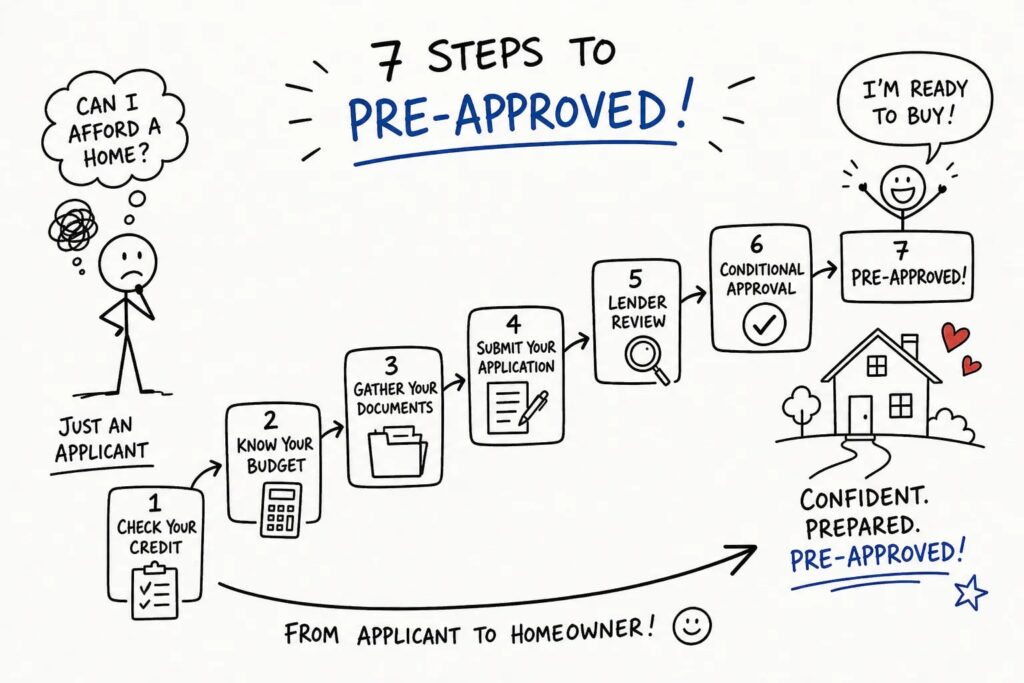
Getting pre-approved for a home loan involves seven steps: check your credit score, calculate your debt-to-income ratio, gather your documents, choose a mortgage advisor, submit your application, receive the lender’s decision, and use your preapproval letter when you make an offer. Each step is manageable when you know what to expect and who to ask.
For many first-time buyers, especially those who are the first in their family to go through this process, the preapproval stage feels like the most intimidating part of buying a home. It doesn’t have to be. This guide walks through each step in plain language so you arrive at every conversation with a lender feeling informed and ready. Working with a dedicated mortgage advisor, like our team at Isabelle Mortgages, can make each of these steps feel far less daunting because you’re never navigating them alone.
Key takeaways
- Credit score matters: Your score determines which loan programs you qualify for, with 580 opening FHA options and 620 unlocking many conventional loans.
- DTI is your qualifying range: Keep your back-end debt-to-income ratio under 43% for the strongest shot at approval across most loan programs.
- Documents win the race: A complete document packet from the start prevents delays and signals to lenders that you’re a serious buyer.
- Advisor choice shapes your experience: Personalized, bilingual guidance removes confusion and keeps you moving forward with confidence.
- Preapproval is conditional: Your letter opens doors with sellers but doesn’t guarantee final loan approval; keep your finances stable after you receive it.
- Rate-shop within 45 days: Multiple mortgage inquiries in that window are generally treated as one under CFPB guidance, protecting your credit score while you compare lenders.
Steps 1 and 2: Know your numbers before you talk to anyone
Before you touch a single document or fill out a single form, your credit score and your debt-to-income ratio are the two numbers that shape every conversation you’ll have with a lender. These aren’t obstacles; they’re your starting point, and knowing them early gives you time to improve them if needed.
What credit score do lenders actually need to approve you?
Credit score requirements differ by loan type, and the gap between programs is wider than most buyers realize. The table below lays out what each major mortgage program typically accepts in 2026, according to Experian and Lower.com.
| Loan type | Program minimum | Practical target | Down payment note |
|---|---|---|---|
| Conventional | 620 (common lender benchmark) | 680–740+ | Better rates above 680 |
| FHA | 500 with 10% down; 580 with 3.5% down | 580+ | 3.5% down at 580+ |
| VA | No VA-mandated minimum | 620+ | No down payment required |
| USDA | No universal program minimum | 640+ | 640 enables streamlined processing |
According to Experian and Lower.com, a score of 620 commonly opens many conventional options and is frequently used by lenders as the practical threshold for VA loans. A score of 580 makes FHA financing practical for buyers still building credit. Reaching 640 gives you the best shot at streamlined USDA processing. A higher score never hurts: scoring above 680 on a conventional loan puts you in a stronger position for better rates and fewer lender restrictions.
How to calculate your DTI before a lender does it for you
Lenders look at two ratios. The front-end DTI is your projected housing payment divided by your gross monthly income; the traditional guideline sits around 28%. The back-end DTI adds all monthly debt payments to that housing figure and divides the total by gross income. A back-end DTI under 43% is a solid practical target for most loan programs, though FHA loans can allow up to 50% when other qualifying factors are strong.
To run your own numbers, add up your minimum monthly debt payments, auto loans, student loans, credit card minimums, then add your estimated future mortgage payment and divide the total by your pre-tax monthly income. Multiply by 100 to get your percentage. If that number comes back above 43%, reducing a debt balance or increasing income before you apply can shift your file significantly.
Step 3: What documents should you gather before applying?
The document stage is where most buyers lose time, not because the list is complicated, but because they start pulling it together too late. Having your paperwork ready before you contact a lender speeds up the entire process and signals that you’re a serious buyer. According to the Consumer Financial Protection Bureau, a complete packet typically moves through review in one to three business days; an incomplete file almost always causes delays.
The core documents every lender requests
For a standard mortgage preapproval, you’ll need your most recent 30 days of pay stubs, W-2 forms from the past two years, and federal tax returns from the past two years. You’ll also need two to three months of bank statements covering checking and savings accounts, a government-issued photo ID, your Social Security number or ITIN, employer contact information, and current statements for any outstanding debts, including auto loans, student loans, and credit cards.
Extra documents if your income doesn’t come from a W-2
Self-employed borrowers and 1099 earners need additional documentation: personal and business tax returns for the past two years, a year-to-date profit and loss statement, and business bank statements. If your down payment includes gift funds, you’ll also need a signed gift letter showing the source and transfer of the money. Any large recent deposits, an unexplained transfer, for example, may require a written explanation. The more complete your packet, the faster the lender can move and the fewer surprises you’ll face later.
Step 4: How do you pick the right mortgage advisor for your situation?
Choosing a lender isn’t just about finding the lowest rate. It’s about finding someone who understands your full financial picture, communicates clearly, and keeps you informed at every stage. This step matters more than most first-time buyers realize, because the wrong fit can mean stalled communication, generic loan products, and a closing process that feels confusing from start to finish.
What separates a great mortgage advisor from an average one?
A strong mortgage advisor asks questions before giving answers. They want to understand your income type, your long-term goals, and your timeline, not just run your numbers through a calculator. Look for someone who clearly explains the difference between prequalification and preapproval, walks you through loan options without pushing one-size-fits-all products, and reaches you consistently via text, email, or phone in a way that fits your schedule.
Why bilingual, one-on-one guidance changes the experience
For Spanish-speaking buyers or first-generation homebuyers who have never navigated this process before, working with a mortgage advisor who offers bilingual support and personalized attention can be the difference between feeling lost and feeling confident. Our team at Isabelle Mortgages was built specifically for buyers like this. Through the Gen-First Mortgage Method™, we provide one-on-one guidance at every step, from document review to closing, in both English and Spanish, so nothing gets lost in translation and no question goes unanswered.
Steps 5 and 6: What actually happens when you submit your application?
Once you submit your application and documents, the lender reviews your full financial picture. Knowing what happens on their end helps you stay patient and prepared rather than anxious about the wait. When your file is complete, most lenders return a decision within one to three business days.
What does the lender review during the preapproval process?
The lender pulls your credit report, verifies your income and employment history, assesses your debt obligations, and confirms that your back-end DTI fits within their guidelines for the loan program you’re targeting. They calculate your qualifying income before taxes, factor in your proposed housing payment (principal, interest, property taxes, homeowners insurance, and any HOA dues), and stack all monthly debts against that income figure. An incomplete file almost always causes delays, which is why the document step matters so much.
Does applying for preapproval hurt your credit score?
A formal mortgage preapproval usually triggers a hard credit inquiry, which can lower your score by about three to five points temporarily, according to Experian. This impact is minor and short-lived; the scoring effect typically fades within about a year. If you plan to compare lenders, submit all applications within a 45-day window. Under CFPB guidance, multiple mortgage inquiries made within that window are generally treated as a single inquiry for scoring purposes. Avoid opening new credit cards, taking on auto loans, or making large purchases while your file is under review, since unrelated inquiries count separately.
Step 7: What does your preapproval letter actually mean?
Receiving your preapproval letter marks a real milestone. Knowing exactly what it does and doesn’t guarantee protects you from surprises and keeps your expectations grounded as you move into the offer stage.
How to use the letter when you make an offer
Many sellers require a current preapproval letter before they’ll seriously consider an offer. Your letter tells the seller that a lender has reviewed your finances and believes you qualify for financing up to a stated amount, which lets you move quickly when you find the right home. Preapproval letters are usually valid 30–90 days; 60–90 days is common, according to the Consumer Financial Protection Bureau. If yours expires before you go under contract, contact your lender to renew it; they’ll typically request updated pay stubs and bank statements to reissue the letter.
What preapproval doesn’t cover
Preapproval is conditional, not final. The lender still needs to verify the property, complete the appraisal, review the title, and confirm your financial details haven’t changed before closing. Keep your finances stable after preapproval: don’t change jobs, make large purchases, or take on new debt. Your preapproval letter also doesn’t bind you to that lender. According to the Consumer Financial Protection Bureau, you’re free to compare options and choose a different lender after your offer is accepted.
You don’t have to figure this out alone
Getting pre-approved for a home loan is a seven-step process you can move through with confidence when each step is clear. Check your credit and DTI first, build your document packet early, choose an advisor who genuinely guides you, submit a clean application, and understand what your preapproval letter does and doesn’t mean before you make an offer. Many buyers find that preparing in advance leads to fewer delays and a smoother path to closing.
At Isabelle Mortgages, we work with first-generation buyers, entrepreneurs, and families building generational wealth through the Gen-First Mortgage Method™. Whether your income comes from a W-2, a 1099, or business bank statements, and whether you need support in English or Spanish, we guide you through every one of these steps personally. Reach out to our team today, your first step is a conversation, not a stack of paperwork.
Frequently Asked Questions
How long does it usually take to get a preapproval decision after we submit our application?
You can typically expect a decision within one to three business days once your file is complete. The lender reviews your credit, income, and debts, and an incomplete document packet will almost always cause delays.
What should we do if our preapproval letter expires before we find a home?
You should contact your lender to renew the preapproval letter. Lenders will typically request updated pay stubs and bank statements to reissue the letter, since preapprovals commonly last between 30 and 90 days.
Can we switch lenders after we receive a preapproval letter and before closing?
Yes, you are free to choose a different lender after your offer is accepted. Preapproval is conditional and does not bind you to that lender, so comparing options remains allowed.
Will shopping for rates with multiple lenders hurt our credit score?
Shopping for mortgage rates within a 45-day window is generally treated as a single inquiry for scoring purposes, so it minimizes impact on your credit. A formal preapproval normally triggers a hard inquiry that can lower your score by about three to five points temporarily, and unrelated new credit or large purchases during review can cause separate scoring effects.