
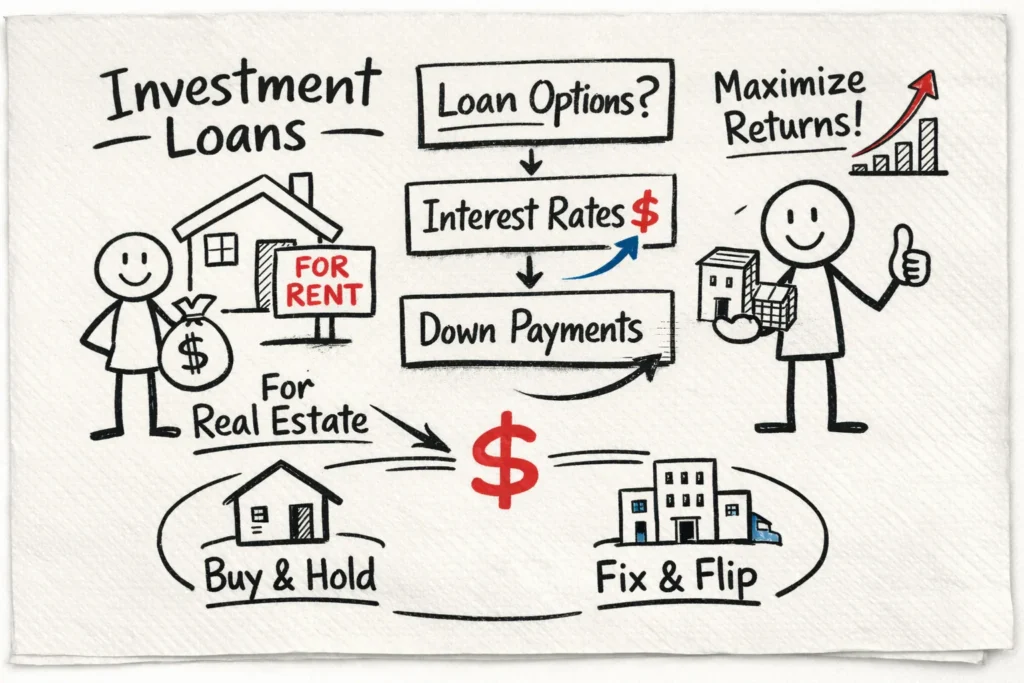
Investment loans for rental properties differ meaningfully from owner-occupied mortgages, yet many lenders hand real estate investors the same checklist they give a first-time homebuyer. Same income docs, same rate sheet, same process. The problem is that financing a rental property is a fundamentally different exercise, and the wrong loan structure can quietly drain your cash flow for years before you realize the decision was the wrong one.
Investment property loans carry higher down payment requirements, stricter reserve rules, and rate premiums that can run a full percentage point or more above those of owner-occupied borrowers. Those gaps exist for a reason, and understanding them before you apply is what separates investors who build profitable portfolios from those who close on deals that barely break even. At Isabelle Mortgages, we walk investors through the loan structure before a single document gets submitted, because the product you choose shapes every number in your deal.
This article gives you a clear map: the main types of investment loans, current rate expectations, qualification thresholds, real cost estimates, and a practical framework for matching a loan to your investment strategy.
The main investment loans and loan types real estate investors use in 2026
Not every rental property mortgage is built the same way. The right product depends on your income type, credit profile, investment timeline, and the number of properties you already have financed. Here are the four categories that matter most for investors right now. Note that government-backed programs like FHA and VA loans are generally reserved for owner-occupied properties, though limited exceptions exist, such as house-hacking arrangements where the borrower occupies one unit of a multi-unit property, making conventional and non-QM products the primary investment loan options for most buyers. For a concise rundown of common rental property loan options, see 8 types of rental property loans.
Conventional loans: the standard path for investors with strong W-2 income
Conventional investment property loans follow Fannie Mae and Freddie Mac guidelines, which means they offer the lowest available rates but demand the most documentation. You’ll need two years of personal tax returns, two years of W-2s, a credit score of at least 620 (680 or above for competitive pricing), and a debt-to-income ratio under 45%. Down payment requirements are 15% for single-unit properties, rising to 25% for multi-unit properties or to unlock best-tier pricing.
One critical limit to know: Fannie Mae caps the number of financed properties a single borrower can hold at ten under conventional guidelines. Once you hit that ceiling, conventional financing is off the table, and you move into non-QM territory. For investors in the early stages of building a portfolio with stable employment income, conventional is still the most cost-effective starting point.
DSCR loans: when the property’s income meets the qualifying
A DSCR loan (debt-service-coverage-ratio loan) qualifies borrowers based on the property’s rental income relative to its total debt payments, not on personal income. Most lenders require a ratio of 1.0 or higher, meaning the rent at least covers the full mortgage obligation. No W-2s, no tax returns, no personal income documentation at all.
This structure is especially useful for self-employed investors, entrepreneurs with complex tax filings, or anyone scaling a portfolio quickly. Down payments typically run 20% or 25%, and rates are slightly higher than conventional, typically 0.75% to 2% above primary-residence baselines. For investors whose personal income documentation creates friction, that premium is often worth every basis point. If you are self-employed and want a checklist to prepare, review our Mortgage for Self-Employed: Your Ultimate Guide & Checklist to make the qualification process smoother.
Hard money and portfolio investment loans: speed, flexibility, and niche use cases
Hard money loans are asset-based. The lender cares about the property’s after-repair value, not your income or credit history. Terms run 6, 24 months, rates sit at the high end of the spectrum, and they are built for fix-and-flip acquisitions or distressed properties that need to close fast. The exit strategy matters: investors typically refinance into a long-term product once the property is stabilized or sold. For guidance on how bridge lenders compare to hard money options, see this comparison of bridge loan vs hard money loan.
Portfolio loans are held in-house by the lender rather than sold on the secondary market, which gives them flexible underwriting. Investors who don’t meet conforming criteria, already own multiple financed properties, or have income structures that don’t map cleanly to standard guidelines will often find portfolio lenders the most accommodating. Rates are higher than conventional, but the access they provide is frequently worth the cost.
What to expect from investment mortgage rates in 2025
Running your cash flow model on the wrong rate assumption is one of the most common mistakes investors make. Getting your numbers anchored to realistic rate expectations before you analyze a deal means your projections reflect what you’ll actually pay, not an optimistic figure that erodes your margins at closing.
How much more do investors pay vs. owner-occupied borrowers
As of early 2025, 30-year fixed conventional rates for primary residences were approximately 6.17% nationally. Non-owner-occupied mortgage products carry a premium of 0.25%, 2.00% above those baselines, depending on down payment, credit score, and property type. A borrower who secures 6.875% on a primary home purchase should model 7.5%, 8.0% on a rental property as a realistic range. DSCR loan rates in 2025 ranged from 6.5% to 8.5%, with 7% and 8% as the typical average, while conventional investment loans sat slightly lower at 6.0% and 7.25%. For up-to-date market context on investment mortgage pricing, consult current investment property rates.
These spreads exist because lenders treat rental properties as higher risk. An owner-occupied borrower will fight to keep their home in financial distress. An investor holding a rental property they don’t live in has a different calculus, and lenders price that risk accordingly.
The factors that tighten or loosen your rate
Down payment size has an outsized effect on investment mortgage rates. Putting 25% down produces meaningfully better pricing than 20% on most non-owner-occupied mortgage products. The difference isn’t marginal; it can move your rate by half a point or more on some product types. Credit score, reserves, and the number of properties you already have financed all push the rate in different directions as well.
DSCR and portfolio loans are priced slightly higher than conventional loans, but they remove the income documentation barrier that blocks many investors entirely. For a self-employed investor or someone with significant paper losses on their tax returns, the rate premium on a DSCR loan is not a cost; it’s the price of access to a product that actually works for their situation.
The qualification criteria lenders use for investment loans
Knowing the exact thresholds before you apply gives you time to optimize your position. Each of these inputs moves your approval odds and your rate.
Down payment, credit score, and DTI minimums
The minimum down payment on a single-unit investment property is 15%, though 20% eliminates mortgage insurance and 25% unlocks best-tier pricing across most conventional and DSCR products. Multi-unit properties (2, 4 units) typically require 25% down. Credit score floors sit at 620 or 680, depending on the product and lender, but 720 or above is where the best rates and terms become available. Multi-family purchases may require a minimum of 700 from some lenders.
DTI limits for investment lenders generally cap at 43%, with Fannie Mae’s automated underwriting allowing up to 50% when compensating factors are present. One important nuance: under conventional guidelines, 75% of projected rental income counts toward your qualifying income. That rental income offset can significantly change how your DTI is calculated, especially on multi-unit properties.
Cash reserves and documentation requirements
Lenders typically require 6 to 12 months of mortgage payments in liquid reserves after closing costs are covered, with exact requirements varying by lender, property type, and borrower profile. Multi-family property purchases and investors who already have multiple financed properties tend to face the most stringent reserve requirements.
Conventional loans require two years of tax returns, two years of W-2s, and two months of bank statements at a minimum. Self-employed borrowers also need profit and loss statements. DSCR loans bypass personal income documentation entirely; lenders typically require only a rent schedule or executed lease to verify the property’s income performance. That difference in documentation burden is what makes the DSCR loan the go-to product for entrepreneurs and portfolio builders.
Real costs to budget before you close on a rental property
Your cash flow projection is only as accurate as the cost inputs you feed it. Many investors underestimate what leaves their account at closing and overestimate the cost of holding a rental over time.
Upfront costs: what leaves your account at closing
For a $250,000 investment property, the combined upfront cash requirement typically ranges from $45,000 to $75,000. That figure includes a down payment of 15, 25% plus closing costs of 2, 6% of the purchase price. Closing costs cover appraisal fees ($300, $600), title charges, origination fees, inspection costs ($200, $1,000), and prepaid taxes and insurance. Investment property loans tend toward the higher end of the closing cost range, closer to 3%-6%, because they lack access to government-backed programs that reduce costs for owner-occupied buyers. For a detailed breakdown of typical mortgage closing costs and ways to lower them, see this guide to mortgage closing costs.
Beyond closing costs, lenders commonly require six months or more of mortgage payments to remain in liquid reserves after the transaction closes, some lenders set this higher depending on your portfolio size and property type. That reserve balance is not a cost you spend; it is cash you must have and cannot count toward your down payment or closing costs. Factor it into your liquidity planning before you ever go under contract.
Ongoing expenses that determine actual cash flow
The mortgage payment is only one line in your cash flow model. A realistic rental property budget includes the following:
- Property management: 8, 12% of the monthly rent if you use a manager
- Maintenance and repairs: 1- 3% of the property value annually
- Vacancy buffer: 5, 10% of expected annual rent to cover empty months
- Property taxes and landlord insurance vary by location and property type
Factor in property management even if you plan to self-manage. If you ever scale, get sick, or move, you’ll need that cost covered. These are not optional line items in a well-run portfolio; they are the difference between a rental that builds wealth and one that drains it.
Matching the right investment loan to your strategy
The best investment property loan is not the one with the lowest rate in isolation; it is the one that fits your income profile, your timeline, and your exit strategy without straining the deal’s cash flow.
Cash flow focus vs. appreciation play: the loan structure changes
For long-term buy-and-hold rentals where monthly cash flow is the priority, DSCR loans remove the friction of income documentation and let the property’s rent justify the financing. This buy-to-let loan approach is particularly effective for investors seeking to build passive income without relying on W-2 verification. For investors with high W-2 income and credit above 680, conventional investment loans offer the lowest available rates and the best protection of monthly margins. For short-term strategies like fix-and-flip or the BRRRR method, hard money bridges the gap quickly; investors then refinance into a permanent DSCR or conventional product once the property is stabilized and producing rent.
A simple framework for choosing between loan types
Use this decision path before you contact any lender:
- Consistent personal income and credit above 680: start with a conventional investment loan for the lowest rate
- Self-employed, scaling a portfolio, or the property is the primary qualifier: evaluate a DSCR loan first
- Need to close fast on a distressed or below-market asset: hard money with a clear exit strategy to permanent financing
- Don’t fit the conforming box due to multiple properties or complex income: portfolio loans from investor-friendly lenders cover the gap
No single product wins across every scenario. The goal is to align the loan’s logic with the deal’s logic so the financing works with your strategy rather than against it.
Why working with a specialized mortgage partner changes your outcome
Many traditional lenders treat a rental property mortgage as a variant of a primary home loan. They run the same income documentation process, offer a conventional quote, and send you a rate sheet. What they may not do is explore whether a DSCR loan or portfolio product would better serve your situation. Some lenders do not offer those products at all, while others simply don’t evaluate them proactively for investor clients. That approach can cost investors their loan approval entirely, or lock them into a product that strains cash flow from day one.
At Isabelle Mortgages, investment clients receive a one-on-one review of their loan structure before any application is submitted. The conversation covers the property’s projected rent, the investor’s credit profile and income type, existing financed properties, and long-term portfolio goals. From there, we identify whether a conventional, DSCR, or portfolio investment loan best fits the numbers and the strategy. That upfront analysis is not a formality; it is what determines whether the deal pencils out. Read more about our approach on the Blog, Isabelle Mortgages.
For investors focused on systematically building real estate wealth, working with an advisor who understands cash flow analysis, reserve requirements, and product fit is not a luxury. It is what separates a profitable portfolio from an expensive lesson. Whether you’re financing your first rental or your fifth, the right loan structure starts with the right conversation.
The bottom line: loan structure is a wealth decision, not just a paperwork decision
Investment loans vary significantly in structure, qualification logic, and cost. A conventional loan, a DSCR product, and a hard money bridge solve completely different problems, and using the wrong one for your situation creates friction that compounds over the years. Rate, down payment, and reserve requirements are not fixed obstacles; they are inputs you can optimize when you understand what drives them.
The most important step before submitting any application is to run your loan structure decision the same way you run your deal analysis: with specific numbers, clear assumptions, and a qualified partner who can pressure-test the plan.
If you’re ready to move forward on a rental property or want to evaluate your options before you’re under contract, reach out to Investment Loan Property: Build Generational Wealth for a personalized investment loan review. The right loan today is the foundation for a portfolio that actually builds wealth over time.