
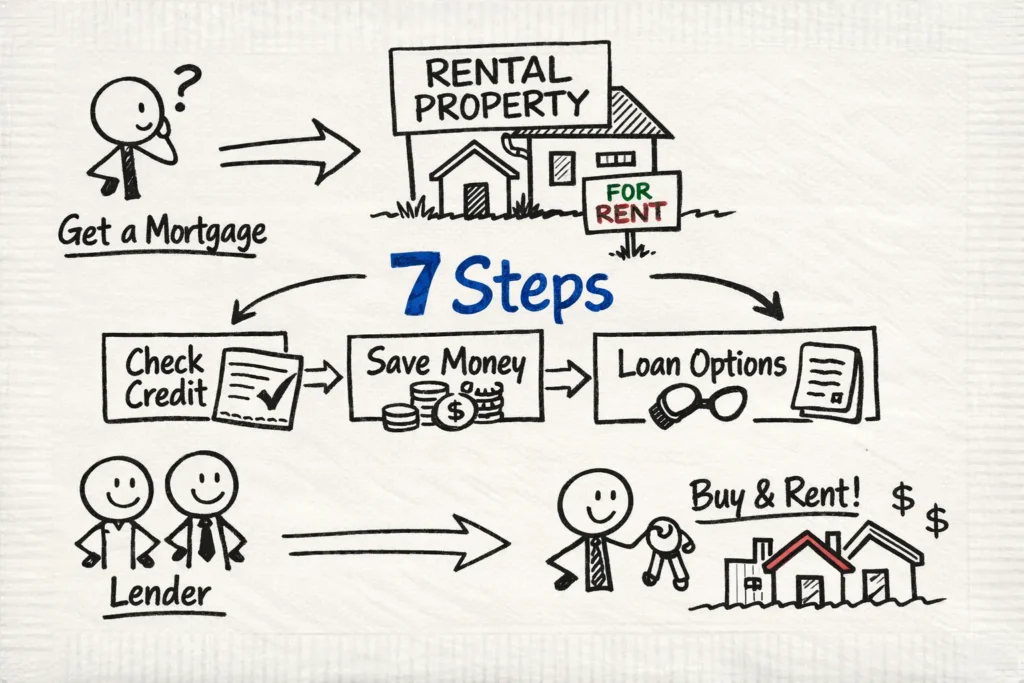
If you’ve been asking yourself, “how do I get a mortgage for a rental property?”, the honest answer is that it works differently than financing the home you live in. Lenders classify investment properties as higher-risk loans, and that distinction changes several key qualification standards: credit thresholds, down payment minimums, reserve requirements, and how rental income gets counted. Understanding these differences before you apply saves time and prevents surprises mid-process.
At Isabelle Mortgages, we work directly with real estate investors to match them to the right loan structure from day one. The seven steps below cover everything lenders actually evaluate when you apply for a rental property loan, from baseline credit requirements to the income documentation that trips up even experienced buyers.
Steps 1 and 2: What lenders check first before approving a rental property loan
The credit score and DTI numbers lenders use for investment loans
Most conventional lenders set a minimum credit score of 620 to 680 for investment property financing, but 680 or higher is where you start seeing competitive rates. Borrowers with scores above 720 unlock significantly better pricing. Loan-level price adjustments (LLPAs) on conventional loans stack based on your credit score and LTV ratio, even a modest score improvement can meaningfully reduce your rate, since LLPA pricing grids show distinct cost breaks at key FICO tiers like 720 and 740.
On the DTI side, lenders look at two numbers. Your front-end ratio, which covers housing costs, should stay at or below 28% of gross income. Your back-end ratio, covering all monthly debt obligations, should fall between 36% and 45%. Some portfolio lenders allow up to 50% for well-qualified borrowers, but staying well under 45% gives you more flexibility and better terms. Properly documented rental income can offset part of your DTI calculation, which matters more as you scale a portfolio.
Why investment property lending requirements are stricter than owner-occupied loans
The logic is straightforward: a borrower is statistically more likely to default on a rental property than on the home they sleep in. When income stops, a landlord tends to protect the primary residence first. Lenders price that risk into every layer of the loan, from credit minimums to documentation requirements. This is also why DSCR loans exist as a separate category: they qualify based entirely on the property’s cash flow rather than your personal income, sidestepping DTI constraints for investors who are self-employed or scaling a portfolio beyond conventional limits.
Steps 3 and 4: Down payment and cash reserve expectations for rental properties
Minimum down payment by property type
For a single-unit investment property under conventional guidelines, the minimum down payment is 15%. For 2 to 4 unit properties, that number jumps to 25%. Compare that to a primary residence, where 3 to 5% down is possible. In practice, most rental property financing scenarios use 20 to 25% down, both to avoid PMI and to improve rate pricing. LTV directly affects your rate through LLPAs, so putting down more upfront lowers your cost of borrowing over the life of the loan.
How many months of reserves lenders require, and how that scales
Per Fannie Mae guidelines, the standard requirement for a single rental property on a conventional loan is typically six months of PITIA reserves, though some lenders apply overlays requiring up to 12 months. PITIA stands for principal, interest, taxes, insurance, and any association dues. These reserves must be held in liquid assets after you’ve already paid the down payment and closing costs, meaning you need to plan your capital well in advance of applying.
Owning multiple financed properties compounds this requirement. Fannie Mae mandates additional reserves for each financed property beyond the first, and some lenders require six months of PITIA stacked per property. An investor with three financed properties could be required to hold 18 or more months of combined PITIA reserves before any new purchase is approved. For guidance on how lenders view liquid savings for mortgage qualification, see resources on cash reserves for a mortgage.
Steps 5 and 6: How lenders verify and use rental income during underwriting
The 75% vacancy factor and what it means for your rental property mortgage rates
Lenders don’t count the full amount of rent a property generates. They apply a 75% factor to gross rental income, discounting 25% to account for vacancies, maintenance, and repairs. If a property rents for $2,000 per month, lenders use $1,500 in their calculations. This applies whether you’re submitting a signed lease, Schedule E tax returns from an existing rental, or a market rent estimate from an appraisal using Form 1007 for single-family properties or Form 1025 for 2 to 4 unit buildings.
What documentation underwriters accept as proof of rental income
There are three income scenarios lenders evaluate, and each requires a different documentation package. For an existing rental with a tenant already in place, underwriters typically want two years of Schedule E tax returns and rent history verified through bank statements or canceled checks, though Fannie Mae may accept one year in certain cases, and individual lender overlays vary. For a newly purchased property with a signed lease but no payment history yet, the lease must be executed for at least 12 months, and lenders will look for bank evidence of deposits. For a vacant property with no lease, the appraiser’s comparable rent schedule becomes the basis for projected income, applied at 75% of the estimated market rate.
Documentation integrity matters more than many investors expect, lenders flag leases that show inflated rents inconsistent with market comps, same-day deposits that look manufactured, or first-time landlords without any property management history. Fannie Mae guidelines require at least one year of documented property management experience before rental income from a new lease can be used to qualify on an investment property.
Step 7: Choosing the right loan program and taking the next step
Conventional, DSCR, and portfolio loans compared for rental investors
Conventional loans work well when you have strong W-2 income, a solid credit profile, and a modest portfolio. They carry lower rates than most alternatives, but under Fannie Mae’s Desktop Underwriter guidelines, they cap you at 10 financed properties and require full personal income documentation. DSCR loan rental income qualification works differently: lenders assess the property’s rental income relative to its monthly debt service, with most requiring a ratio of 1.0 to 1.25. A ratio of 1.0 means rent exactly covers the PITIA payment; 1.25 means rent covers it with a 25% buffer. DSCR loans require no personal tax returns or DTI calculation, making them the preferred structure for self-employed investors or anyone building a portfolio at scale. For rate comparisons, see current investment property mortgage rates to help evaluate how DSCR pricing stacks up against conventional loans.
Portfolio loans sit outside Fannie and Freddie guidelines entirely. Sometimes called non-owner-occupied loans, they offer flexibility in structure and no cap on properties, but they come with higher rates and lender-specific underwriting criteria. FHA and VA loans remain an option only when the borrower occupies one unit of a 2 to 4 unit property as their primary residence; they aren’t available for pure investment purchases.
How to get prequalified for a rental property mortgage, answering the key question
So, how do you get a mortgage for a rental property, practically speaking? Start by pulling your credit report, calculating your back-end DTI, and confirming you have enough liquid reserves after your planned down payment and closing costs. Gather two years of tax returns, your current lease agreements or rent history, and three months of bank statements. If you’re applying for a DSCR loan, have a market rent estimate or executed lease ready to support the property’s income projection.
Working with a lender experienced in buy-to-let mortgage products and investment property financing makes a real difference at this stage. The loan structure, documentation requirements, and income calculations vary significantly from a standard home purchase. At Isabelle Mortgages, our team sits down directly with investors at each decision point, identifying the right program, flagging documentation issues before they cause delays, and walking through every income calculation so there are no surprises at underwriting.
The short version before you apply
Know your credit score and DTI benchmarks before you start. Plan for a 15 to 25% down payment depending on the number of units. Build six or more months of liquid reserves beyond your closing costs. Understand that lenders will apply a 75% factor to whatever rental income you present, and that documentation requirements vary based on whether the property already has a tenant. Choose the loan program, conventional, DSCR, or portfolio, that fits your income structure and portfolio size.
The question of how do I get a mortgage for a rental property has a clear answer once you know what lenders are actually evaluating. The process has more moving parts than a standard purchase, but it’s entirely navigable with the right guidance. If you’re ready to move forward, the team at Isabelle Mortgages is here to help you identify the right loan structure, work through your numbers, and get prequalified for your next rental property.