Being a first-generation homebuyer means figuring out one of the biggest financial decisions of your life without a roadmap from your parents. No dinner table conversations about what to expect at closing. No family wisdom on whether to choose FHA or conventional. Just you, a stack of paperwork, and a process that can feel designed for people who already know the rules.
Here’s what most people in your position don’t know: real money exists specifically for buyers like you. Grants and down payment assistance programs worth tens of thousands of dollars were built with first-gen buyers in mind. The eligibility rules are navigable, the documents are manageable, and the path is clearer than it looks from the outside. At Isabelle Mortgages, we work with first-generation homebuyers every day, walking clients through a process that no one else in their family has done yet.
By the end of this guide, you’ll know exactly what first-generation status means under the programs that matter, which state programs have real dollars available right now, what it takes to qualify, and the documents you’ll need to apply.
What “first-generation homebuyer” actually means
Before you can apply for any first-gen assistance program, you need to know whether you qualify for the label. The answer depends on which program you’re applying to, because the definition is not standardized.
The Fannie Mae definition you’ll see most often
Under the Fannie Mae standard, every borrower on the loan must be purchasing the property as a primary residence, must have had no ownership interest in another property during the prior three years, and must meet one additional family condition. That condition is satisfied if no parent owned a property in the prior three years, if the borrower aged out of foster care, or if the borrower became legally emancipated. This definition applies to all borrowers on the loan, not just the primary applicant. For the formal policy language, review the Fannie Mae selling guide, and for recent industry discussion about efforts to standardize the label, see reporting on agencies aiming to standardize the first-generation homebuyer mortgage definition.
How state housing agencies define it differently
State programs often use broader definitions that don’t mirror the Fannie Mae standard. Minnesota Housing, for example, defines first-generation eligibility based on whether the borrower and their parents or legal guardians have never owned a home or lost one to foreclosure. Minnesota explicitly states that Fannie Mae and Freddie Mac’s definition does not apply to their program. Some states look at whether parents owned a home at any point in the borrower’s lifetime, a much longer lookback window than three years. For more analysis of how first-generation definitions affect access and equity, see the NFHA report on first-generation homeownership.
The most important takeaway: qualifying under one program’s definition doesn’t automatically mean qualifying under another. Read the specific eligibility language for every program you’re interested in before assuming you’re in or out.
First-generation vs. first-time buyer: why both labels matter
A first-time buyer is anyone who hasn’t owned a home in the past three years. A first-generation buyer also has no parental homeownership history. Many buyers are both, and that dual status can unlock layered assistance. Some first-gen homebuyer programs require both statuses simultaneously; others require only one. Understanding which label each program needs is the difference between maximizing your assistance and leaving money on the table.
Loan types that work well for first-gen buyers
Down payment assistance doesn’t work in a vacuum. It attaches to a first mortgage, which means your loan type directly affects which DPA programs are available to you. Choosing the right loan first makes everything else easier.
FHA loans: the most common starting point
FHA loans require as little as 3.5% down with a credit score of 580 or higher. They have flexible credit requirements, and most first-gen DPA programs are compatible with FHA financing. The trade-off is mortgage insurance, called the mortgage insurance premium, which adds to your monthly payment. For buyers with limited savings or credit histories that aren’t perfect, FHA is typically the most accessible entry point. Learn more about FHA loan eligibility and the broader FHA credit requirements, and how DPA programs commonly pair with FHA in resources on FHA loans and down payment assistance.
Conventional, USDA, and VA options worth knowing
Conventional loans offer 3% down options and are required by some state DPA programs. Michigan’s MSHDA First-Generation DPA, for instance, pairs with an MI Home Loan that can be conventional, FHA, or USDA. USDA loans cover 0% down in eligible rural and suburban areas, with DPA still available to cover closing costs on top. For a clear comparison of those non-VA options, see this guide to USDA vs FHA loans. VA loans serve eligible veterans at 0% down, where DPA can absorb other upfront expenses. Each loan type opens different combinations, and your location, income, and credit profile all factor into which pairing makes sense.
How a specialized lender matches you to the right loan
Loan selection is not a one-size-fits-all decision. Your income documentation, credit score, county, and the specific DPA programs active in your state all determine which mortgage structure closes successfully. This is where working with a lender who focuses on first-generation homebuyers makes a concrete difference. The team at Isabelle Mortgages | Mortgage Rates on Home Loans is built around exactly this: knowing which loan-DPA combinations are active in your state, which ones have stacking restrictions, and which ones actually get to the closing table without surprises.
Grants and down payment assistance for first-gen buyers
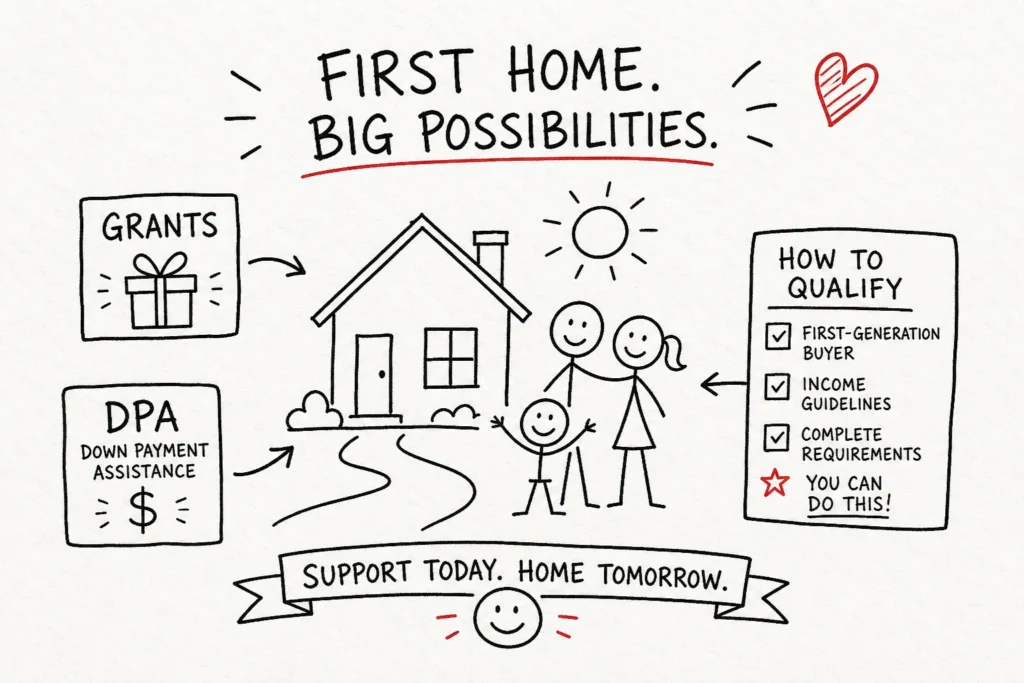
This is where the real money lives. Several state programs offer substantial down payment and closing cost assistance specifically for first-generation homebuyers, and the dollar amounts are significant.
State programs with real dollars available right now
Michigan’s MSHDA First-Generation Down Payment Assistance Program offers up to $25,000 for down payment, closing costs, and prepaid escrows. It operates as a limited-time statewide pilot and pairs with the MI Home Loan (conventional, FHA, or USDA). One important restriction: it cannot be combined with Michigan’s MI10K DPA loan, so you choose one or the other. See the MSHDA press release about $25,000 in down payment assistance and the program details on the MSHDA First-Generation DPA page. For additional context on income and purchase caps, review local guidance such as MSHDA income limits for DPA and reporting on MSHDA income and sales price limits 2024.
Minnesota’s First-Generation Homebuyer Loan Program offered up to $35,000 for down payment and closing costs, though it closed to new commitments in late 2024. The separate Forgivable First Generation Homebuyers Community Down Payment Assistance Fund is a zero-interest, forgivable loan of up to $32,000 or 10% of the purchase price, whichever is lower. These two Minnesota programs cannot be stacked with each other. Regional nonprofit and partner pages that explain local first-gen DPA options include organizations like Northwest HomePartners’ first-generation DPA.
Beyond Michigan and Minnesota, Connecticut’s CHFA FirstGeneration program offers up to $25,000. MaineHousing runs a First Gen pilot for buyers whose parents never owned a home during the borrower’s lifetime. New Jersey’s HMFA launched a first-generation buyer initiative tied to its Down Payment Assistance Program; see New Jersey HMFA homebuyer resources for details. Local housing authorities and HFA pages, like San Diego’s first-time homebuyer programs, also publish first-gen eligibility updates in many jurisdictions. If you’re looking for centralized program information or state-specific portals, resources such as the national FirstGen DPA program site list many emerging initiatives.
The federal first-gen DPA proposal: where it stands
You may have seen references to a federal First Generation Down Payment Fund that would provide the greater of 10% of the purchase price or $20,000. This is a legislative proposal, not a currently operating program, state programs are where accessible money exists right now, and those deserve your energy.
Stacking DPA with other first-time buyer programs
Many first-gen DPA programs can be layered with other assistance, but every program has its own stacking rules. Michigan’s MSHDA program explicitly prohibits combining with MI10K. Minnesota’s two first-generation programs cannot be used together. Applying to the wrong combination doesn’t just waste time; it can delay your closing or cause a denial. Work with a lender who knows these rules before you apply, not after.
Eligibility rules most programs have in common
The specifics vary by state and program, but clear patterns emerge across first-generation mortgage programs that give you a solid starting point for assessing your eligibility.
Credit score, income limits, and purchase price caps
There is no single credit score minimum across all first-gen DPA programs, but 640 is a commonly cited threshold, Michigan’s MSHDA program references this number explicitly. FHA financing, which pairs with many DPA programs, requires a minimum score of 580 for the 3.5% down option. Income limits are typically tied to Area Median Income for the county where you’re buying, based on total household income rather than just your own earnings. Purchase price caps are program-specific: Michigan uses a statewide cap around $544,233, while other states apply county-based limits.
Prior ownership and parental ownership lookback rules
Most programs require that you haven’t owned a home in the past three years, though some programs use a seven-year lookback. Many programs also require that your parents or legal guardians have no recent or current ownership interest, with exceptions carved out for borrowers who aged out of foster care or became legally emancipated. The primary residence requirement is nearly universal across first-gen DPA programs: no second homes, no investment properties.
The homebuyer education requirement
Most first-gen DPA programs require completion of a HUD-certified homebuyer education course before closing. Some also require a minimum borrower cash contribution, such as Michigan’s 1% minimum. Think of the education requirement as an asset rather than a hurdle. For buyers navigating this process for the first time without family guidance, a quality homebuyer education course genuinely reduces anxiety and fills in the knowledge gaps that no one else in your family can fill for you.
Documents and next steps to apply for first-gen assistance
Knowing you likely qualify is only the beginning. The application process requires a specific set of documents, and getting them in order before you start talking to lenders puts you in a much stronger position.
The document checklist most programs require
- Government-issued ID for all borrowers on the loan
- Two years of W-2s or tax returns; 1099s and business bank statements for self-employed buyers
- Recent pay stubs or proof of current income
- Two to three months of bank statements
- Signed first-generation status certification or attestation (required by most programs)
- Completion certificate from a HUD-approved homebuyer education course
One document that catches buyers off guard: a signed self-certification about parental ownership history. While most programs, following Fannie Mae guidance, rely on your signed attestation rather than a formal title search, some programs or localities may request additional documentation. Know the specific lookback window and verification requirements for your program before you certify.
How to verify your first-generation status
Most programs use a signed self-certification combined with lender attestation rather than a formal title search of your parents’ history. Under Fannie Mae guidance, the lender is not required to independently verify the parent’s information; they rely on your signed certification and keep it in the loan file. For the official policy reference, see the Fannie Mae guidance document. Some lenders may run a database check to confirm no parental ownership on record, depending on the specific program’s requirements. Know the exact lookback window before you sign any certification.
Choosing a lender who already knows these programs
Not every lender participates in state DPA programs, and not every participating lender knows how to stack them correctly or which programs are currently accepting applications. This is a real gap that costs buyers time and, in some cases, their rate lock. Blog, Isabelle Mortgages and our loan officers specialize in working with first-generation homebuyers, guiding clients through eligibility requirements, identifying which programs are currently open, and pairing the right loan type with the right assistance from the start. One-on-one guidance from application to closing, with no guesswork.
Your next step starts here
Being a first-generation homebuyer does not mean starting from zero. Real programs with real money exist right now, and the eligibility rules are more navigable than they look once you understand them clearly.
The path forward becomes clear when you break it into steps. Start by confirming your first-generation definition under the specific programs available in your state. Then identify which programs are currently active and accepting applications. From there:
- Gather your documents using the checklist above
- Complete your HUD-certified homebuyer education course
- Connect with a lender who already knows how these systems work together
If you’re self-employed and worried about documentation, our Mortgage for Self-Employed: Your Ultimate Guide & Checklist explains the tax return, 1099, and bank statement rules most lenders expect. If you want a team that has guided first-gen buyers through this exact process, reach out to Isabelle Mortgages today. The process your parents couldn’t walk you through is one we’ve helped many people navigate, and we’re ready to do the same for you.
Frequently Asked Questions
Do I qualify as a first-generation homebuyer?
Qualification depends on the specific program. Under the common Fannie Mae standard, you generally qualify if you haven’t owned a home in the past three years and your parents also had no ownership interest in the past three years. State programs may use broader definitions, some look at your parents’ entire lifetime ownership history. Review the eligibility language for each program you’re considering.
Which states currently offer first-gen homebuyer grants?
As of 2026, active or recently active programs include Michigan (MSHDA, up to $25,000), Minnesota (Forgivable Community DPA Fund, up to $32,000), Connecticut (CHFA FirstGeneration, up to $25,000), Maine (MaineHousing First Gen pilot), and New Jersey (HMFA first-generation initiative). More states are launching programs, contact your state housing finance agency for the latest status. For regional examples and additional first-gen program listings, see the national FirstGen DPA program site and local partner pages such as Northwest HomePartners’ first-generation DPA.
Can I stack first-gen DPA with other down payment assistance?
Sometimes, but not always. Each program has its own stacking rules. Michigan’s MSHDA first-gen program cannot be combined with the MI10K DPA loan. Minnesota’s two first-generation programs cannot be used together. Always confirm stacking restrictions with your lender before applying to multiple programs.
What credit score do I need for first-gen down payment assistance?
There is no single minimum across all programs. A score of 640 is a commonly cited threshold, Michigan’s MSHDA program references it explicitly. If you’re using FHA financing alongside DPA, you’ll need at least 580 to qualify for the 3.5% down option.
Is the federal first-generation homebuyer grant available yet?
No. The federal First Generation Down Payment Fund, which would offer up to $20,000 or 10% of the purchase price, remains a legislative proposal and is not currently operational. Focus on state-level programs, which are active and funded right now.
Do I need to prove my parents never owned a home?
Most programs rely on a signed self-certification or attestation from the borrower rather than a formal title search. Under Fannie Mae guidance, lenders are not required to independently verify parental ownership history, they keep your signed certification in the loan file. Some programs or lenders may conduct additional checks. Confirm the specific requirements with your lender before signing anything.
For broader context on first-generation supports beyond housing, such as scholarships and student-success grants for first-generation students, see resources on first-generation college student scholarships and the First Generation Student Success Grants RFA, which illustrate how first-generation initiatives are expanding across sectors.