If you’ve ever wondered what mortgage options exist for small business owners, you’re not alone, and the answer is more encouraging than most people expect. You built a real business. Your bank account shows it. But the mortgage lender keeps saying no. This is one of the most common frustrations small business owners face: you look “broke on paper” because your tax strategy is working exactly as it should. Aggressive but legal write-offs reduce your adjusted gross income on your returns, and most traditional lenders stop right there. They see the number, not the full picture.
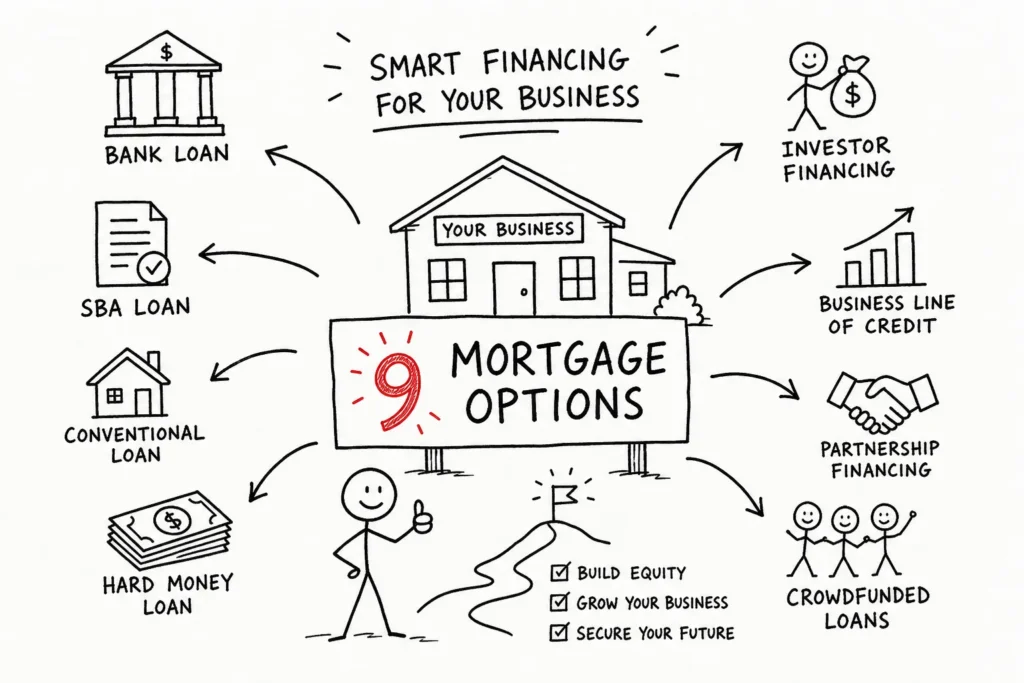
The good news is that 2026 offers more loan paths for business owners than most people realize. Bank statement loans, DSCR products, 1099-based programs, and government-backed options each serve a different financial profile. This guide breaks down all nine so you can identify which one actually fits your situation, not just get a generic list of possibilities. At Isabelle Mortgages, we specialize in working with small business owners who have been turned away by traditional lenders, not because they can’t afford a home, but because their income doesn’t fit a standard W-2 box.
What mortgage options exist for small business owners, and why traditional loans fall short
Tax write-offs are a major obstacle for many self-employed borrowers. A borrower who earns $180,000 gross but writes off $80,000 in legitimate business expenses nets only $100,000 in the lender’s eyes. Conventional underwriting uses that adjusted gross income figure from your tax returns to calculate what you can afford. The same financial discipline that reduces your tax bill quietly shrinks the income number lenders use to approve you.
What lenders are really measuring is income stability and your ability to cover the mortgage payment reliably. Whether they verify that through tax returns or bank deposits, the core question never changes. Understanding this logic helps you see why alternative documentation methods aren’t loopholes. They’re simply different ways to answer the same question.
Most lenders want to see at least two years of self-employment history before they’ll approve you, because they want proof that your income is consistent rather than a one-year spike. Some Non-QM programs accept 12 months of history under specific conditions, which we’ll cover below. If you’re newly self-employed, that timeline matters when planning your purchase; see our self-employed mortgage guide for a step-by-step checklist.
How lenders calculate income without a W-2
For conventional and government-backed loans, lenders work from two years of personal tax returns, and sometimes business returns for borrowers with significant ownership stakes in a partnership or S-corp. Schedule C, K-1 distributions, and depreciation add-backs can improve your qualifying income on paper, but for many business owners with heavy write-offs, the resulting number still falls short. IRS transcripts are often pulled to verify what was actually filed.
Bank statements offer a different calculation. Lenders look at 12 or 24 months of deposits and apply an expense factor to estimate net income. For business accounts, that factor is typically 50%, meaning $20,000 per month in average deposits produces $10,000 in qualifying income. Personal accounts often carry a slightly lower expense factor, in the 40, 50% range, because fewer business costs are assumed to run through a personal account. The math is straightforward once you know the formula.
1099 income and CPA-prepared profit and loss statements are two additional documentation paths used in Non-QM lending. A current-year P&L, sometimes accompanied by a balance sheet, can supplement tax returns or replace them depending on the program. When a P&L alone is sufficient varies by lender, some require it alongside returns while others accept it as the primary document for borrowers with strong current-year income. These tools exist specifically because the self-employed borrower’s financial story often can’t be told through a single document type.
The five flexible mortgage options for non-traditional income
1. Bank statement loans are built for business owners whose deposits tell a stronger story than their returns. Most programs use 12 or 24 months of statements, require a minimum credit score around 620, and expect 10, 20% down. Rates typically run approximately 0.5, 2% above conventional mortgage rates, reflecting the trade-off for income flexibility. If your deposits are consistent and strong, this is often the cleanest path; for more on how lenders tailor these programs to self-employed borrowers, see this industry overview on bank statement loans for self-employed borrowers.
2. 1099 mortgage loans are designed for contractors, freelancers, and commission-only earners who receive 1099 forms instead of W-2s. Lenders use one or two years of 1099 income alongside bank statements or tax transcripts to calculate qualifying earnings. If the majority of your revenue comes from a single client or multiple 1099 sources, this product was built for your income structure.
3. P&L-only loans allow a CPA-prepared profit and loss statement to serve as the primary income document, often combined with a business balance sheet. This works well for borrowers who have strong current-year income that recent tax returns don’t yet reflect. The lender is essentially underwriting your business’s current financial health rather than its historical tax picture.
4. Non-QM mortgages are the umbrella category covering bank statement, 1099, and P&L-based loans, and they’re among the most important mortgage options available to small business owners today. Non-QM does not mean bad credit. It means the borrower doesn’t fit the qualified mortgage template that conventional and government-backed programs require. Some Non-QM lenders allow debt-to-income ratios up to 50% with compensating factors, and most require 3, 6 months of cash reserves after closing. Lender overlays vary significantly, so a 620 credit score might qualify at one lender and not another even within the same product category.
5. Stated income loans represent a smaller segment of the Non-QM market where income is stated but supported by asset verification rather than full income documentation. These carry stricter reserve requirements and higher rates, and they suit borrowers with substantial liquid assets relative to the loan amount. They’re not as widely available as bank statement products, but they remain an option worth discussing with a specialized lender.
Conventional and government-backed options that still apply
6. Conventional loans remain the best option when your net income after deductions still qualifies. Fannie Mae’s underwriting guidance for self-employed borrowers (and similar Freddie Mac standards) accept two years of personal and business tax returns, and down payments can go as low as 3% for qualifying borrowers. The rates are competitive precisely because the documentation is thorough. If your write-offs are moderate and your returns show consistent qualifying income, this path is worth running before assuming you need a Non-QM product.
7. FHA loans follow the same tax-return documentation rules as conventional loans, so they’re not bank-statement friendly. What they offer instead is a lower barrier to entry: a minimum credit score of 580 for the 3.5% down payment option, or as low as 500 with 10% down, depending on the lender. The 2026 FHA loan limit is $541,287 in most counties and $1,249,125 in high-cost areas, per HUD guidelines. Business owners who can document qualifying income through returns and want a lower down payment will find FHA worth evaluating.
8. VA loans are an often-overlooked option for veteran small business owners. Zero down payment, competitive rates, and no private mortgage insurance make this one of the strongest loan products available. VA loans use standard income documentation including tax returns and employment verification. If you qualify for VA benefits, this should be the first path you explore regardless of your business structure. The funding fee is the main cost consideration, and it can be financed into the loan.
DSCR loans: buying investment property without personal income review
DSCR loans qualify the property rather than the borrower’s personal earnings, making them one of the most practical mortgage options for small business owners pursuing investment real estate. The Debt Service Coverage Ratio is calculated by dividing the property’s gross monthly rental income by the total PITIA payment (principal, interest, taxes, insurance, and HOA if applicable). A DSCR of 1.0 means rent exactly covers the debt. Most lenders prefer 1.25 as the comfortable threshold, though some programs accept below 1.0 with compensating factors like lower loan-to-value or stronger credit.
9. DSCR loans are exclusively for non-owner-occupied investment properties. They typically de-emphasize personal income verification, some programs require minimal borrower documentation such as reserves and credit, while others require none in the traditional sense, which makes them a clean path for business owners buying rental properties. Typical program minimums include a 620, 680 credit score, 20, 25% down payment, and loan amounts starting around $100,000, $150,000, though these vary by lender and program. The documentation package is straightforward: a current lease or rent roll, property appraisal with market rent estimate, proof of insurance, and property-level cost data. If you’re exploring whether DSCR can apply to owner-occupied scenarios or unique cases, see this comparison of DSCR loans versus owner-occupied mortgages.
For short-term rentals, lenders calculate qualifying income using trailing 12-month booking revenue, appraisal-based market rent, or third-party STR market data. The DSCR calculation works the same way. The income input just reflects projected or historical short-term revenue rather than a fixed lease amount. For detailed lender perspectives on DSCR for short-term rental models, specialized resources outline how booking revenue and occupancy assumptions are treated by underwriters.
How to choose the right mortgage option for your situation as a small business owner
Here’s a practical framework for identifying your starting point based on your financial profile:
- High write-offs, strong monthly deposits: bank statement loan (Option 1)
- 1099 contractor or freelancer: 1099 Non-QM mortgage (Option 2)
- Strong current-year income, weaker prior returns: P&L-only loan (Option 3)
- Moderate write-offs, two solid years of returns: conventional or FHA (Options 6 or 7)
- Veteran business owner: VA loan (Option 8)
- Buying a rental or investment property: DSCR loan (Option 9)
Matching the product is only half the equation. The lender you choose matters just as much as the loan type. Many business owners waste months applying to banks that only offer conventional products, then get denied and assume homeownership isn’t possible. A lender experienced in non-traditional income underwriting looks at your full financial picture: deposits, returns, business structure, and goals. They identify the right program before you apply, not after a rejection. For an overview of the kinds of products lenders market to self-employed borrowers, see this primer on self-employed home loans.
At Isabelle Mortgages, that’s how we approach every file. We review your complete financial situation, including tax returns, bank statements, and business documentation, before recommending a loan path. Whether you need a bank statement product, a DSCR investment loan, or a conventional loan structured around your returns, we match the program to your actual numbers. Reach out before assuming you don’t qualify. If you have multiple jobs or overtime income, our article on qualifying for a mortgage with overtime and multiple jobs explains how that income is evaluated. You can also browse our blog for more case studies and downloadable checklists.
The bottom line
Being a small business owner does not mean being locked out of homeownership or investment property ownership. The mortgage market in 2026 includes flexible paths built specifically for borrowers with non-traditional income, variable deposits, and aggressive tax strategies. Now you know what mortgage options exist for small business owners in 2026, the key is identifying which product fits your profile and working with a lender who understands the difference.
Stop applying to lenders who only know one product. Start with a lender who knows all nine. Reach out to Isabelle Mortgages to review your options. We’ll map the right program to your actual numbers and guide you through the process from first review to closing.