Most first-time buyers spend weeks researching neighborhoods, school districts, and square footage before they ever ask the question that actually shapes their financial future: which loan type should I be using? The assumption is simple and wrong, that there’s one kind of mortgage, you either qualify or you don’t, and the rest is just paperwork. In reality, four distinct mortgage structures exist specifically because no two buyers start from the same financial position. Understanding the right first-time buyer loan types before you apply is one of the most financially consequential decisions you’ll make in this process.
At Isabelle Mortgages, the first real conversation with a new buyer focuses on loan type fit rather than interest rates, because choosing the wrong structure can cost tens of thousands of dollars over the life of the loan, even when you qualify for multiple options. A buyer with a 620 credit score and a VA Certificate of Eligibility sitting in a drawer should be comparing VA terms first, since VA often delivers zero down payment and no monthly mortgage insurance. A buyer with strong credit and 15% saved shouldn’t default to FHA just because a friend did.
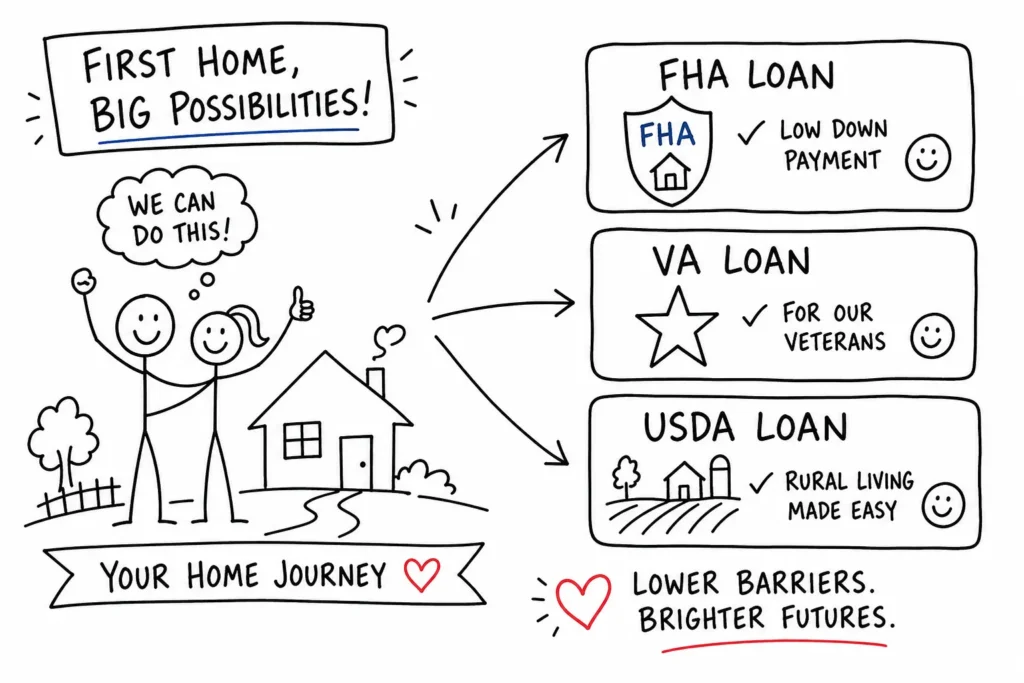
This guide to first-time buyer loan types breaks down the four major mortgage options available in 2026: FHA, conventional, VA, and USDA. By the end, you’ll know which loan fits your credit score, your savings, and your situation, and exactly what to do next.
First-time buyer loan types: FHA loans for limited savings and flexible credit
FHA loans are commonly used by first-time buyers because they were designed to lower barriers to homeownership. The Federal Housing Administration created this program to expand access to homeownership through lower credit requirements, smaller down payments, and more flexible debt-to-income guidelines. That mission still shapes how the loan works today, making FHA one of the most accessible loan structures on the market for buyers who are just getting started.
What FHA actually requires to qualify
The FHA uses a tiered credit score structure tied directly to your down payment. With a 580 or higher credit score, you qualify for the minimum 3.5% down payment. If your score falls between 500 and 579, you can still qualify, but the required down payment jumps to 10%. Keep in mind that these are FHA program minimums: individual lenders often set overlays slightly higher, so a 580 score may still face some lender resistance depending on the rest of your file.
How MIP works and what it actually costs you
FHA mortgage insurance comes in two pieces. The upfront mortgage insurance premium (MIP) is 1.75% of the loan amount, added at closing or rolled into the loan balance. The annual MIP runs between 0.15% and 0.75% depending on your loan term, loan-to-value ratio, and down payment size (per HUD guidelines). On a $300,000 loan, the 1.75% upfront MIP alone comes to roughly $5,250.
For official FHA guidance on mortgage insurance premiums, see FHA’s MIP rules.
The piece most buyers miss: with less than 10% down, MIP stays for the life of the loan. Put down 10% or more, and it drops off at 11 years. That difference matters enormously over a 30-year term. Total FHA mortgage insurance on a $300,000 loan held to term can approach $55,000 or more. This isn’t a reason to avoid FHA; it’s a reason to understand the full cost before you commit.
The buyer profile FHA is built for
Picture a buyer with a 600 credit score, $8,000 saved, and a steady W-2 job. FHA is built for that person. It’s also well-suited for buyers who’ve had a past credit event, a late payment history or a resolved collection, that makes conventional approval harder to achieve right now. FHA isn’t a consolation prize; it’s the right tool for a specific financial starting point, and using it strategically can put you in a home years sooner than waiting to qualify for something else.
Conventional loans: when stronger credit unlocks better long-term costs
Conventional mortgages don’t carry a government guarantee, which means lenders hold them to stricter standards. That doesn’t make them out of reach, though. Programs like Fannie Mae HomeReady and Freddie Mac Home Possible let qualified buyers put as little as 3% down, and for buyers with solid credit, conventional financing often costs less over time than FHA.
Down payment options and the credit score baseline
The common minimum credit score for conventional loans is 620, but the pricing story doesn’t really get favorable until 740. Between 620 and 740, you’ll qualify, but your rate reflects the added risk. According to Experian rate data, a 620-score borrower on a 30-year fixed conventional loan may see a rate around 7.21%, while a 740-score borrower may see 6.58%. On a $300,000 loan, that gap translates to a meaningful monthly difference, roughly $130 to $140 per month, that compounds across 360 payments. Down payments range from 3% for first-time buyer programs all the way to 20%, with every percentage point affecting both your rate and insurance requirements.
PMI vs. MIP: why conventional insurance can be the smarter long-term cost
Conventional PMI typically runs between 0.58% and 1.85% annually, depending on your credit score, loan-to-value ratio, and loan details. That sounds similar to FHA MIP on the surface, but the critical difference is the exit. Conventional PMI is cancellable once you reach 20% equity. Depending on your amortization schedule, extra payments, and home-price appreciation, many borrowers reach that threshold in several years, well before the loan term ends. FHA MIP with less than 10% down never goes away unless you refinance. For a buyer who plans to stay in the home long term, the difference in total cost can run into tens of thousands of dollars.
For a clear comparison of the two approaches, see this PMI vs. MIP guide.
The borrower who benefits most from conventional financing
If you have a 700-plus credit score, stable W-2 income, and at least 5% saved, conventional is worth running the numbers on seriously. For most buyers in this profile, the long-term cost runs lower than FHA once PMI cancellation is factored in. One note for self-employed buyers or those with 1099 income: conventional underwriting tends to scrutinize non-traditional income more carefully than FHA. That’s a real consideration, worth discussing with your loan officer before you choose a path. (See Mortgage for Self-Employed: Your Ultimate Guide & Checklist for a detailed checklist and documentation tips.)
VA loans: the most powerful benefit most eligible buyers underuse
If you or your spouse served in the military, this section deserves your full attention. For eligible borrowers, VA loans are often the most financially favorable mortgage structure available, offering zero down payment, no monthly mortgage insurance, and competitive rates backed by the Department of Veterans Affairs. Many eligible veterans don’t fully appreciate the financial value of this benefit until someone walks them through a side-by-side comparison with FHA or conventional financing.
Who qualifies for a VA loan
VA loans are available to active duty service members, veterans who meet minimum service requirements, and qualifying surviving spouses. The VA itself sets no official minimum credit score, but most lenders apply their own overlay around 620. The property must be your primary residence, and you’ll need a Certificate of Eligibility, which your lender can typically pull directly from the VA system during the application process.
Zero down and no mortgage insurance: what that actually saves you
Consider a $300,000 home purchase. A conventional buyer putting 5% down brings $15,000 to closing plus monthly PMI. A VA borrower puts $0 down and pays no monthly mortgage insurance, ever. The VA does charge a one-time funding fee, which ranges from 1.25% to 3.30% of the loan amount depending on down payment size and whether it’s a first or subsequent use (per the VA’s funding fee schedule). First-time use with no down payment comes to 2.15%. That fee can be rolled into the loan, so many VA buyers close with minimal out-of-pocket costs. For eligible borrowers, VA financing often produces the lowest total cost when mortgage insurance savings are weighed against the one-time funding fee.
For specifics on the funding fee and how it’s calculated, review this VA funding fee overview: VA funding fee.
When a VA loan is the clear choice
Any eligible veteran or active service member buying a primary residence with less than 20% saved should start this conversation with a VA loan. The savings on mortgage insurance alone over a 30-year term can exceed $50,000 compared to FHA. The financial cost of not using this benefit is measurable and significant.
USDA loans: the zero-down option hiding outside city limits
USDA loans are consistently underused relative to the number of buyers who would actually qualify. Most buyers skip past them because they assume “rural” means farmland or remote properties far from anything useful. That assumption disqualifies a lot of people who would qualify, because many suburban communities, small towns, and areas within commuting distance of major cities fall within USDA-eligible boundaries.
Geographic eligibility and what “rural” actually means in 2026
USDA eligibility is determined address by address, not by county or ZIP code. The USDA Property Eligibility Map lets you enter a specific street address and get an immediate result. Many buyers are surprised to find that homes just outside the edge of a major metro area qualify. In Florida, for example, USDA-eligible areas exist within reasonable commuting distance of Tampa, Orlando, and Jacksonville. The only way to know for certain is to run the address through the official USDA eligibility tool and confirm with a USDA-approved lender, since final determination comes during the application process.
Income limits and how they’re calculated
USDA uses household income to determine eligibility, not just the borrower’s income. In 2026, the standard limits for most counties are $119,850 for households of one to four people and $158,250 for households of five to eight, with higher allowances in some higher-cost areas. Household income includes everyone living in the home, which catches some buyers off guard. If a non-borrowing spouse or adult household member earns income, it factors into the calculation even if they’re not on the loan.
Who benefits most from USDA financing
A buyer with moderate income, a credit score around 640 or higher, and flexibility on location is the ideal USDA borrower. Zero down payment combined with lower annual mortgage insurance costs, typically 0.35% annually versus FHA’s up to 0.75% (per USDA and HUD guarantee-fee schedules), makes this a genuinely competitive option for the right situation. If you’re open to suburban markets or smaller cities and you fall within the income limits, USDA deserves a serious look alongside other first-time buyer loan types.
How your credit score shapes your actual monthly payment
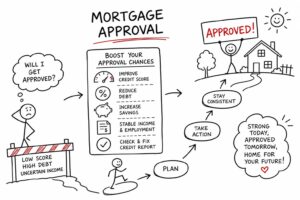
Buyers know credit matters. What most don’t appreciate is how sharply a 100-point score difference moves the needle on rate, and by extension, every single monthly payment for 30 years. Understanding your starting point before you apply isn’t just preparation; it’s one of the most financially significant steps you can take before entering the mortgage process.
The rate difference between a 620 and a 740 score
On a conventional 30-year fixed loan, Experian rate data shows a 620-score borrower at approximately 7.21% versus a 740-score borrower at approximately 6.58%. That difference works out to roughly $130 to $140 per month on a $300,000 loan, over $47,000 across a 30-year term. That’s real money, and it’s entirely within your control to address before you apply. If your score is currently 640, spending three to six months improving it to 680 or 700 can meaningfully change both your loan options and your long-term cost.
APR vs. interest rate: the number that shows total cost
When comparing loan offers, always use APR, not the interest rate. The interest rate is simply the borrowing cost. APR adds in lender fees, points, and other costs to give you a truer picture of what you’re paying for the loan overall. Two offers with the same interest rate can carry very different APRs depending on the fee structure. Comparing APR to APR is the only accurate way to evaluate competing loan offers side by side.
How down payment assistance programs fit into this picture
Down payment assistance doesn’t come from a separate government office. In most cases, it’s accessed through a participating lender during the mortgage application process. Programs like Fannie Mae HomeReady and National Homebuyers Fund grants can significantly reduce how much cash you need at closing.
State HFA programs expand those options further. Florida Housing’s FL Assist offers up to $10,000 as a deferred second mortgage, and the Hometown Heroes program provides up to $35,000 for eligible frontline workers. Assistance programs can also affect which loan type makes the most sense for your situation, since some are paired specifically with FHA or conventional first mortgages. Start a preapproval conversation to see which programs you may qualify for alongside your loan type.
Choosing the right first-time buyer loan types for your situation
Now that you’ve seen each loan type on its own terms, the question is how to choose. The honest answer isn’t “it depends” with a shrug. There’s a clear decision framework based on your credit score, military status, location flexibility, and savings, and running through it takes less time than most buyers expect.
A quick side-by-side snapshot of all four loan types
FHA works with a 580 score and 3.5% down but carries MIP for the life of the loan if you put less than 10% down. Conventional starts at 620, allows as little as 3% down through first-time buyer programs, and offers PMI that can be canceled once you hit 20% equity. VA offers zero down with no monthly mortgage insurance for eligible veterans and service members, with a one-time funding fee that can be rolled into the loan. USDA offers zero down in eligible rural and suburban areas with household income caps and lower annual insurance costs than FHA.
None of those is objectively best. Each fits a specific borrower profile. Think through your credit score, military status, location flexibility, and available savings, those four variables will point you to the right loan type more reliably than any headline rate ever will.
When to stop researching and start a preapproval conversation
If you’ve read this article and have a sense of which loan type fits your profile, the next step is not more research. It’s a preapproval conversation. Preapproval isn’t a commitment; it’s clarity. It shows you exactly where you stand on credit, income, and qualifying loan amount, and it gives you real numbers instead of estimates. Many borrowers find preapproval clarifying, the picture is often better than expected, or the gaps are smaller and more fixable than initially assumed.
How Isabelle Mortgages helps first-time buyers choose the right loan
At Isabelle Mortgages, this is exactly the work the Gen-First Mortgage Method™ was built for. Designed specifically for first-generation buyers navigating this process without a family blueprint, it starts by matching your loan type to your actual financial life, not just a checklist of minimums. The goal isn’t simply closing a loan. It’s choosing the loan that fits where you are now and builds toward where you want to be next: a first home, long-term equity, or a foundation of generational wealth. Learn more in our Home Buying Guidelines: First-Gen Path to Mortgage Freedom.
The bottom line on first-time buyer loan types
There’s no single best loan for every first-time buyer. There’s the right one for your credit score, your savings, your military status, and your geographic flexibility. FHA opens the door for buyers with lower scores and limited savings. Conventional rewards stronger credit with cancellable insurance and better long-term costs. VA delivers highly favorable terms for eligible veterans who choose to use the benefit they earned. USDA extends zero-down financing to buyers willing to look in eligible suburban and rural markets.
The most valuable thing you can do right now is talk to a mortgage professional who will look at your full financial picture, not just run your credit score and point you at a rate sheet. Every buyer’s situation has nuance, and the right recommendation on first-time buyer loan types comes from understanding your income, your goals, your timeline, and your starting point together.
Also explore our Blog, Isabelle Mortgages for ongoing tips and deeper articles on specific loan types and programs.
When you’re ready to have that conversation, Isabelle Mortgages is here. Reach out for a one-on-one consultation and find out exactly which loan type fits your path to homeownership.