
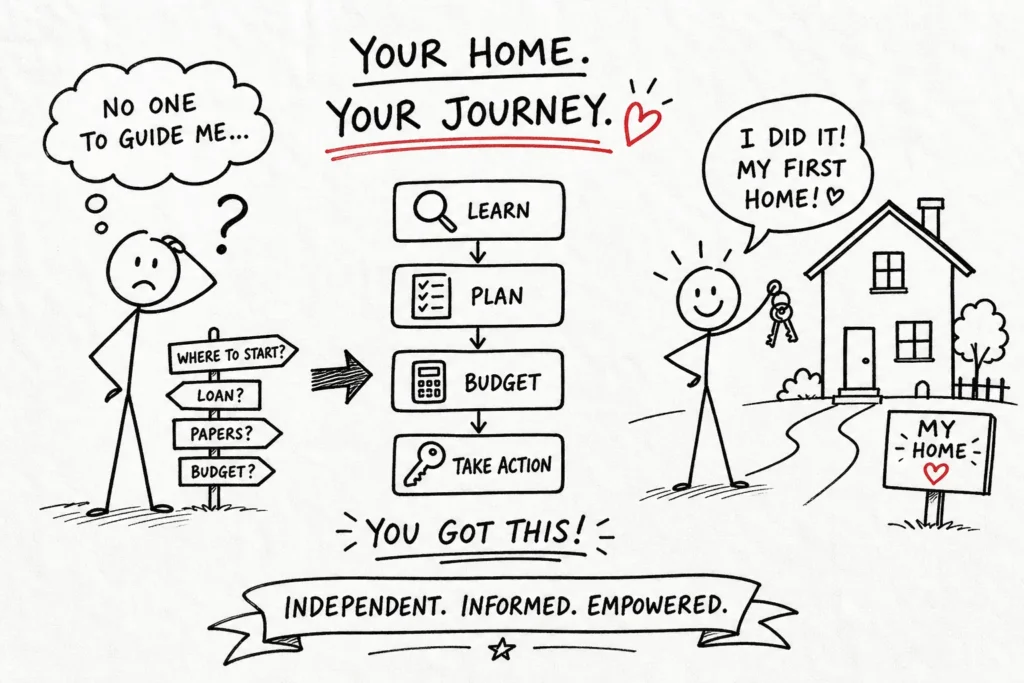
If you’ve ever asked yourself, how do I buy a home with no family guidance?, you’re not alone, and you’re not at a disadvantage that can’t be overcome. Most homebuying advice assumes you have someone to call: a parent who refinanced twice, an older sibling who still has their closing disclosure in a folder somewhere, an aunt who can tell you what earnest money actually is and why it matters. For many first-time buyers in the U.S., that phone call simply doesn’t exist. Nobody in your circle has been through underwriting, nobody has negotiated a seller concession, and nobody can explain what escrow means in plain terms over Sunday dinner.
That gap is real. But it is not a dealbreaker. Many federal, state, and local programs, including FHA, USDA, VA, and state housing finance agency loans, were built specifically for buyers navigating homeownership without generational knowledge at home. The right mortgage partner functions exactly like the family advisor most first-time buyers never had: someone who walks every step with you and explains every document in plain language, staying available from your first question to the day you get your keys.
This guide gives you a prioritized, realistic action plan from credit preparation to closing day, no assumptions about who you can call for backup. You’ll leave with the steps, the numbers, and the resources you need to buy your first home on your own terms.
The financial baseline every solo buyer needs to establish first
Before you ever talk to a lender, you need to know your numbers. Think of this as the kitchen-table conversation most first-time buyers never got to have. It takes an hour or two, and it replaces years of guesswork.
How your credit score controls your loan options
Your credit score determines which loan programs you can access and how much you’ll pay to use them. A score of 580 or above qualifies you for an FHA loan with just 3.5% down. Scores between 500 and 579 can still qualify for FHA, but the required down payment jumps to 10%. For conventional loans, most lenders want to see at least 620, and you’ll get noticeably better pricing at 700 and above.
Pull your free credit reports from all three bureaus at AnnualCreditReport.com and review them carefully. The two fastest levers for moving your score are paying down revolving credit card balances below 30% utilization and disputing any errors directly with the credit bureau. Both actions often produce measurable results in a matter of weeks to a few months, which matters when you’re on a timeline.
Debt-to-income ratio: the number lenders watch more than most buyers realize
Your debt-to-income ratio, or DTI, is the percentage of your gross monthly income that goes toward debt payments. The formula is straightforward: add up all your monthly debt obligations, car payment, student loans, credit card minimums, any other installments, and divide by your gross monthly income before taxes. Most loan programs target a DTI at or below 43 to 45%, though some go higher with what lenders call compensating factors like strong reserves or a higher credit score.
Here is a quick example: if you earn $5,500 per month gross and have $600 in existing monthly debt payments, your current DTI is about 11%. Add a projected $1,500 mortgage payment and it rises to 38%, which clears the threshold on most programs. Calculate this before you apply so there are no surprises when the underwriter runs your file.
Building a realistic savings target before you start searching
Solo buyers need to account for more than just the down payment. On a $350,000 home using an FHA loan at 3.5% down, your down payment is $12,250. Add closing costs at a conservative 3% ($10,500) and you are already looking at roughly $22,750 before inspection fees, earnest money, and the initial escrow cushion your lender will collect at closing. That number is not meant to discourage you; it is meant to give you a concrete savings target so your timeline is grounded in reality rather than guesswork.
How do I buy a home with no family guidance? Start with the right loan
While many federal and state programs enable buyers without family help, qualification still depends on your credit, income, and program eligibility, some applicants may need a co-signer if they can’t meet underwriting standards on their own. That said, the following loan types are specifically structured for buyers who are doing this independently, and each one has eligibility conditions worth understanding before your first lender conversation.
FHA loans: the most accessible entry point for most solo buyers
Available for primary residences only, FHA loans carry no income cap and require just 3.5% down with a 580 credit score. You will pay an upfront mortgage insurance premium (1.75% of the loan amount, typically rolled into the loan) plus an annual premium, so factor that into your monthly budget. For a useful summary of FHA credit thresholds and expectations, see the FHA loan credit score requirements.
One detail that matters specifically for buyers without family money: FHA allows gift funds from non-family sources, including employers, charitable organizations, labor unions, and government assistance programs, not just relatives. The gift must be documented, the donor cannot be a party to the transaction, and there can be no expectation of repayment. This opens real doors for buyers with supportive employers or community organization connections. Learn more about using non-family gift funds when buying a home with gift funds.
Loan options when you buy a home without family guidance: USDA and VA
USDA loans offer 0% down for eligible properties in rural and many suburban areas, with income limits tied to the area median income for your household size. Many buyers dismiss USDA because they assume “rural” means remote farmland, but the USDA eligibility map covers a broader range of areas than most people expect. Many lenders use a 640 credit score as a benchmark for streamlined USDA processing, though exact lender overlays vary.
VA loans are available to eligible veterans, active-duty service members, and some surviving spouses. They offer 0% down, no federal mortgage insurance, and no income cap. For eligible veterans and service members, VA loans provide substantial benefits that make them one of the most advantageous mortgage options for those who qualify, and one that far too many eligible buyers overlook entirely.
Low-down conventional loans and when they make sense
Fannie Mae and Freddie Mac both offer 3% down conventional programs for first-time buyers. The trade-off compared to FHA is a stronger credit requirement, typically 620 at minimum and more comfortably at 700 or above. However, private mortgage insurance on a conventional loan cancels automatically once you reach 20% equity, which makes the long-term cost profile attractive if you have the credit profile to support it.
Many state housing finance agency programs also use conventional loan structures as the first mortgage, then layer down payment assistance on top. This combination can get a well-qualified buyer into a home with very little cash out of pocket.
Covering your down payment and closing costs without family money
This is the point where many solo buyers feel most stuck. They’ve done the math, they see the $15,000 to $30,000 figure, and there’s no family member offering to help bridge the gap. The good news is that this gap has legitimate, well-established solutions, including down payment alternatives for first-time buyers that most people don’t know exist. For a broad overview of first-time homebuyer loans and programs, see this helpful summary.
State and local down payment assistance programs
Most states have a housing finance agency (HFA) that offers first-time buyer programs, though the structure and availability vary by state. Many pair a first mortgage with a deferred or forgivable second loan covering down payment and sometimes closing costs. A few examples worth knowing:
- Florida Housing FL Assist, up to $10,000 as a deferred second mortgage at 0% interest
- Florida Housing PLUS, 3% to 5% of the loan amount as a forgivable second on eligible conventional products
- California CalHFA MyHome, up to 3.5% assistance on FHA loans
- Ohio Grants for Grads, up to 5% for recent graduates
The starting point for every buyer is a simple search: “[your state] housing finance agency first-time buyer.” Your state’s HFA portal will list available loan products, income limits, and current programs.
Grants and forgivable loans that don’t come back to haunt you
Many buyers assume all assistance must be repaid, but that is not always the case. Deferred second mortgages are repaid when you sell or refinance. Forgivable loans are forgiven entirely after you meet a residency requirement, often five to ten years. Outright grants require no repayment at all. Understanding which category your assistance falls into changes how you think about the long-term cost of your purchase.
The HUD Good Neighbor Next Door program is one of the most powerful examples of targeted grant assistance: eligible teachers, firefighters, law enforcement officers, and EMTs can purchase HUD-designated homes in revitalization areas at 50% off the list price. If you work in one of these fields and haven’t looked into this program, it is worth thirty minutes of your time.
Gift fund rules: what’s allowed when it’s not family money
FHA allows gift funds from employers, unions, charitable organizations, and government programs, not just relatives. The rules are specific: the gift must be documented with a signed gift letter stating the amount, the donor’s information, the property address, and a clear statement that no repayment is expected. The lender will also need to document the money trail, typically a donor bank statement plus proof of deposit. The donor cannot be the seller, agent, builder, or anyone else with a financial interest in the transaction.
For solo buyers with supportive employers or ties to community organizations, this is a legitimate and underused path. The documentation requirement exists to protect you as much as the lender, and meeting it is straightforward when the gift is genuine.
Your realistic timeline from preapproval to closing day
The homebuying process feels like a black box until you’ve been through it at least once. Here is the roadmap, milestone by milestone, so you know exactly what to expect and when.
Getting preapproved: what to gather and what to expect
A lender will ask for two years of tax returns, recent pay stubs (or 1099s and business bank statements if you’re self-employed, Mortgage for Self-Employed: Your Ultimate Guide & Checklist), two months of bank statements, and a government-issued ID. This is a preapproval, not a prequalification. Prequalification is an informal estimate based on self-reported information. Preapproval means the lender has verified your documents and is committing to a specific loan amount, which makes your offer significantly stronger in a competitive market. Preapproval letters are typically valid for 60 to 90 days.
From offer accepted to closing: the 30 to 45 day stretch
Once your offer is accepted, the clock starts. Schedule your home inspection within the first five to seven days of the contract; inspections typically take two to three hours and costs vary by market and scope, though $300 to $500 is a common range. The lender orders the appraisal, which typically takes one to two weeks. Underwriting then reviews your full file, which can run two to three weeks. Throughout this period, respond to any lender document requests immediately, delays in underwriting are often caused by slow document turnaround from the buyer, not the lender.
Cash-to-close reality check before you sign anything
Three business days before closing, you will receive a Closing Disclosure showing your exact cash-to-close figure. Review it line by line against your original Loan Estimate and confirm that your down payment assistance funds are confirmed, no fees changed without explanation, and the total matches what you planned for. Many closings require a cashier’s check or wire transfer for funds, confirm the acceptable forms with your settlement agent in advance, as policies vary by title company and state. Arrive with your ID and a copy of the Closing Disclosure, and you will have everything you need.
Trusted resources that fill the family-guidance gap
Solo buyers need independent advice that isn’t tied to a lender’s interest in closing your loan. These resources exist specifically for that purpose and are a core part of any independent homebuying checklist. For topical articles and how-to guides, see our Blog, Isabelle Mortgages.
HUD-approved housing counseling agencies
HUD-approved counselors provide pre-purchase education, review your loan options, help with budgeting, and connect you with DPA programs, usually at little or no cost. Many loan programs require a HUD-approved homebuyer education course as part of eligibility, so completing this step can unlock assistance programs while building your knowledge at the same time. Call 800-569-4287 or use the CFPB housing counselor search tool at consumerfinance.gov to find a certified agency near you. You can also review HUD’s national intermediary partners on the HUD national agencies listing for additional contacts and resources.
State HFA portals and national nonprofit intermediaries
Your state’s housing finance agency maintains a homebuyer portal listing available loan products, income limits, and current DPA programs. For buyers who want additional support, HUD’s national intermediary network includes GreenPath, HomeFree-USA, BALANCE, and Nueva Esperanza, which specifically serves Latino communities. These organizations offer independent guidance for buyers who need a knowledgeable resource outside of the lending process itself.
Having the right mortgage partner makes this journey possible
Everything covered in this guide is navigable. The credit work, the loan selection, the assistance programs, the preapproval process, the closing, all of it has a clear path. Navigating it accurately, without missing a program you qualified for or misunderstanding a document that matters, goes faster and smoother with the right partner walking alongside you.
What the Gen-First Mortgage Method™ was built to solve
Isabelle Mortgages | Mortgage Rates on Home Loans was built for exactly the buyer this article is written for. The Gen-First Mortgage Method™ is a structured framework designed specifically for buyers charting homeownership without a generational roadmap. It accounts for non-traditional income, limited credit history, and the emotional weight of being the first in your family to do this. It is not a generic intake process; it is a method that treats your situation as the starting point, not a variation on someone else’s standard file.
One-on-one bilingual guidance from the first call to closing day
Isabelle Mortgages provides consistent one-on-one contact via text, email, or phone, along with bilingual support in English and Spanish and genuine personal investment in your outcome rather than just your transaction. For Hispanic and Latino buyers who are often underserved by lenders without Spanish-language capability, that bilingual support is not a courtesy feature, it is the difference between understanding your loan terms and signing something you hope is right. For any solo buyer navigating this without family to call for a second opinion, this level of access functions as the experienced advisor you never had in your corner.
How do I buy a home with no family guidance? Here’s your action plan
Not having family guidance in homebuying is a real disadvantage. It means you start without the institutional knowledge that other buyers absorbed around the dinner table over years. But it is a solvable disadvantage, not a permanent one. The loan programs and assistance programs exist. The trusted resources exist to help you use them. What it takes is a clear plan and the willingness to follow it.
Here is the path in short: get your credit score and DTI baseline right, match yourself to the loan type your profile actually qualifies for, layer available down payment assistance on top of that loan, follow the preapproval-to-closing timeline without skipping steps, and use HUD-approved counselors and state HFA resources rather than guessing. The emotional weight of doing this alone is real, and the best counter to that weight is a clear plan and people who are genuinely invested in your success.
If you’re buying your first home without a family roadmap and want one-on-one guidance built precisely for this journey, Isabelle Mortgages and the Gen-First Mortgage Method™ exist for exactly that reason. A first conversation costs nothing, reach out today to get started.
Frequently asked questions: how do I buy a home with no family guidance?
Can I get a mortgage without a co-signer?
Yes, many federal and state programs, including FHA, USDA, and VA loans, are designed to help first-time buyers qualify independently. Whether you need a co-signer depends on your individual credit, income, and the specific program’s underwriting standards.
What credit score do I need to buy a home on my own?
FHA loans accept scores as low as 580 with 3.5% down (or 500, 579 with 10% down). Conventional loans generally require 620 or above. The higher your score, the better your rate and program options.
Are there down payment assistance programs for solo buyers?
Yes. Most states offer down payment assistance through their housing finance agency, ranging from deferred second mortgages to forgivable loans and outright grants. These are among the most accessible down payment alternatives for first-time buyers with limited savings.
Do I need family gift money to buy a house?
No. FHA loans allow documented gift funds from employers, labor unions, charitable organizations, and government programs. Down payment assistance programs and savings-based loan structures provide additional paths that don’t require family contributions.
What is a HUD housing counselor and do I need one?
HUD-approved housing counselors provide free or low-cost pre-purchase education, loan reviews, and connections to local assistance programs. Many DPA programs require completing a HUD-approved homebuyer education course. They are one of the most valuable independent resources for solo buyers navigating the process without family guidance.
How long does buying a home take from start to finish?
From the time you begin credit and savings preparation to closing day, most first-time buyers should budget three to twelve months depending on their starting point. Once under contract, the closing process typically runs 30 to 45 days.
What resources can replace family homebuying advice?
HUD-approved counseling agencies, your state’s housing finance agency portal, and national nonprofit intermediaries like GreenPath, HomeFree-USA, and BALANCE provide independent guidance. A mortgage lender with dedicated first-time buyer support, such as the one-on-one guidance Isabelle Mortgages offers through the Gen-First Mortgage Method™, can serve as the functional equivalent of an experienced family advisor.