
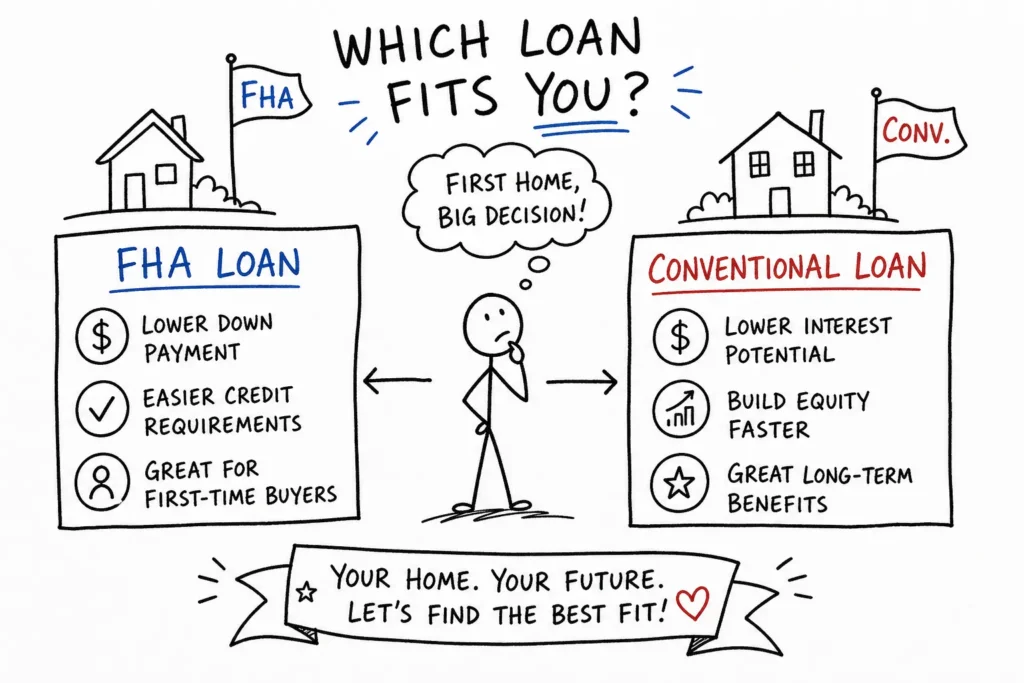
You’ve found the home. You’ve done the tours, crunched the rough numbers, and finally said yes to a place that feels right. Then someone on the other end of the phone asks whether you want an FHA or conventional loan, and the conversation hits a wall. For most first-time buyers, this is the moment where clarity matters most and information is hardest to find. If you’re trying to decide which loan is better for first-time buyers, FHA or conventional, the answer isn’t one-size-fits-all. The wrong choice can cost you thousands of extra dollars over the life of the loan. That gap isn’t random; it reflects how each loan type interacts with your credit score, your savings, and how long you plan to stay in the home. This article breaks both options down so you can walk into any lender conversation, including the kind of one-on-one guidance Isabelle Mortgages is built around, knowing exactly which direction fits your situation.
What Actually Separates FHA from Conventional Loans
The difference between these two loan types comes down to one structural fact: FHA loans are insured by the Federal Housing Administration, meaning the government steps in to cover the lender if you default. Conventional loans carry no government guarantee, so lenders tighten their qualifying standards to protect themselves. That single difference explains nearly every variation in cost, flexibility, and eligibility you’ll encounter when comparing FHA vs. conventional for first-time buyers.
Most conventional loans are also called conforming loans because they meet the guidelines set by Fannie Mae and Freddie Mac, the two government-sponsored enterprises that buy mortgages from lenders. Those guidelines govern loan limits and underwriting standards, both of which matter directly to first-time buyers shopping in competitive or higher-priced markets. Understanding this structure helps you see why lenders aren’t being arbitrary when they treat the two loan types so differently.
Down Payment and Credit Score Requirements Side by Side
FHA loans require a minimum down payment of 3.5% for borrowers with a credit score of 580 or above. If your score falls between 500 and 579, the minimum jumps to 10%. What makes FHA especially accessible is that your down payment funds can come from savings, gift money from family, or down payment assistance programs offered by your state. The general DTI ceiling for FHA is 43%, though lenders do have some flexibility with strong compensating factors like significant cash reserves.
Conventional loans set the floor at 3% down for eligible first-time buyers, which sounds competitive on paper. The catch is the credit score requirement: most conventional lenders require at least a 620 score to qualify, and conventional pricing improves with higher scores, the most favorable pricing is generally seen at scores well above 680, often at 740 or higher. DTI expectations typically run between 36% and 45%, though individual lenders enforce these ranges with varying degrees of flexibility. A buyer with a 610 credit score may find it difficult to qualify for conventional financing, since most conventional products require a 620 minimum, but that buyer can often still access FHA financing. That gap in accessibility helps explain why FHA is a common entry point for buyers with limited credit history or savings.
Which Loan Is Better for First-Time Buyers: FHA or Conventional on Mortgage Insurance?
This is where the comparison gets complicated, and where the decision often flips. FHA loans come with two layers of mortgage insurance. The first is the upfront mortgage insurance premium, known as UFMIP, which is 1.75% of the loan amount paid at closing or rolled into the loan balance. On a $350,000 purchase with 3.5% down, that adds roughly $5,775 to your loan balance on day one. The second layer is the annual MIP, which runs between 0.15% and 0.75% of the loan amount and is paid monthly as part of your mortgage payment.
The detail that surprises most buyers: for FHA borrowers who put less than 10% down, MIP lasts for the entire life of the loan. There is no automatic cancellation at 20% equity. You either pay it for 30 years, or you refinance your way out of it. This is fundamentally different from how conventional mortgage insurance works. For an official explanation of how the FHA mortgage insurance premium works, see this resource on FHA mortgage insurance premiums FHA mortgage insurance premium.
Conventional loans only require private mortgage insurance (PMI) when the down payment is below 20%. PMI rates vary based on your credit score and loan-to-value ratio, typically ranging from 0.1% to 2% annually. For a buyer with a 680 credit score putting 5% down on a $350,000 home, that works out to roughly $272 per month. The key advantage: once you reach 20% equity through payments, appreciation, or a formal appraisal, PMI can be removed. For buyers who plan to stay in a home for the long haul, that removability creates a meaningful financial advantage, one that grows more significant the longer you hold the loan. If you want a broader comparison of FHA vs. conventional loan trade-offs, this guide comparing the two loan types can help compare FHA vs. conventional loans.
Interest Rates, Loan Limits, and How Location Plays a Role
FHA loans tend to quote slightly lower interest rates than conventional loans for borrowers with similar credit profiles. For buyers in the 620 to 660 score range, the gap in 2026 sits at roughly 0.73 to 0.97 percentage points, with FHA coming in lower. That sounds like a clear win for FHA until you factor in the ongoing MIP. When you add the monthly insurance premium to the payment, the total cost on an FHA loan frequently exceeds what a conventional borrower pays at the higher rate. Comparing APR and total monthly cost tells the real story. Comparing interest rates alone does not.
Loan limits add another layer to the decision, especially in higher-priced states. In 2026, FHA loan limits start at $541,287 in low-cost areas and reach $1,249,125 in high-cost markets. Conventional conforming loans carry a standard limit of $832,750 in most areas, with the same high-cost ceiling of $1,249,125. For buyers in Florida, the picture is mixed: most Florida counties sit at the FHA floor, while coastal counties like Monroe and Miami-Dade have higher limits. In California and New York, many counties reach the FHA ceiling, making both loan types competitive for larger purchases. Before assuming either option is off the table, check your county’s specific limit, official summaries of FHA loan limits provide helpful, up-to-date context on FHA loan limits FHA loan limits. The county-level data can change the math in ways that general rules don’t capture.
Long-Term Cost Comparison: Running the Real Numbers
Take a buyer purchasing a $350,000 home with 3.5% down on an FHA loan. The 1.75% UFMIP adds $5,775 to the loan balance at closing, bringing the financed amount to roughly $343,025. Adding the monthly MIP on top of principal, interest, and taxes creates a total monthly payment that can run higher than what a conventional buyer with slightly less favorable terms is paying. The FHA buyer also carries that insurance cost indefinitely unless they refinance.
Now look at a buyer who puts 5% down on the same $350,000 home with a conventional loan. At a 680 credit score, they pay PMI of approximately $272 per month to start. But as they build equity, that PMI eventually drops off, timing depends on the amortization schedule, any additional payments, and home appreciation. Over a ten-year window, the conventional loan often costs less in total, even accounting for the higher interest rate and the upfront difference in down payment. In practice, this pattern tends to hold for buyers with scores above 640 and a steady income history, though individual results will vary based on loan terms and market conditions. If you’re self-employed and evaluating how your income documentation affects mortgage options, see this Mortgage for Self-Employed: Your Ultimate Guide & Checklist for checklist items lenders commonly request.
Many first-time buyers choose FHA to get into a home, then refinance into a conventional loan once their equity and credit have improved. A practical threshold where this move often makes sense: 20% equity in the home combined with a credit score of at least 620, with better pricing available as scores climb toward 740 and above. At that point, refinancing eliminates MIP permanently and typically lowers the monthly payment. This isn’t an immediate action item for most new buyers, but knowing about it from the start changes how you think about your loan as a long-term financial instrument rather than a fixed cost. If you want a practical walk-through of the FHA-to-conventional refinance process, this resource explains the typical mechanics of an FHA-to-conventional refinance FHA-to-conventional refinance.
FHA vs. Conventional for First-Time Buyers: A Decision Framework
Four questions can help you identify which loan type fits your current situation. Work through each one honestly, and the right direction usually becomes clear. These aren’t rigid rules, lender overlays and compensating factors can shift outcomes, but they give you a strong starting point.
- Is your credit score below 620? If so, FHA is often more attainable than typical conventional products. Most conventional lenders require a 620 minimum, though underwriting overlays can vary. If you’re below that threshold, FHA financing is usually the more accessible path forward.
- Do you have less than 5% saved for a down payment? FHA’s 3.5% minimum gives you more room to close without draining your reserves, and it allows gift funds from family or down payment assistance to cover part of that requirement.
- Are you planning to stay in the home for more than seven years? If so, conventional’s removable PMI becomes a meaningful long-term advantage. The longer you stay, the more MIP costs you on an FHA loan with less than 10% down. Keep in mind that the actual break-even point depends on your loan terms, home appreciation, and whether you make any extra payments, so run the numbers for your specific scenario.
- Is the home price above the FHA loan limit for your county? In that case, conventional may be the only option on the table without needing a jumbo loan.
These four questions won’t replace a full lender analysis, but they give you a starting point that most buyers don’t have when they walk into their first mortgage conversation. Knowing which direction you’re leaning before the meeting gives you better questions to ask and a clearer way to evaluate the numbers you’re shown.
The real picture only comes into focus when a lender runs actual quotes on both loan types using your specific income, credit profile, and target price. At Isabelle Mortgages, that side-by-side comparison is exactly what a first-time buyer session looks like. Rather than steering you toward one product, the process models both scenarios with real numbers so the choice becomes obvious rather than overwhelming. For a structured approach to planning your mortgage as a first-generation homebuyer, see this Step by Step Guide to Confident Mortgage Planning for First Generation Homebuyers, Isabelle Mortgages.
The Bottom Line on FHA vs. Conventional
So which loan is better for first-time buyers, FHA or conventional? Neither is universally the right answer. FHA opens the door for buyers who are still building credit or working with limited savings; it trades long-term mortgage insurance costs for a lower barrier to entry. Conventional rewards buyers with stronger credit and slightly more cash to put down, giving them more control over their insurance costs and more flexibility over time.
Use the four questions above as your starting point: credit score, down payment savings, how long you plan to stay, and whether the purchase price fits within FHA’s county limit. Those answers point toward a direction faster than any chart can. From there, the goal isn’t just to get a loan, it’s to choose the financing structure that supports the bigger objective: building a financial foundation that creates real, lasting wealth for your family. Buying a home is the beginning of that story. Getting the loan right is how you start it well. If you’re ready to see those real numbers side by side, that’s exactly where Isabelle Mortgages starts, review our Home Buying Guidelines: First-Gen Path to Mortgage Freedom to learn more about the process.