
If this is your first home purchase, there’s no playbook waiting for you. No parent sat you down to explain earnest money deposits, debt-to-income ratios, or what actually happens on closing day. You’re figuring this out on your own, and that’s more common than you think. The number of first-generation homebuyers entering the market in 2026 is growing steadily, which means more people than ever are navigating this process without a family member who’s been through it before.
This guide walks you through every critical milestone in the first home purchase process, from organizing your finances to getting the keys. Whether you’re six months away or six weeks out, the steps here are sequenced so you know what to do, in what order, and why it matters. At Isabelle Mortgages, we built our entire approach around buyers in exactly this position. The clarity you’ll find here reflects what we walk every client through, one step at a time.
Here’s what we’ll cover: budgeting, loan selection, offer strategy, inspection, assistance programs, and closing costs. Think of it as a homebuying checklist you can actually use, not just a list of things to google.
First Home Purchase: Getting Your Finances in Order
Most first-time buyers start browsing homes before they’ve looked at their finances. That’s the wrong order. Financial preparation determines which loan programs you qualify for, how much home you can realistically afford, and what cash you need ready on day one. Starting here saves you from falling in love with a home that’s out of reach.
How to calculate what you can actually afford
A reliable starting point is keeping your total housing payment at or below 28% of your gross monthly income. That includes principal, interest, taxes, insurance, and any HOA fees. But affordability isn’t just about the monthly payment. You also need to account for the total cash required upfront: a down payment of 3.5% to 20%, plus closing costs of 2% to 5%. On a $350,000 home, that’s roughly $12,250 to $70,000 in total upfront cash depending on your loan type and the local market. The monthly carrying cost, the purchase price, and the upfront cash requirement are three separate numbers. Plan for all three before you tour a single property.
Credit scores and DTI thresholds by loan type
Your credit score and debt-to-income ratio (DTI) are the two variables that determine which loan doors are open to you. Here’s the practical breakdown for 2026:
- Conventional: 620 is the standard lender baseline; most lenders still require 620 even after Fannie Mae and Freddie Mac loosened their strict floor in late 2025. Scores of 740 or higher unlock the best rates.
- FHA: 580 minimum with 3.5% down; some lenders accept 500 with 10% down.
- VA: The VA sets no minimum, but most lenders require 580 to 620 for eligible veterans.
- USDA: 640 is typical for rural and suburban properties with income limits.
On the DTI side, conventional loans cap at 43% to 50%, FHA runs similarly, and VA loans can stretch up to 60% with strong residual income. Your credit score and DTI shape every option available to you, so know both numbers before you apply anywhere.
The documents you’ll want to gather now
Pull these together before your first conversation with a lender: 30 days of pay stubs, the last two years of W-2s, two years of signed tax returns (including business returns if you’re self-employed), two months of bank statements, and a government-issued ID. Early document gathering compresses your pre-approval timeline significantly. It also prevents last-minute scrambles that can throw off your closing schedule.
Choosing the Right Mortgage for Your First Home Purchase
Loan selection is one of the most consequential decisions in the first home purchase process, yet most first-time buyers default to whatever their bank offers. The right loan type depends on your credit profile, income documentation, military status, and the property’s location. Getting this wrong can cost you thousands over the life of the loan.
FHA, conventional, VA, and USDA: which one fits your situation
Conventional loans require 3% down for first-time buyers, carry no upfront mortgage insurance premium, and offer the best long-term cost if your credit is solid. FHA loans require 3.5% down and are more flexible on credit, but they include an upfront MIP of 1.75% plus annual MIP for the life of the loan in most cases. On a $350,000 loan, that upfront MIP alone adds about $6,125 to your costs compared to a conventional loan with no such fee. VA loans require 0% down for eligible veterans, carry no private mortgage insurance, and include a funding fee of 0.5% to 3.3% depending on service history. USDA loans offer 0% down for qualifying rural and suburban areas, with a 1% guarantee fee and income limits that vary by county.
Loan type isn’t just about the down payment. It shapes your monthly costs for years, which is why working with a mortgage advisor who understands your full income picture, including non-traditional income like 1099s or business bank statements, can surface options a standard bank would never present.
What pre-approval actually means (and what it isn’t)
Pre-qualification is not pre-approval. It involves a soft credit pull and self-reported numbers that carry no real weight with sellers or agents. Pre-approval means a lender has pulled your credit hard, verified your documentation, and issued a real signal of creditworthiness. Sellers take pre-approved buyers seriously because it de-risks the transaction. With complete documentation, pre-approval typically takes one to three business days, and the resulting letter is generally valid for 60 to 90 days.
Making an offer and navigating the home inspection
Once you find the right property, the offer and inspection phases move quickly. Understanding what goes into each helps you act decisively without making costly mistakes.
What goes into a competitive offer
A real estate offer has four core components: the purchase price, an earnest money deposit, contingencies, and a proposed closing date. The earnest money deposit (typically 1% to 3% of the purchase price) is held in escrow as a good-faith signal. Contingencies are your legal exit ramps, covering inspection findings, financing, and the appraisal. Removing contingencies can make an offer more attractive to sellers, but it also removes your protection. As a first-time buyer, you should almost always keep the inspection and financing contingencies in place. The risk of waiving them outweighs the competitive advantage in most markets.
What a home inspection covers and why you can’t skip it
A standard home inspection costs $300 to $500 and covers the structure, roof, foundation, electrical system, plumbing, HVAC, water heater, windows, and doors. Inspectors don’t pass or fail homes; they document conditions so you can make an informed decision. The most common issues found in homes purchased by new buyers include roofing problems, aging HVAC systems, faulty electrical wiring, water drainage issues, and foundation concerns. After the report, you can request repairs, negotiate a price reduction, or walk away if the findings are serious enough. Schedule your inspector immediately after offer acceptance to avoid delays in your closing timeline.
Down payment programs most first-time buyers don’t know about
One of the most persistent myths in homebuying is that you need 20% down. You don’t. In many cases, you can get meaningful financial assistance that reduces your out-of-pocket costs substantially before you’ve saved a single additional dollar.
National first-home loan programs worth checking right now
According to Down Payment Resource, there are 2,624 active down payment assistance programs nationally in 2026, offering an average benefit of $18,000. Fannie Mae’s HomePath program offers 3% down on foreclosed properties with up to 3% in closing cost credits, though a HUD-approved education course is required. Bank of America’s Down Payment Grant provides up to 3% of the purchase price or $10,000 with no repayment required. America’s Home Grant offers up to $7,500 as a lender credit toward closing costs or a rate buydown. The Housing Choice Voucher Homeownership program assists lower-income buyers with monthly expenses. These are genuine grant programs, not loans, which means there’s nothing to repay if you meet the conditions.
State-level assistance: how to find what’s available where you live
Most assistance is state and local, and the differences are significant. Ohio’s OHFA Your Choice DPA offers 2.5% to 5% of the loan amount applied to down payment or closing costs. Texas’s Home Sweet Texas program provides grants plus a 30-year fixed rate for low and moderate-income buyers. Palm Beach County, Florida’s Homebuyer Match Pilot offers up to $50,000 in matching funds for income-eligible buyers who can contribute at least $10,000 themselves. Search the HUD program directory or the Down Payment Resource database to find programs specific to your county and income level. Your mortgage advisor can also flag programs you’d otherwise miss.
Closing Costs for Your First Home Purchase
Closing costs catch a lot of first-time buyers off guard because they’re not included in the mortgage amount and they show up late in the process. Understanding them early, in real dollar terms, removes one of the biggest surprises at the closing table.
Breaking down the 2% to 5% you’ll owe at closing
On a $350,000 home, closing costs land between $7,000 and $17,500. The main categories include lender origination and application fees (0.5% to 1%), title insurance (0.5% to 1%), an appraisal fee ($450 to $900), recording and transfer fees ($100 to $500), and optional discount points at 1% per point to buy down your rate. Loan type affects this total: FHA adds a 1.75% upfront MIP, VA adds a funding fee of 0.5% to 3.3%, and USDA adds a 1% guarantee fee. One negotiating tool many buyers overlook: sellers can cover up to 6% of the purchase price in buyer closing costs, so a well-structured seller concession can meaningfully reduce your out-of-pocket cash at closing.
Prepaid items and your real cash-to-close number
Closing costs are only part of what you’ll need to bring to the table. Prepaid items add another $2,500 to $4,500, including your first-year homeowners insurance premium ($2,200 to $4,500), prepaid daily mortgage interest from closing date to month-end ($50 to $100 per day), and escrow impound setup covering two to three months of property taxes plus two months of insurance. On a $400,000 home, total cash-to-close (closing costs plus prepaids, before your down payment) typically runs $12,000 to $15,000. Request a Loan Estimate from your lender as early as possible. It’s a standardized document that breaks down every fee so you can plan accurately before you’re committed.
The offer-to-closing timeline and what to expect on closing day
Knowing the timeline from accepted offer to keys in hand helps you plan your moving logistics, manage your expectations, and protect yourself from the most common delays. The process is predictable when you understand the phases.
A realistic timeline from accepted offer to closing
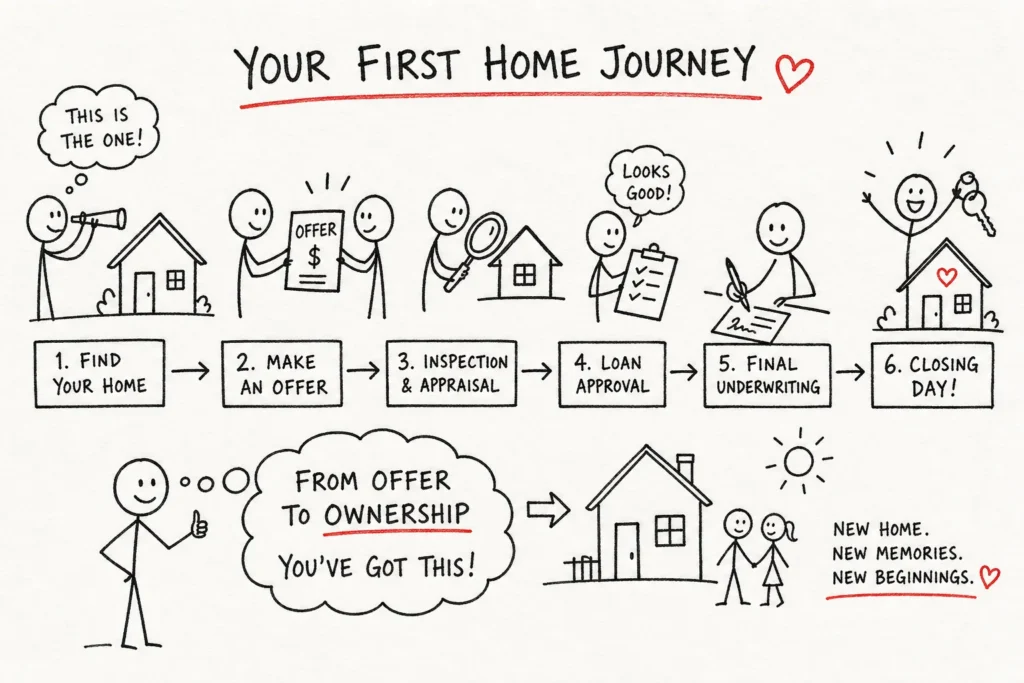
For a conventional loan, the average offer-to-close window is 30 to 45 days, with the national average sitting around 42 days in 2026. FHA and VA loans typically take 45 to 60 days due to stricter documentation requirements. Cash purchases can close in 7 to 21 days. The major phases break down as follows: loan application and Loan Estimate delivery takes about one week; inspection and appraisal runs one to three weeks; underwriting takes approximately two weeks; and the mandatory three-day Closing Disclosure review period falls in the final days before closing. From first pre-approval to actual closing, including the home search, the full journey typically takes two to six months.
Common delays and how to stay on schedule
The biggest timeline killers are low appraisals (which can add two to four weeks for renegotiation or appeals), missing documents in underwriting, slow HOA or condo documentation, title search complications, and post-inspection repair negotiations. Buyers who submit complete documentation upfront, schedule the inspection immediately after offer acceptance, and work with a mortgage team that communicates proactively tend to close on schedule rather than scrambling at the end.
What closing day actually looks like
On closing day, you’ll sit down in person or remotely via e-closing depending on your state, and sign the final loan documents, the deed, and the closing disclosure. You’ll wire or bring a cashier’s check for your remaining cash-to-close amount. Once everything is signed and the lender funds the loan, the title transfers and you receive the keys. The full appointment typically takes one to two hours. After months of preparation, it moves faster than most buyers expect.
You don’t have to figure this out alone
Your first home purchase doesn’t have to feel like a maze when you understand the sequence. Start with your budget, get pre-approved with the right loan type, make a strong offer with the right contingencies in place, protect yourself with a thorough inspection, explore assistance programs before assuming you need 20% down, and know your closing costs well before the final table. Each step builds on the last, and clarity at each stage makes the next one easier.
The guidance you get from your mortgage partner matters more than almost anything else in this process, especially when you’re navigating it without a roadmap. At Isabelle Mortgages, the Gen-First Mortgage Method™ was built specifically for buyers in this position: people who want straight answers, consistent communication, and a team that’s genuinely invested in getting them to closing day with confidence.
Start with a pre-approval conversation. That single step tells you exactly where you stand financially, which loan options fit your situation, and what your realistic price range looks like. Everything else follows from there. Reach out to Isabelle Mortgages today and get your path to ownership mapped out.