
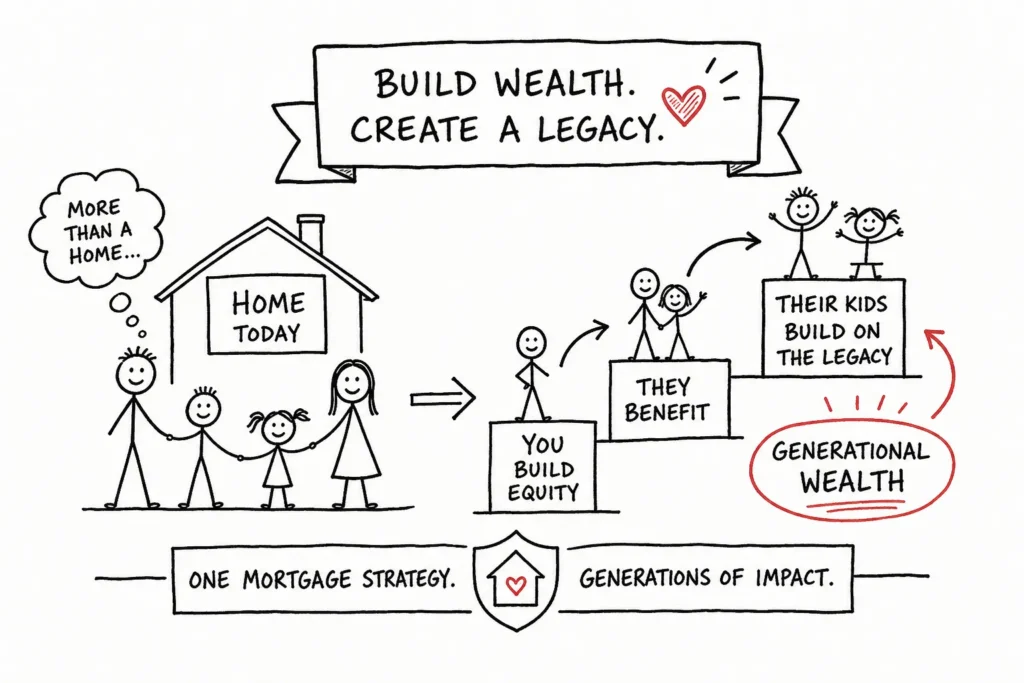
A generational mortgage strategy gives families a structured way to pool resources, plan title, and build long-term wealth across multiple generations, but most families never think about it when they walk into a lender’s office. More American families are pooling their finances to buy a single home together, and that trend hit a record high in 2024, with 17% of all U.S. home purchases being multigenerational. Rising home prices, aging parents who need support, and adult children who can’t afford to buy alone are all pushing families toward shared ownership. Yet most walk in focused on a single goal: getting approved. Few stop to think about what happens to that asset over the next 20 or 30 years.
That’s the gap between buying a house and building a legacy. The mortgage you choose, the names on the title, and the equity plan you put in place at closing are what determine whether this purchase stays a monthly expense or becomes a tool for generational wealth. At Isabelle Mortgages, every client conversation starts with that longer view. The Gen-First Mortgage Method™ is our framework for helping families make decisions that serve not just their immediate needs, but the generation that comes after them.
What a generational mortgage strategy actually means
A generational mortgage strategy isn’t a single loan product you can apply for. It’s a framework, a way of making every homeownership decision with long-term wealth transfer in mind. That means asking not just “can we qualify?” but “who holds title, how does equity accumulate, and what happens to this asset when the oldest borrower is gone?” Those questions separate a standard home purchase from a multigenerational home financing plan with real staying power.
It starts with the question most buyers never ask
Most buyers walk into a lender’s office focused on monthly payment and approval odds. A multigenerational approach starts somewhere different: who benefits from this home in 10, 20, and 30 years? Once you answer that, you can align the mortgage term, loan type, and title structure with that actual goal rather than just your current income situation. A 30-year fixed loan held by a 65-year-old parent produces a very different outcome than the same loan co-signed with a 35-year-old adult child who will eventually inherit the property.
How the Gen-First Mortgage Method™ shapes the decision
The Gen-First Mortgage Method™ approaches every loan through this generational lens, specifically for families who lack the inherited homeownership knowledge that many buyers take for granted. It maps the loan to the family’s actual wealth goal, not just the income on the application. That means evaluating co-borrower arrangements, ownership structure, equity timelines, and succession planning before a single document is submitted to a lender.
Generational mortgage strategy: loan options for multigenerational households
Understanding which loan product fits your family’s situation is the first practical step. The right answer depends on the ages of each borrower, the type of property you’re buying, and how income is distributed across generations. Each program below handles co-borrower mortgage strategies differently, so the details matter.
FHA and HomeReady loans for flexible co-borrower structures
FHA loans are one of the most flexible options for multigenerational home financing. They allow non-occupying co-borrowers, meaning a parent can contribute financially to the purchase without living in the home, and the down payment can be as low as 3.5% with gift funds covering the full amount. For families adding a separate living unit, the FHA 203(k) and Fannie Mae HomeStyle renovation loans allow purchase and renovation costs to be combined into one mortgage, making it easier to build an in-law suite or accessory dwelling unit from the start.
Fannie Mae’s HomeReady program goes further by allowing income from non-occupant borrowers and, under specific conditions, from boarders or household members who contribute to expenses. The minimum down payment is 3%, and the program is available to borrowers at or below 80% of the Area Median Income in most census tracts (or 100% AMI in designated high-minority or disaster areas). If your family includes a parent helping a child qualify, HomeReady is often one of the most efficient paths available, thanks to its flexible income-counting rules and reduced mortgage insurance costs compared to standard conventional financing.
HECM for Purchase: when a senior anchors the deal
For families where a parent aged 62 or older is the primary buyer, the HECM for Purchase (a reverse mortgage used to buy a new primary residence) removes the burden of monthly mortgage payments entirely. The senior contributes a large down payment, typically 45% to 65% of the purchase price depending on age. The loan balance then grows over time instead of being paid down monthly. This works well when a parent sells an existing home and uses the equity to fund the purchase of a property where extended family will also live.
The critical limitation for multigenerational planning is that every co-borrower on a HECM must be 62 or older. Adult children cannot be co-borrowers; they can live in the home as non-borrowing occupants, but title and loan access require careful structuring to protect everyone’s interests. The 2026 FHA loan limit reaches up to $1,249,125 for high-cost areas (limits vary by county, so check HUD’s county lookup for your specific market), and costs include an origination fee capped at $6,000 plus mortgage insurance premiums. All of those factors need to be weighed against the family’s long-term equity plan.
VA loans and income restrictions that affect multi-generation planning
For eligible veterans, VA loans offer zero down payment and competitive rates, which makes them attractive for multigenerational purchases. The key limitation is income: the VA does not permit boarder or roommate income to count toward qualification. If your generational mortgage plan involves a relative paying rent for a separate unit within the home, that income won’t help you qualify under a VA loan. For families counting on rental income from a household member to stretch their buying power, this restriction can meaningfully affect which property size or price range is achievable.
How lenders underwrite income from multiple generations
Families often assume that more income from more people means easier approval. The reality is more nuanced, and understanding the underwriting math before you apply saves time and prevents surprises. Co-borrower mortgage strategies work differently depending on which loan program is involved.
Non-occupant co-borrowers: the real math lenders run
A non-occupant co-borrower’s income counts toward qualification, but their debts count against the combined debt-to-income ratio. Adding a parent with a pension plus significant credit card balances may not improve your picture as much as expected. Lenders also look for a two-year income history for most sources, and the lower credit score among all borrowers on the loan typically sets the interest rate for everyone, even if the other borrowers have strong credit profiles. For more on how lenders evaluate income documentation, see Fannie Mae’s general income information.
Boarder income, rental units, and what actually qualifies
Boarder or roommate income is generally excluded from standard underwriting unless it has been documented as rental income with a two-year receipt history. When that documentation exists, lenders typically count 75% of the rental income to account for vacancy. HomeReady and Home Possible are the main exceptions, allowing household member income under specific documentation conditions. For self-employed family members whose tax returns understate true earnings, bank statement loans (Non-QM products) provide an alternative path using 12 to 24 months of deposits as qualifying income.
Ownership structures that protect every family member
The mortgage is only half the equation. How the title is held determines what happens when someone passes away, goes through a divorce, or decides they want out. Getting this wrong is one of the most common and most expensive mistakes multi-generation families make.
Applying a generational mortgage approach to title and equity: TIC vs. joint tenancy
Tenancy in common (TIC) allows unequal ownership shares and lets each owner pass their share through their estate rather than automatically to the other co-owners. That flexibility is valuable for parent-child or sibling co-ownership, but it comes with a risk: any owner can petition a court to force a sale through a partition action. TIC also complicates refinancing, since lenders require unanimous consent from all co-owners to replace the existing loan, and one weak credit profile can block the entire process.
Joint tenancy requires equal shares and includes automatic right of survivorship, meaning a co-owner’s share passes directly to the surviving owners at death, bypassing probate. This is efficient for couples or two-person ownership, but it’s rigid: transferring any share severs the joint tenancy and converts it to TIC. The step-up in basis at death applies only to the deceased owner’s share, which affects capital gains exposure for the surviving owners. Working with a tax advisor to model those outcomes before closing is worth the time.
When a trust or LLC makes sense for a family home
A revocable living trust holds the title and allows assets to pass to beneficiaries immediately at death without going through probate. The grantor is still treated as the owner for tax purposes, so mortgage interest deductions and capital gains treatment flow through personally. For families focused on smooth, low-conflict wealth transfer, a trust paired with a TIC structure is a commonly recommended approach among estate planning attorneys, though the right solution depends on your family’s specific circumstances and should be reviewed with qualified legal and tax counsel.
An LLC offers strong liability protection and flexible operating agreements that define cost-sharing, buyout terms, and exit strategies in advance. The drawback for primary residences is significant: most residential lenders won’t finance an LLC-held property (though some will under specific conditions), and the mortgage interest deduction may not be available to members personally. LLCs work well for investment or rental properties but add unnecessary complexity for a home the family lives in. Regardless of which structure your family chooses, a written co-ownership agreement is non-negotiable. It defines how expenses are split, how buyouts are calculated, and what happens when someone wants out. It’s far easier to settle those terms before emotions are running high.
What to gather and who to talk to before you apply
Strategy without preparation stalls at the application stage. Every co-borrower should have their documentation organized before the first lender conversation, because the quality of that conversation depends on it.
Documents every co-borrower needs before the first conversation
- Two years of tax returns and W-2s, or 12 to 24 months of bank statements for self-employed borrowers
- Recent pay stubs or written proof of pension, Social Security, or documented rental income
- Credit reports for all borrowers going on the loan (ask your lender whether they’ll use a soft or hard pull, as practices vary)
- Documentation of any gift funds or home sale proceeds being used toward the down payment
- If boarder income will be included: a signed rental agreement plus bank statements showing two years of consistent receipt
How to structure the conversation with your lender
A lender experienced in multigenerational purchases asks different questions than one running a standard approval. Who is on the loan versus who is on title? What is the long-term plan for the property? Is there a succession plan if a co-borrower passes? These aren’t abstract questions; they directly affect which loan product works, what the ownership structure should be, and what documents are needed at closing.
At Isabelle Mortgages, every client goes through the Gen-First Mortgage Method™ framework, which maps the right loan product, the right ownership structure, and the right equity-building path to each family’s specific situation. That process is especially valuable for first-generation buyers who are navigating this without the benefit of parents or grandparents who have done it before. Before closing, work with a real estate attorney alongside your lender to align the title structure with your family’s estate plan. The mortgage and the ownership structure need to work together from day one.
The purchase is the beginning, not the finish line
A home purchase is the largest financial decision most families make, and how it’s structured determines whether it stays a transaction or becomes a foundation for lasting wealth. The loan type, the co-borrower arrangement, the title structure, and the equity plan all work together. Getting any one of them wrong can create conflict, financial loss, or a probate process that costs far more than the planning would have.
Families who approach this with intention are the ones who turn a home into a legacy. If you’re ready to put a generational mortgage strategy to work for your family, reach out to Isabelle Mortgages for a personalized review through the Gen-First Mortgage Method™. Get a plan built around where your family is headed, not just where you are right now. For broader industry coverage on the rise of multigenerational home purchases, see the MarketWatch coverage.