
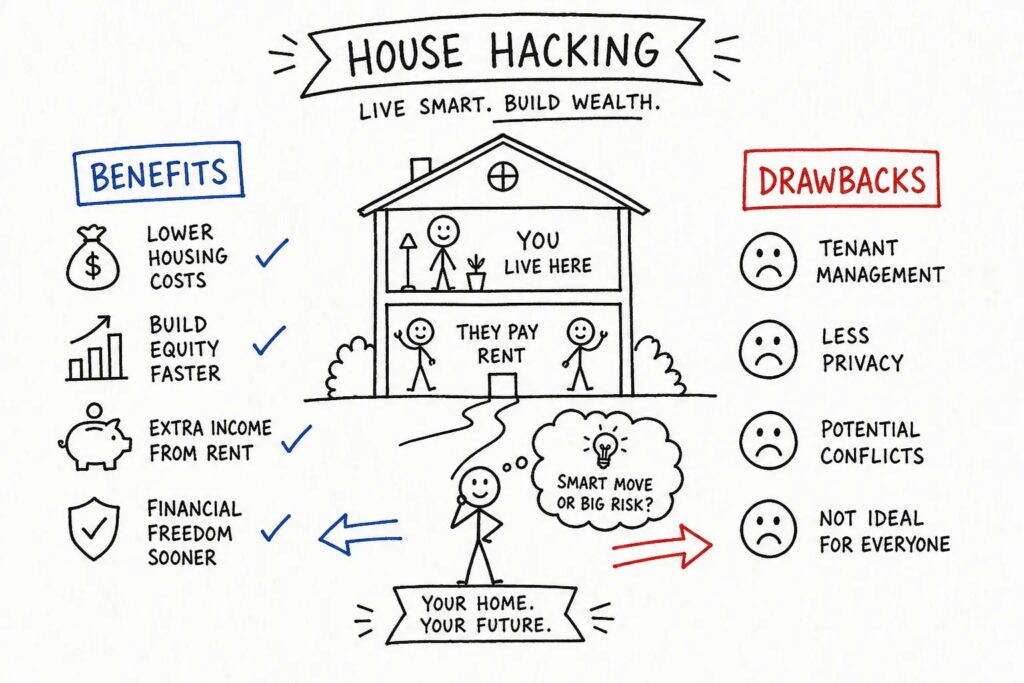
When weighing the house hacking pros and cons, it’s easy to fixate on the promise, “live for free”, and skip the parts that actually determine whether this strategy works for you. House hacking can be a genuine wealth-building move. It can also turn into a stressful, expensive experiment if you go in without a clear picture of both sides.
The concept itself is straightforward. You buy a multi-unit property, live in one unit, and collect rent from the others. Or you purchase a single-family home with an accessory dwelling unit or extra rooms and rent those out. Either way, tenant income offsets your housing cost, sometimes dramatically.
At Isabelle Mortgages, one of the most common questions we hear from first-time buyers is how they can use a home purchase to lower their monthly housing costs, house hacking is exactly that conversation. This article breaks down the financial upside, the financing rules that apply, what taxes actually look like, and the real lifestyle tradeoffs, so you can decide whether this strategy deserves a spot in your financial plan.
House Hacking Pros and Cons: The Financial Case
How rental income offsets your mortgage payment
The primary appeal is simple: someone else’s rent covers part or all of your mortgage, which lowers your actual out-of-pocket housing cost every month. For a duplex, the rented unit typically generates $900 to $1,800 per month depending on the market and unit quality. A triplex setup can bring in $1,800 to $5,400 combined across the non-owner units. Even a partial offset of $800 per month saves nearly $10,000 per year in living costs, and that number compounds quickly over time.
These are national planning ranges, not guarantees. Local rents in high-cost markets like parts of Florida, California, or New York can push well above these figures, while smaller metros may fall below them. Run the actual comps in your specific area before building a financial model around any number.
Building equity while someone else helps pay the note
Every mortgage payment you make grows your ownership stake in the property, even when tenants are funding a portion of that payment. Contrast that with renting, where you pay 100% of your housing cost and walk away with zero ownership benefit at the end of the lease. For first-generation buyers focused on building generational wealth, this distinction is significant. You’re not just reducing your housing expense. You’re converting a living cost into an asset that grows over time.
What cash flow and ROI realistically look like
Here’s the part that gets glossed over in most house hacking content. Run a simple duplex cash flow estimate: start with gross rent, apply a 5% to 8% vacancy rate (or up to 10% in higher-turnover or seasonal markets), then subtract 25% to 30% of gross rent for repairs, reserves, and operating surprises. Then subtract your full mortgage, taxes, and insurance payment. The result is often a small negative number or close to breakeven. That’s not a bad outcome. Your net housing cost is still dramatically lower than what you’d pay as a renter or a standard homeowner. The real win is reduced net housing cost, not immediate cash flow profit.
How to Finance a House Hack: FHA, VA, and Conventional Loan Rules
FHA loans: the most accessible path for first-time buyers
FHA financing allows 3.5% down with a 580+ credit score on owner-occupied properties with one to four units. If your credit score falls between 500 and 579, the down payment requirement rises to 10%. You must move in within 60 days of closing and maintain the property as your primary residence. For three- and four-unit properties specifically, FHA applies a self-sufficiency test: 75% of the total appraised market rent across all units must equal or exceed the full monthly housing payment, including principal, interest, taxes, insurance, and mortgage insurance. That test makes lender experience on multi-unit FHA loans genuinely important. The underwriting is more involved than a standard single-family purchase, and not every loan officer works through it regularly.
VA and conventional options worth knowing
VA financing allows 0% down for eligible veterans and active-duty service members on owner-occupied one- to four-unit properties, with no monthly mortgage insurance. If you qualify, it’s the lowest-cost entry point available. Conventional loans typically require 5% down on owner-occupied two- to four-unit properties with a 620+ credit score. Programs like HomeReady and Home Possible can help buyers who fall within income limits, though both add education requirements. Across all loan types, lenders can generally count 75% of projected rental income from the non-owner units toward your qualifying income, which can meaningfully improve your debt-to-income ratio and your approval odds.
Why working with the right lender matters on a multi-unit purchase
Multi-unit financing has more moving parts than a standard single-family loan. Occupancy rules, rental income counting, self-sufficiency tests, and eligible property types all vary by program. The team at Isabelle Mortgages regularly guides buyers through exactly these scenarios, helping them choose between FHA and conventional based on credit profile, available down payment, and long-term goals, not just the lowest rate on paper. Understanding which loan structure fits your specific situation is what turns a promising house hacking idea into a deal that actually closes on the right terms.
House Hacking Pros and Cons: Drawbacks to Take Seriously Before You Commit
Living next door to your tenant is harder than it sounds
Privacy ranks among the most consistent complaints from experienced house hackers. Noise travels. Common areas get complicated. The unexpected knock at your door at an inconvenient hour is real, not hypothetical. You’re simultaneously a neighbor and a landlord to the same person, and that dual role creates friction a purely financial analysis doesn’t capture.
Tenant conflicts over cleanliness, guests, shared utilities, and quiet hours are frequent when expectations aren’t defined in writing before move-in. The mitigation is straightforward: a proper lease that specifies private versus shared spaces, guest policies, quiet hours, and a written dispute process. Set it before anyone moves in, not after the first conflict surfaces.
Budget leaks that can quietly kill your cash flow
Repairs and maintenance typically run 8% to 10% of gross rent on a standard property. Add 5% to 10% for vacancy reserve and operating surprises, and your combined buffer lands at 25% to 30% of gross rent. Older properties and high-turnover areas push that number to 30% or higher. Many first-time house hackers underbudget for repairs in year one, then absorb a water heater replacement or a roof issue that wipes out months of rental income in a single hit. Budget conservatively before you buy, not after you’re already holding the property.
Liability and insurance gaps most new landlords miss
A standard homeowner’s policy generally does not cover tenant-related liability or property damage caused by a renter. A landlord policy or dwelling fire policy, combined with requiring your tenant to carry renters insurance, closes most of those gaps. For a duplex, expect to budget roughly $2,500 to $4,000 per year for landlord coverage depending on your state and property value. Document the property’s condition at move-in and move-out with photos, and make sure your lease assigns responsibility for damage clearly. Those two steps alone prevent the majority of costly disputes.
Taxes, Schedule E, and What You Can Actually Deduct
How rental income and shared expenses are reported
Rental income from your house hack goes on Schedule E, Part I of your federal return (see IRS Publication 527 for detailed guidance). This includes cash rent and any taxable in-kind payments. Shared expenses like mortgage interest, property taxes, insurance, and utilities must be split between personal use and rental use. Square footage is the most common and defensible allocation method. Expenses that apply exclusively to the rental unit are fully deductible to the rental activity on Schedule E, while the personal-use share of shared costs may qualify for deduction on Schedule A if you itemize.
Depreciation benefits and the recapture pitfall at sale
You can depreciate the building portion of the rental-use area over 27.5 years, per IRS guidelines for residential rental property. Land is excluded from depreciation, and capital improvements are depreciated rather than expensed immediately. This annual depreciation reduces your taxable rental income, one of the most meaningful tax advantages of owning rental property. The pitfall comes at sale: depreciation claimed during ownership reduces your cost basis, and the IRS recaptures that amount and taxes it, typically at a maximum 25% rate under unrecaptured Section 1250 gain rules. That doesn’t eliminate the benefit of taking depreciation, but it does mean you need to plan for recapture with a tax professional before you sell, not the week you sign a listing agreement.
How to Decide If House Hacking Is the Right Move for You
Running a quick back-of-napkin cash flow estimate
Start with the expected gross rent for your target market. Apply a 5% to 8% vacancy rate, up to 10% in higher-turnover markets. Subtract 25% to 30% for operating expenses and reserves. Then subtract your projected mortgage, taxes, and insurance. If the result is a small negative number, house hacking still works because your net housing cost is far below what you’d pay as a renter or standard homeowner.
If the result is deeply negative before reserves even enter the picture, the property is likely overpriced for this strategy or the rental market in that area doesn’t support it. The math doesn’t lie. Don’t rationalize around it.
The lifestyle questions that determine whether you’ll stick with it
Ask yourself honestly: are you comfortable being a landlord to someone who lives feet away from you? Can you handle a late-evening call about a broken faucet without resenting it? If you value your privacy and tend toward a quieter lifestyle, the live-in landlord model can feel invasive regardless of the financial upside.
House hacking works best for people who are organized, patient, and genuinely comfortable with the landlord role, not just the cash flow spreadsheet. The buyers who succeed with this strategy long-term aren’t just chasing a lower mortgage payment. They treat the rental side of the property like a small business from day one.
Making Your Decision and Taking the Next Step
Understanding the house hacking pros and cons, the advantages and the real drawbacks, is the only honest way to evaluate this strategy. It has genuine financial power, particularly for buyers focused on building equity and reducing housing costs early in their wealth-building journey. But it comes with real management demands, lifestyle adjustments, and financial risks that deserve an honest assessment before you commit.
You now have three filters to run your decision through: the cash flow test, the financing path, and the lifestyle readiness question. If all three point in a reasonable direction, you’re in a position to take the next step with real clarity rather than just enthusiasm.
If the numbers are looking promising and you want to understand which loan program fits your situation on a two- to four-unit property, the next step is a conversation with a mortgage professional who knows multi-unit financing inside and out. The team at Isabelle Mortgages regularly helps buyers in exactly this position, whether they’re leaning toward FHA for a lower down payment or conventional for long-term flexibility. The right loan structure is the foundation everything else in this strategy builds on. Reach out to get a clear picture of what you qualify for and what the numbers actually look like in your market.