If you want to know how to improve your chances of getting approved for a mortgage, start by understanding what lenders actually evaluate, and what you can do to move those numbers before you ever submit an application. Most buyers walk into the mortgage process with the same quiet fear: what if I get denied? The problem is not just not knowing the answer. It is not knowing what to fix first, how long it will take, or whether any of it will even matter. That uncertainty leads to one of two outcomes: people apply too early and get declined, or they wait too long and miss their window.
Getting denied is not just a disappointment. It can set your timeline back by months, and applying with multiple lenders without a strategy can create multiple hard inquiries on your credit report. The buyers who get approved quickly are not necessarily the ones with the most money or the perfect financial picture. They are the ones who prepared before they ever talked to a lender.
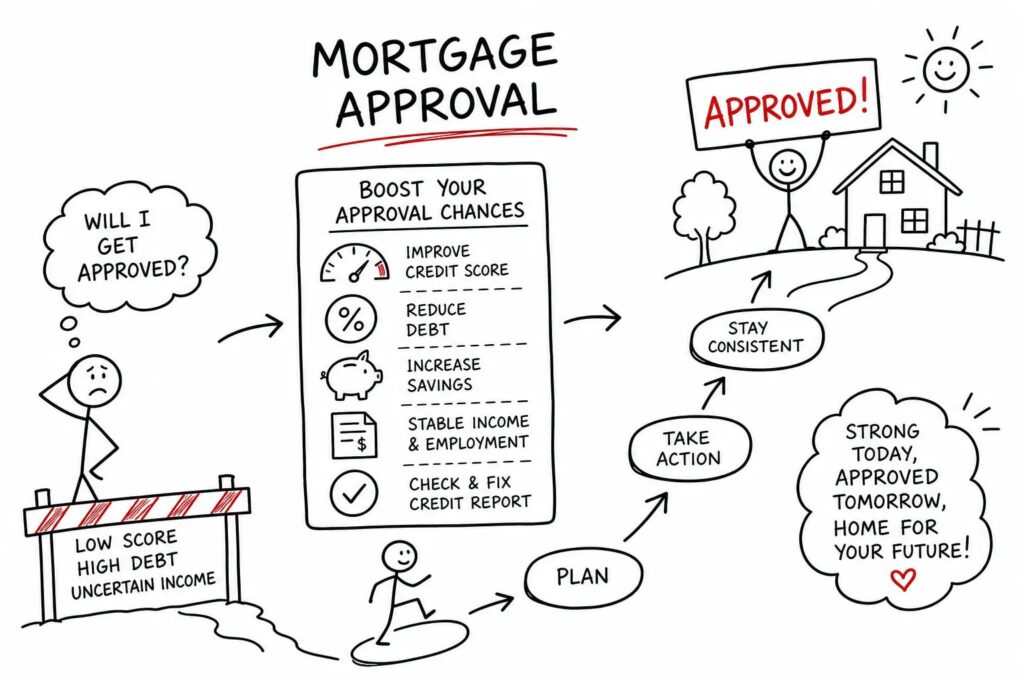
This guide walks through the five most impactful things you can do right now to boost your mortgage eligibility. Each step includes specific targets so you are not guessing. For borrowers with non-traditional income or more complex financial situations, having a specialized advisor in your corner, like the team at Isabelle Mortgages, can change the outcome entirely.
How to Improve Your Chances of Getting Approved for a Mortgage: Fix Your Credit Score First
Your credit score is the first number a lender looks at, and it determines not just whether you get approved, but what rate you pay for the life of the loan. Knowing the actual thresholds by loan type lets you set a real target instead of aiming vaguely at “better.”
Target scores by loan type
For conventional loans, most lenders require a minimum of 620, though Fannie Mae and Freddie Mac removed their strict floor in late 2025. That change matters less than it sounds because individual lenders impose their own internal rules, called overlays, that keep 620 as the practical minimum. FHA loans allow 580 with a 3.5% down payment, or as low as 500 if you can put 10% down. VA and USDA loans have no government-set floor, but lenders typically require 620 for VA and 640 for USDA. Hitting 740 or above unlocks the best rates and the lowest PMI premiums on conventional loans. That number is worth chasing even if you already qualify.
Quick wins to lower your utilization
The fastest way to raise your score is to pay down revolving balances before your statement closes, not before the due date. Dropping your utilization from 50% to 30% can add approximately 20 to 35 points within one billing cycle once the new balance is reported. Disputing errors on your credit report is equally impactful: removing a single collection account can add anywhere from 25 to 75 points. Avoid opening new accounts or closing existing ones in the months before you apply. Closing a credit card does not improve your credit. It reduces your available credit limit and raises your utilization ratio, which hurts your score.
If you are starting with balances to pay down and errors to dispute, a combined improvement of 40 to 70 points is achievable within 30 to 90 days. Moving from the 500s to the 600s is a larger lift that typically requires 6 to 12 months of consistent effort.
How to Improve Your Chances of Getting Approved for a Mortgage: Lower Your Debt-to-Income Ratio
Many buyers focus entirely on credit and treat their monthly debt obligations as fixed. That is a mistake. Your debt-to-income ratio, or DTI, is the second major lever lenders use to evaluate your application, and it is often the reason a borrower with a solid credit score still gets denied.
DTI is calculated by dividing your total monthly debt payments by your gross monthly income. Lenders look at two versions: front-end DTI, which covers housing costs only, and back-end DTI, which includes all monthly obligations. For conventional loans, the back-end ideal is 36%, with a standard ceiling of 43% and a maximum of 50% through automated underwriting systems like Fannie Mae’s Desktop Underwriter. FHA loans allow up to 57% with strong compensating factors. VA loans do not use a hard DTI cap at all. Instead, they evaluate residual income, the actual dollar amount remaining after all debts and taxes are paid. The VA approach asks a fundamentally different question: not what percentage of your income goes to debt, but how much money you have left to live on.
To reduce your DTI before applying, target small installment loans first. Eliminating a $200 per month car payment completely removes that obligation from the DTI calculation, which has a bigger impact than making an extra credit card payment. If you carry student loans on an income-driven repayment plan, lenders use the actual payment amount, so it is worth understanding how your specific plan shows up on your credit report before you apply. Avoid taking on any new monthly obligation before you close, including new car financing, furniture payment plans, or new credit accounts.
If your DTI is higher than ideal, compensating factors can work in your favor. Large cash reserves, a credit score above 680, and a significant down payment can push lender approval to 50% DTI on conventional loans and up to 57% on FHA. These are not automatic workarounds, but they give your underwriter a reason to approve the file.
Save for Your Down Payment with a Specific Target in Mind
The 20% down payment myth stops more first-generation buyers than almost any other misconception. You do not need 20% to buy a home. What you need is a clear understanding of how different down payment amounts affect your loan and your monthly cost.
Loan-to-value ratio, or LTV, is calculated by dividing your loan amount by the purchase price. A 20% down payment produces an 80% LTV, which eliminates the requirement for private mortgage insurance on conventional loans. Below 20%, PMI is added to your monthly payment, and the lower your down payment, the higher the premium. PMI is not permanent. It automatically cancels at 78% LTV, and you can request removal once you reach 80% equity through payments or appreciation. Alternatives like piggyback loans and lender-paid PMI exist for buyers who want to avoid it without the 20% threshold.
Minimum down payments by loan type break down this way:
- Conventional (first-time buyers): 3% minimum
- FHA: 3.5% with a credit score of 580 or higher; 10% for scores between 500 and 579
- VA loans: 0% for eligible veterans and active military
- USDA loans: 0% for qualifying rural and suburban properties
Down payment assistance programs exist at the state and local level, and availability varies significantly by location. California’s Dream For All program offers shared-appreciation loans up to 20% of the purchase price for first-generation buyers. Michigan, New Jersey, Minnesota, and Texas each have their own programs with specific eligibility windows and funding limits. The advisors at Isabelle Mortgages can identify which programs apply to your specific location and buyer profile, because the right program for a buyer in Florida looks different from one in California.
Have Your Documentation Ready Before the Lender Asks
Delays in mortgage underwriting rarely come from financial problems. They come from missing paperwork. Having your documents organized before your first lender conversation puts you ahead of most buyers and signals to the underwriter that you are a prepared borrower. Think of it as your personal mortgage preapproval checklist, one that can prevent weeks of back-and-forth once underwriting begins.
Every W-2 employee needs the following core documents:
- W-2 forms from the last two consecutive years
- Pay stubs from the most recent 30 days showing year-to-date earnings
- Two years of federal tax returns (Form 1040 with all schedules)
- IRS Form 4506-C, which authorizes the lender to pull your tax transcripts directly from the IRS
- Bank statements from the last 60 days for any account used for the down payment or reserves
- Two to three months of statements for investment and retirement accounts
Self-employed borrowers and 1099 earners face a different documentation picture. Instead of W-2s, you will need two years of personal and business tax returns, a year-to-date profit and loss statement, a business balance sheet, and 12 to 24 months of business bank statements. The critical issue for self-employed borrowers is that lenders qualify you based on net income after deductions, not gross revenue. Write-offs that reduce your tax liability also reduce your qualifying income. Working with a lender who understands how to read self-employed income documentation is not optional. It is the difference between an approval and a denial.
If any portion of your down payment is a gift from a family member, you will need a signed gift letter documenting that the funds are a gift and not a loan. Rental income requires current signed leases and proof of deposits. Large cash deposits that appear in your bank statements without a clear paper trail will need to be explained in writing, so keep records of any significant transfers in the months before you apply.
Choose the Right Lender for Your Financial Situation
Not all lenders evaluate the same application the same way. Every lender imposes overlays, internal rules that go beyond the minimum government guidelines. One lender may decline a 610 credit score on a conventional loan while another approves it. This variation is especially pronounced for self-employed borrowers, 1099 earners, and buyers with non-traditional income documentation. Understanding these differences is one of the most overlooked mortgage underwriting tips borrowers can act on.
Shopping multiple lenders is smart. The key is doing it within a 14 to 45 day window, because credit bureaus group mortgage inquiries made during that period and treat them as a single inquiry for scoring purposes. This protects your score while giving you real comparison data on rates, APR, and lender fees, the three numbers that matter most when evaluating competing offers.
For first-generation buyers, entrepreneurs, and real estate investors, the right lender is not just the one with the lowest rate on a rate sheet. It is the one who knows how to present your file. Isabelle Mortgages was built specifically for buyers who face hurdles that standard bank loan officers are not equipped to solve. The Gen-First Mortgage Method™ is a structured approach designed for buyers who lack generational homeownership experience, helping them build and present the strongest possible application from the start. Guidance runs from application through closing, with bilingual support in English and Spanish and clear communication at every step.
Once you have your lender, get preapproved before you start shopping for homes. Preapproval is a real underwriter review of your income, credit, and assets, not a soft estimate. Sellers in competitive markets often require preapproval before accepting an offer, and it tells you your actual budget before you fall in love with a home you cannot finance. Between preapproval and closing, keep your financial profile completely stable: no new debt, no large unexplained deposits, and no job changes.
Where to Start Based on Your Timeline
Knowing how to improve your chances of getting approved for a mortgage comes down to five things you can control: your credit score, your debt-to-income ratio, your down payment, your documentation, and your lender. None of these require a perfect financial situation. They require a clear plan and enough lead time to execute it.
If you are more than 90 days from applying, start with credit and DTI. Those two factors have the most impact on your approval outcome and your rate, and they take the most time to move. If you are 30 to 60 days out, shift focus to gathering your documentation and consolidating your down payment funds so they are properly sourced and seasoned in your account.
If your financial situation does not fit the standard W-2 borrower profile, do not try to navigate it alone. The team at Isabelle Mortgages works with first-generation buyers, entrepreneurs, and investors every day to find the path to approval that fits their actual life. Get your free preapproval consultation today and find out exactly where you stand.