Most buyers assume they need near-perfect credit to get approved for a home loan, and that assumption stops a lot of people from even picking up the phone. The reality is that a 580, a 640, and a 720 all carry real, workable mortgage options in 2026. They just lead to different loan types and different costs. Understanding the actual credit score to buy a house at each threshold is what separates buyers who move forward from buyers who wait unnecessarily.
At Isabelle Mortgages, we often see the same pattern in intake conversations: buyers who could have qualified months earlier held back because they didn’t know where the real minimums sat. They thought they were disqualified. They weren’t. This article lays out the exact credit score thresholds for each major loan type, shows what your score band actually costs you over 30 years, explains what lenders weigh beyond the number, and gives you a concrete plan to raise your score when needed.
Credit score to buy a house: minimum thresholds by loan type in 2026
Conventional loans: the 620 baseline and why 760 matters more
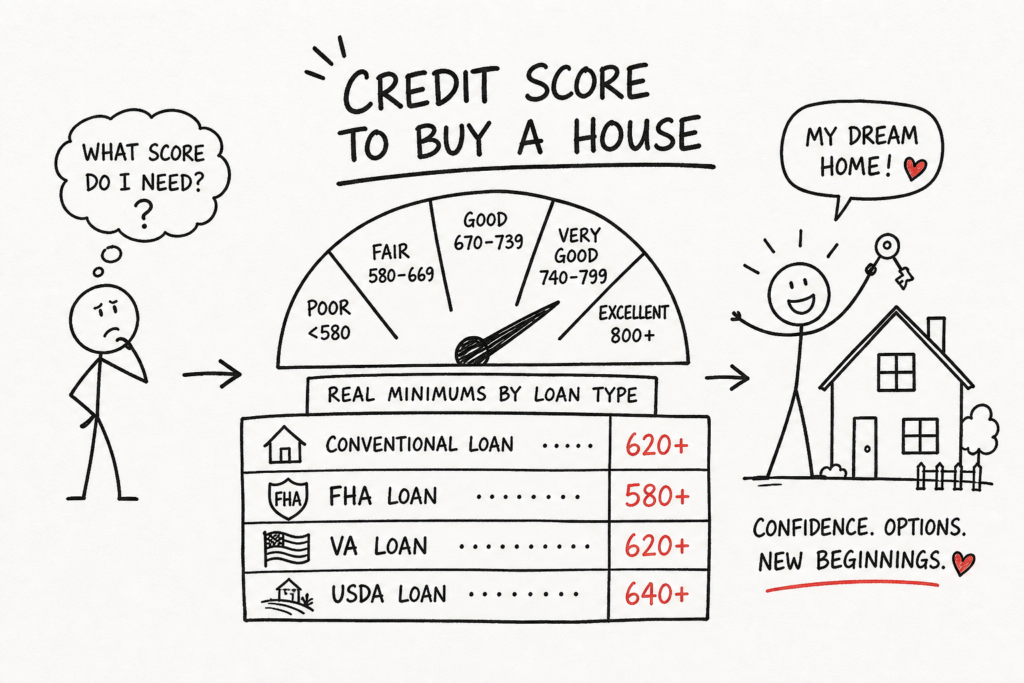
Conventional loans backed by Fannie Mae and Freddie Mac carry a practical floor of 620 for most lenders in 2026. Fannie Mae made a significant change in November 2025 when its Desktop Underwriter (DU) system stopped applying a strict hard-coded minimum credit score for new loan files, shifting instead to a holistic risk assessment. In practice, however, lenders still expect to see 620 or better before they’ll work with a file.
The more important number for conventional buyers is 760. Borrowers above that threshold typically access the best available interest rates and the lowest PMI premium tiers, while those above 740 already see meaningful pricing improvements over the 620 floor. A buyer qualifying at 620 and a buyer qualifying at 760 are both getting conventional loans, but the financial gap between those two loans is substantial over time. More on that in the next section.
FHA loans: the two-tier system at 580 and 500
FHA is the most accessible government-backed option for buyers with credit challenges. Borrowers with a 580 or higher qualify for FHA’s standard 3.5% down payment. Borrowers with scores between 500 and 579 can still access FHA financing, but they must bring a 10% down payment to the table.
Here’s where lender overlays come in. A lender overlay is an internal rule a lender adds on top of official program guidelines. FHA may technically allow a 580 score, but many lenders set their own minimums at 600 or 620 because they want a cushion above the federal floor. This is why shopping multiple lenders matters so much at lower credit levels. One lender’s “no” is another lender’s approval when your score sits in the 580, 620 range.
VA loans and DSCR loans: different rules, different logic
VA loans set no official minimum credit score at the Department of Veterans Affairs level. In practice, lenders typically look for 580 to 620, with some specialty lenders willing to go lower when the full financial picture is strong. USDA loans follow a similar flexibility model, with 640 preferred for automated approval and lower scores possible through manual review.
DSCR loans operate on a different framework entirely. These are investment property loans where qualification is driven primarily by the rental income potential of the property, not the borrower’s personal income or W-2 employment. Most DSCR programs set a credit score floor around 620 to 640; for a primer on typical program minimums, review reputable industry summaries on minimum requirements like those compiled by lending resources. Minimum mortgage requirements vary by program and lender, so working with a specialist can clarify your path.
How your credit score to buy a house affects your actual mortgage cost
The rate spread between a 620 and a 760 FICO score
This is where qualifying stops being abstract and becomes a dollar figure you’ll feel every month for three decades. According to myFICO data, on a $400,000 loan, the difference between a 620, 639 FICO score and a 760+ FICO score translates to roughly $165 more per month in mortgage payments. Over 30 years, that gap adds up to over $59,000 in additional interest paid.
Lenders price for risk. A lower score signals a higher statistical probability of default, and that risk gets embedded into your interest rate from day one and stays there for the life of the loan. On that same $400,000 example, a 760+ borrower is looking at a monthly payment around $2,746, while a 620, 639 borrower pays approximately $2,911 for the exact same home. That $165 per month is real money that could be building equity instead of compensating a lender for perceived risk.
PMI costs and down payment requirements by score tier
Credit score doesn’t just affect your interest rate on a conventional loan. It also drives your private mortgage insurance (PMI) premiums, which stack on top of the rate difference to create a much larger cumulative cost gap. For a borrower at 620 with 5% down on a $300,000 home, annual PMI typically runs around 1.50% of the original loan amount, translating to roughly $356 per month. A borrower at 760 with the same down payment pays closer to 0.46% annually, around $109 per month. These figures represent typical industry ranges rather than guaranteed quotes, and actual premiums will vary by lender and loan specifics.
That’s a $247 monthly difference on PMI alone. Add both the rate difference and the PMI gap together and the case for raising your score even 40 to 80 points before applying becomes one of the clearest financial decisions you can make. Depending on your loan size and starting score, 30 to 90 days of focused credit work, primarily targeting utilization and report errors, can translate to thousands of dollars saved over the life of the loan.
What lenders consider beyond the credit score number
Compensating factors that offset a lower score
Your score matters, but it doesn’t tell the whole story. Lenders use compensating factors to approve borrowers whose scores fall below preferred thresholds but whose overall financial profile is solid. The strongest compensating factors are cash reserves of three to six months of housing payments, a debt-to-income (DTI) ratio well below the program threshold (ideally under 36%), a stable two-year employment history, and a documented track record of paying rent on time.
For FHA loans specifically, strong compensating factors can allow a lender to approve back-end DTI ratios up to 50% even when the score sits in the 500s range. A lower score paired with a large down payment and significant reserves presents a materially different risk profile than a low score with thin documentation and no savings. These factors interact: the more compensating factors you bring, the more flexibility a lender has to work with your file.
Manual underwriting as a real path forward
When automated underwriting systems decline a file, manual underwriting opens a different door. A loan officer presents the full borrower profile to a human underwriter who can weigh factors the algorithm doesn’t capture. FHA and VA both explicitly allow manual underwriting pathways, and this process exists precisely because financial profiles don’t always fit neatly into a system.
Manual underwriting requires more documentation: detailed payment history, explanation letters for any derogatory items, proof of reserves, and in many cases 12 to 24 months of verified payment records across all accounts. Not every lender offers manual underwriting, which is another reason why lender selection is critical at lower credit levels. A lender who only runs files through automated systems has far fewer tools to help a buyer with a complex financial picture.
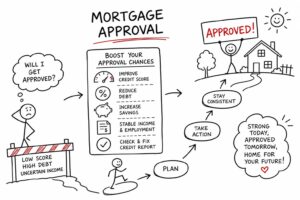
6 steps to raise your credit score before you apply
Steps 1, 3: the fastest moves with the biggest payoff
Step 1 is paying down credit card balances. Credit utilization accounts for 30% of a FICO score, and dropping below 10% utilization per card can produce 30 to 60 point gains within one to two billing cycles. The timing matters: pay at least two days before your statement closing date so the lower balance gets reported to the bureaus. That single move is the fastest lever most buyers have available. For guidance on how and when payments are reported, see the explainer from consumer credit bureaus and reporting authorities. When credit card payments get reported.
Step 2 is disputing credit report errors. Inaccurate collections, duplicate accounts, or misreported late payments can be silently costing you points. A successfully disputed error can add 50 to 100 points in a matter of weeks. Pull all three bureau reports at AnnualCreditReport.com and review every line before you apply.
Step 3 is protecting your payment history going forward. Payment history is 35% of the score, the largest single factor. Set up autopay for every account minimum to eliminate the risk of a missed payment derailing months of progress.
Steps 4, 6: smart moves that cost nothing
Step 4 is becoming an authorized user on a trusted person’s credit card account. If a parent, spouse, or close friend has an account with a long history and low utilization, being added as an authorized user gets that positive history reflected in your file within one to two months. You don’t need to use the card or even hold it. Step 5 is requesting a credit limit increase from your existing card issuers. A higher limit immediately lowers your utilization ratio without requiring any spending change. Most issuers handle this online with no hard inquiry against your credit.
Step 6 is the restraint step: avoid opening new credit accounts, applying for new cards, or financing anything significant in the months leading up to your mortgage application. Each hard inquiry drops your score slightly, and new accounts lower your average account age, both of which work against you exactly when you need your score at its best.
On realistic timelines: moving from 620 to 700 is achievable in one to three months in best-case scenarios where significant balance paydown combines with successful error disputes. For most buyers, three to six months of sustained effort is a more accurate expectation.
Finding the right loan path for where your credit stands today
Every score range has a workable strategy
A buyer at 580 is not in the same position as a buyer at 640, and a buyer at 640 is not in the same position as one at 720. Each band opens different loan products, different rate structures, and different cost profiles, and the rate and PMI data in the sections above illustrate just how large those differences can be in dollar terms. The smartest move is not to wait indefinitely for a “perfect” score, but to understand your real options at your current score, decide whether a short improvement window makes financial sense, and then move with intention.
For some buyers, a 60-day credit push from 620 to 670 can produce meaningful savings in interest and PMI over the loan term, depending on loan size and the specific rate and PMI changes that score improvement unlocks. For others, locking in now with an FHA loan and refinancing into a conventional product after 12 to 24 months of on-time payments and score improvement is the smarter path. Both strategies are valid. The key is knowing which one fits your situation.
Why working with the right lender changes the outcome
Not every lender is equipped to work with a 580 score, a thin credit file, or a self-employed borrower with 1099 income and business bank statements. Standard lenders with overlay-heavy guidelines will decline files that experienced lenders can close. The lender you choose shapes your options as much as your score does.
At Isabelle Mortgages, the work isn’t just matching buyers to a loan product. It’s building a strategy around where each buyer stands today and where they want to be in two, five, and ten years. That applies whether you’re a first-generation buyer navigating this process without family guidance, a self-employed borrower with non-traditional income, or an investor evaluating DSCR financing for a rental property. The approach is the same: match the loan to the real financial situation, and map out what comes next. The right loan isn’t always the one with the lowest rate on the sheet. It’s the one that gets you in the door and positions you to build from there.
Your credit score is a starting point, not a verdict
Knowing the credit score to buy a house that fits your situation is the first step toward a clear path forward. Your score determines which loans are available and what those loans cost over time, but it does not determine whether homeownership is possible. FHA opens doors at 580. Conventional is accessible at 620, with meaningfully better pricing above 740 and the best available tiers above 760. VA offers real flexibility for eligible veterans, and DSCR serves investors on a separate track that prioritizes property income over personal credit profile. Each path exists for a reason, and buyers at every score level have options.
If your score needs work, the six steps above are your fastest route forward, with meaningful gains possible in 30 to 90 days for most buyers who act on utilization and errors first. If you’re ready to understand what your current credit profile actually supports, the right next step is a conversation with Isabelle Mortgages, a team that works across all of these loan types and can map your specific profile to the right path.