
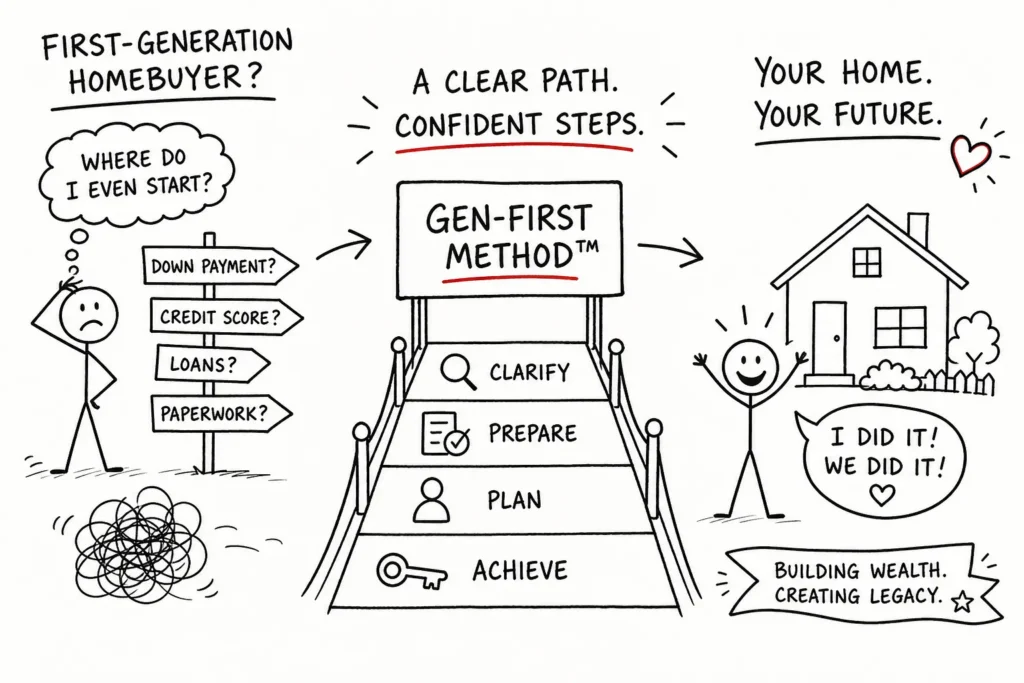
Buying a home is one of the most complex financial decisions most Americans will ever make. The gen first method, Isabelle Mortgages’ structured guidance framework for first-generation buyers, was built specifically to address a challenge that goes far deeper than paperwork and interest rates. When no one in your family has been through the mortgage process before, you’re not just learning new information. You’re navigating a system that was never designed to explain itself to you. And you’re doing it without the informal guidance that passes quietly through families with homeownership history.
The Gen-First Mortgage Method™, as Isabelle Mortgages describes it, is a step-by-step framework built for buyers who are the first in their family to pursue homeownership in the U.S., as well as entrepreneurs, non-traditional income earners, and families who see a home as the foundation of something lasting. It isn’t a sales pitch and it isn’t a generic checklist. It’s a replicable process designed to replace the family knowledge most first-gen buyers never had access to.
This article breaks down exactly what the Gen-First Mortgage Method™ is, who it was built for, how it works from start to finish, and why it treats wealth-building as the real end goal rather than just closing a loan.
What the Gen-First Mortgage Method™ actually is
A proprietary framework, not a loan product
The Gen-First Mortgage Method™ is not a loan type, a government program, or a special interest rate. Think of it as the mortgage world’s answer to a corner-first solving approach: rather than jumping straight into the application, the framework establishes the key structural pieces first, financial clarity, the right loan strategy, and a clear communication plan, so that everything else falls into place in sequence. What makes it distinct is that it was built specifically around the gaps first-generation buyers face: no family context, no informal mortgage education, and no trusted advisor who understands the emotional weight of this milestone.
Isabelle developed the method after observing the same patterns repeat with clients: buyers who were financially capable but had no roadmap, no one to call with questions, and no baseline for what “normal” looks like in a mortgage process. The method was her answer to that recurring problem, giving structure to what is otherwise an overwhelming experience.
The philosophy behind the method
At its core, the Gen-First Mortgage Method™ is built on one belief: homeownership is a wealth-building tool, not just a housing solution. Every step in the process is designed to educate the buyer, not just push a transaction through. That means explaining terms in plain language, proactively communicating what’s happening at each stage, and helping buyers understand how today’s decisions affect their financial position five and ten years from now.
The framework is structured enough to be consistent and replicable, but personal enough to adapt to each buyer’s unique situation. According to Isabelle Mortgages, bilingual support in English and Spanish is built into the framework from the first conversation, so language is never a barrier to clarity.
Who this method was designed for
First-generation buyers with no family playbook
Picture this buyer: motivated, working hard, financially ready in many respects, but walking into a lender’s office having never heard a parent explain what escrow is, or how credit utilization affects a mortgage application, or what actually happens at a closing table. In practice, first-generation buyers often self-disqualify before they even apply, assuming they need a perfect credit score or an impossible down payment because no one in their circle has corrected that misunderstanding, a pattern documented in homeownership access research and Federal Reserve consumer finance data.
This framework was designed to serve as the family knowledge those buyers never had, delivered through a structured, supportive process rather than an overwhelming stack of paperwork. It treats every milestone as something to be explained, not just checked off.
Self-employed buyers and non-traditional income earners
The gen first method also serves 1099 contractors, entrepreneurs, and small business owners who can’t hand over a W-2 and call it done. These buyers often have the income and the drive, but their documentation doesn’t fit the standard mold. In 2026, lenders handling non-traditional income typically work with 12 to 24 months of business bank statements, calculate qualifying income at 50 to 70 percent of total deposits, or use 90 percent of gross 1099 income to establish eligibility.
For self-employed home loans or 1099 earners, this stage also involves organizing bank statements and identifying which loan path makes the most sense before entering the formal process.
The Gen-First framework accounts for all of this. Variable revenue patterns, debt-to-income calculations that reflect actual cash flow, and non-QM loan options for buyers who can’t qualify through a conventional path are all part of how Isabelle Mortgages approaches complex financial profiles. The goal is to find a real solution, not turn someone away because their income looks different on paper.
Families building a legacy, not just buying a house
The third buyer profile this approach speaks directly to is multigenerational families and parents who see this purchase as the first step toward financial security for their children. According to the Federal Reserve Survey of Consumer Finances, homeowners accumulate roughly 38 times the net worth of renters over time, and children raised in homeowner households are nearly 18 percentage points more likely to become homeowners themselves by age 35. That compounding effect is exactly what the Gen-First Method™ is oriented around: not just closing a loan, but starting a cycle.
How Gen-First differs from the standard mortgage process
What most lenders skip
Many lenders focus primarily on a single objective: qualifying you for a loan. They collect your documents, run your numbers through their system, and move the deal forward. The deeper conversations, the context-setting, the questions about long-term financial impact, those are typically left out entirely. For buyers whose parents have been through it before, that gap is manageable. For first-generation buyers, it isn’t, because there’s no one to call when something doesn’t make sense.
Some borrowers report that a standard mortgage process feels transactional from their side: rushed, one-directional, and focused entirely on the immediate transaction. You submit, you wait, you sign. The result is buyers who close on a home without fully understanding their loan terms, their equity position, or what their next financial move should look like.
The Gen-First difference: structure with a human behind it
The Gen-First Mortgage Method™ adds a layer of structured education and personalized guidance on top of the standard loan process. The underwriting, the rate lock, the title work, all of that still happens. But it’s wrapped in clear communication, proactive updates, and plain-language explanations in English or Spanish at every stage. The buyer is never left wondering what just happened or what’s coming next.
Isabelle Mortgages states that this means direct access throughout the process via text, email, or phone, no call centers, no rotating loan officers, no unexplained silence between milestones. Every step is intentional, and the buyer always knows where they stand.
Why this matters more at the first-generation level
First-gen buyers bring more anxiety into the process because they have less reference for what’s normal. When a lender goes quiet for two weeks, a seasoned buyer might know that’s standard during underwriting. A first-generation buyer may assume something went wrong. The corner-first solving logic behind the Gen-First framework is precisely this: establish the structural foundation early, make every milestone visible and expected, and the rest of the process feels manageable rather than mysterious. It treats the buyer as a decision-maker and a partner, not just an applicant submitting documents.
The Gen-First framework in action: how the stages work
Stage one: financial clarity and readiness mapping
Before any loan application is submitted, the Gen-First process begins with an honest assessment of where the buyer actually stands. This covers credit health, debt-to-income ratio, available assets for a down payment, and income documentation. For self-employed borrowers or 1099 earners, this stage also involves organizing bank statements and identifying which loan path makes the most sense before entering the formal process.
Think of it as a corners-first approach to financial readiness: locking in the fundamentals before anything else moves. A buyer who knows exactly what they’re working with, including any gaps to address before applying, is in a fundamentally stronger position than one who finds out mid-process that something needs to be fixed.
Stage two: loan strategy built around your buyer profile
Not every buyer qualifies for the same loan, and not every loan is right for every buyer. This stage matches the client to the right product based on their specific financial picture and long-term goals. An FHA loan offers the most flexibility for buyers with credit scores around 580 and higher debt-to-income ratios, though it carries permanent mortgage insurance if the down payment is under 10 percent. A conventional loan offers lower long-term costs and cancelable private mortgage insurance for buyers with stronger credit. A non-QM product may be the right path for a self-employed borrower who qualifies on cash flow rather than tax returns.
Down payment assistance programs are evaluated at this stage as well. In Florida, programs like Hometown Heroes (up to $35,000) and Florida Assist (up to $10,000) are active statewide options for eligible buyers. Texas and California offer city and county-specific programs, including select forgivable loans for first-generation buyers in certain markets. Isabelle Mortgages navigates this landscape as part of the standard process, so buyers aren’t leaving money on the table.
Stage three: guided application through to closing
Once the strategy is set, Isabelle Mortgages walks the client through every step of the application, underwriting, and closing process. Communication is consistent and proactive throughout, the buyer always knows where their loan stands and what’s coming next, whether that’s a document request, a conditional approval, or a scheduled closing date, communicated in English or Spanish via whichever channel works best for the client.
The experience at the closing table should never feel like the first time the buyer is hearing something important. When the gen first method is applied correctly, closing day is a confirmation of everything the buyer already understands, not a scramble to absorb new information under pressure.
Why the method is built around generational wealth, not just loan closings
Homeownership as a wealth vehicle
A home is one of the most powerful equity-building tools available to working families in the United States. Every mortgage payment reduces the loan balance and builds ownership stake. That ownership appreciates over time, creating a financial asset that can be passed to the next generation or leveraged for future investments. Homeownership accounts for approximately 80 percent of all generational wealth transferred between families in the U.S., which means first-generation buyers who purchase a home aren’t just solving a housing problem. They’re changing their family’s financial trajectory.
The Gen-First Mortgage Method™ frames the loan conversation inside this bigger picture from the very first meeting. Buyers understand from day one that they’re not just signing up for a monthly payment. They’re beginning a wealth-building process that can benefit their children and their children’s children.
What clients leave with beyond a mortgage
A buyer who goes through the Gen-First process walks away with more than keys and a closing disclosure. They leave with a clear understanding of their equity position, their loan terms, and what their next financial move could look like. Some clients go on to use that first home as the foundation for an investment property down the road. The method plants that seed intentionally, not accidentally. The first purchase is treated as the beginning of a strategy, not the end of one.
What to expect when you work with Isabelle Mortgages
A one-on-one process from the first conversation
As Isabelle Mortgages describes its process, the intake experience is straightforward: no call centers, no rotating contacts, no starting over every time you reach someone new. The buyer works directly with Isabelle throughout the entire process. The first conversation focuses on understanding goals, financial situation, and timeline, not just pulling numbers and running a quick pre-qualification. For Spanish-speaking clients, bilingual support is available from the start, not as an afterthought.
The one-on-one model exists because the Gen-First Method™ only works when there’s a real relationship behind it. A framework is only as valuable as the person guiding you through it, and Isabelle Mortgages was built around that idea.
Your next step toward the Gen-First process
If you’re ready to explore what the gen first method looks like applied to your specific situation, the next step is simple: reach out to Isabelle Mortgages and schedule a consultation. Whether you’re just starting to think about buying or you already have a property in mind, the Gen-First Method™ is built to meet you where you are and give you a clear picture of what’s possible.
The bottom line
First-generation buyers don’t have to navigate the mortgage process blind. Systemic wealth disparities and lower access to intergenerational support create documented barriers for first-generation buyers, and the gaps those barriers leave are real. The Gen-First Mortgage Method™ exists precisely to fill them: with clarity about where you stand, structure that guides you step by step, and a wealth-building orientation that frames the entire process around something bigger than a single transaction.
Isabelle Mortgages isn’t just a lender. It’s a framework for building something that lasts. The first home purchase isn’t the destination, it’s the foundation. Where your family goes from there is the real story, and the Gen-First Method™ is designed to make sure that story starts on solid ground.
Frequently asked questions about the gen first method
What is the gen first method?
The gen first method is a structured mortgage guidance framework developed by Isabelle Mortgages for first-generation homebuyers, self-employed borrowers, and families building generational wealth. It combines loan strategy with financial education so buyers understand every step of the process, not just the paperwork.
Who is the Gen-First Method™ designed for?
It was built for three core buyer profiles: first-generation buyers with no family homeownership history, non-traditional income earners such as 1099 contractors and entrepreneurs, and multigenerational families who view homeownership as a long-term wealth strategy.
Is the Gen-First Method™ a specific loan product?
No. It’s a guidance and education framework, not a loan type or government program. It shapes how Isabelle Mortgages walks clients through the entire mortgage process, from financial readiness through closing day.
How long does the Gen-First process take?
The timeline varies by buyer profile and loan type, but the process typically follows the same sequence as a standard mortgage: readiness assessment, loan strategy, application, underwriting, and closing. The difference is that each stage includes proactive communication so the buyer always knows what’s happening and what’s next.
Is bilingual support available?
Yes. According to Isabelle Mortgages, bilingual support in English and Spanish is available from the first conversation through closing, via whichever communication channel works best for the client.
How do I get started with Isabelle Mortgages?
The first step is scheduling a consultation with Isabelle Mortgages. The initial conversation focuses on your goals, financial situation, and timeline, not a hard sell. You can reach out directly to schedule that call and begin mapping out your path to homeownership.