The Federal Reserve’s 2022 Survey of Consumer Finances revealed something that should stop every renter in their tracks: the median homeowner holds $396,500 in net worth. The median renter holds $10,400. That’s a 38-to-1 gap, and generational wealth homeownership research makes clear it isn’t simply a matter of income or luck. Multiple factors drive it: savings habits, access to credit, labor-market opportunities, and above all, one decision made once and compounded over decades.
For families who are the first in their lineage to own property, that decision carries even more weight. It doesn’t just change their financial picture. It changes what the next generation starts with. At Isabelle Mortgages, we’ve guided hundreds of first-generation buyers through exactly this moment, and what we see time and again is that the families who understand these seven strategies don’t just buy a house. They build a foundation that outlasts them.
Generational Wealth Homeownership: Why the Gap Keeps Growing
Why homeowners accumulate wealth at a rate renters simply can’t match
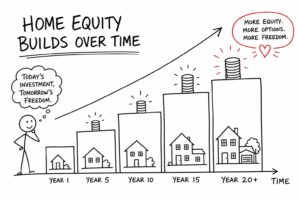
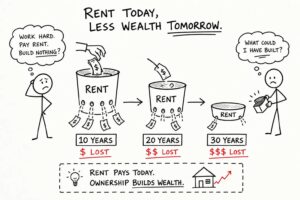
According to Federal Reserve data, home equity represented 28.5% of aggregate U.S. household wealth in 2021. For individual homeowners, that share climbs even higher: the median homeowner derived 45% of their net worth directly from home equity, meaning nearly half of everything they own sits in one appreciating asset. Renters, by contrast, direct every housing dollar toward a landlord’s balance sheet. Not one cent of a rent payment builds personal equity.
The compounding effect is substantial. According to long-run house-price indexes tracked by the FHFA and Case-Shiller, a homeowner who purchased a $150,000 home in 1995 now holds an asset that has multiplied in value several times over in many major markets, while steadily paying down the loan balance. Two engines run at once: appreciation and principal reduction. A renter who made the same monthly payment over those thirty years has nothing to show for three decades of housing costs.
What the data reveals about intergenerational wealth transfer
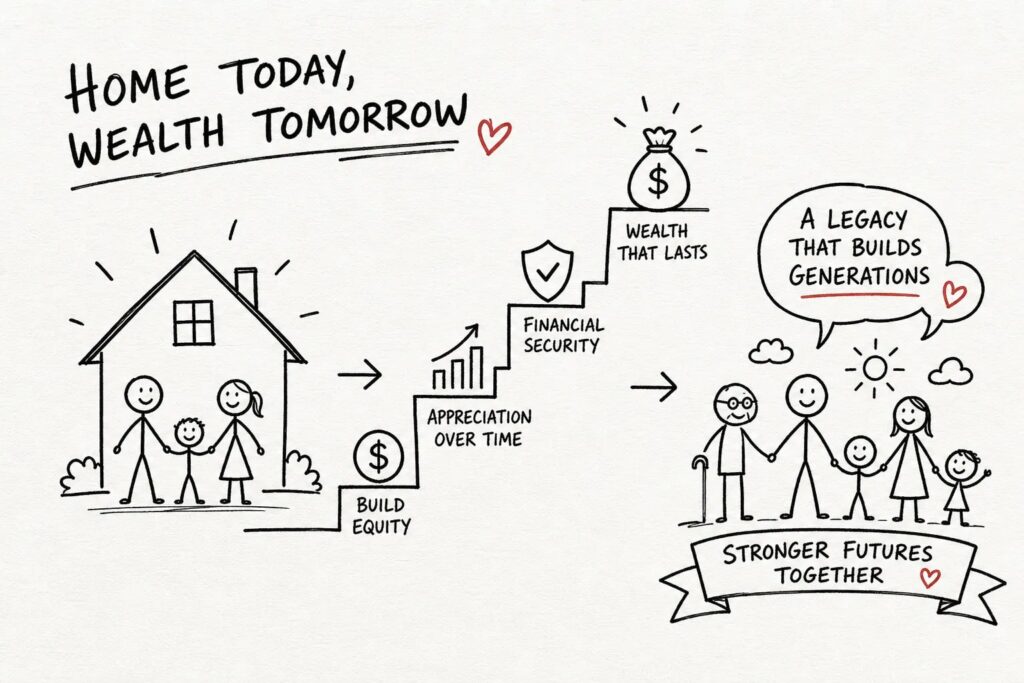
Families that own real estate have something concrete to pass down. Families that rent rarely do. This is the core of the housing wealth gap: it’s not just about the current generation’s finances. It’s about what gets handed to the next one. A home can become a college fund, a stepping stone toward a child’s first property, or the anchor asset in an estate that simply didn’t exist a generation ago.
For first-generation buyers, this is especially significant. There’s no inherited equity to draw from, no family benchmark to follow. The purchase itself is the starting point of a new financial legacy. Understanding what drives that legacy makes it possible to accelerate it.
How Your Home Builds Wealth Automatically Every Month
Forced savings through mortgage: the equity engine most people ignore
Every payment on an amortizing mortgage does two things: it covers the cost of housing, and it reduces the outstanding loan balance. That principal reduction is equity, a real asset on your personal balance sheet. Unlike rent, which is gone the moment you pay it, the principal portion of a mortgage payment functions more like a forced savings deposit. Over a 30-year loan, even before any appreciation, that paydown alone builds substantial wealth.
Most buyers don’t frame it this way. They see a monthly obligation when they could be seeing a monthly investment into an appreciating asset that also provides a place to live. Shifting that perspective is one of the most important moves a first-generation buyer can make early in the process.
Appreciation and leverage: how a small down payment controls a large asset
According to FHFA home price index data, U.S. home prices have appreciated at roughly 7% annually over the 10-year period ending in recent years, with cumulative gains of approximately 57% over that window. Over longer horizons, the annualized rate runs closer to 4, 6%. Those numbers don’t sound dramatic until you factor in leverage.
With 20% down, a buyer controls a 5x leveraged asset. On a $300,000 home, a 5% price increase equals $15,000 in value gained on a $60,000 down payment, a 25% return on capital in a single year. The capital gains exclusion adds another layer: sell a primary residence after meeting the two-out-of-five-year use requirement, and you can exclude up to $250,000 in profit from federal capital gains tax as a single filer, or $500,000 as a married couple. Note that the mortgage interest deduction’s benefit varies by taxpayer, many households no longer itemize since the 2018 Tax Cuts and Jobs Act raised the standard deduction, but for those who do, it further reduces the annual cost of ownership. Together, these advantages make generational wealth homeownership difficult to replicate through almost any other vehicle available to everyday buyers.
Strategies 1, 4: Building and Accelerating Home Equity Faster
Strategy 1: Make extra principal payments early in the loan
Mortgage amortization front-loads interest. In the early years of a 30-year fixed loan, the majority of each payment covers interest rather than principal. That’s where extra payments punch above their weight. On a $350,000 mortgage at 7% over 30 years, an additional $200 per month applied to principal can eliminate approximately five years of payments and save tens of thousands in total interest charges, the equity you build faster becomes a tool you can access sooner. (Run the exact numbers for your loan balance and rate using an amortization calculator to confirm the savings for your scenario.)
Strategy 2: Refinance strategically, not reflexively
Refinancing to a lower interest rate reduces your monthly payment and frees up cash flow that can be redirected into the property or other investments. A cash-out refinance goes further, converting built-up equity into liquid capital that can fund a down payment on a rental property or pay for renovations that directly increase home value. Treat a refinance as a deliberate financial decision rather than an automatic response to rate movement, and it becomes a meaningful wealth-building tool rather than a break-even transaction.
Strategy 3: Renovate for value, not just comfort
Not every renovation produces equal returns. According to industry resale data, including Remodeling Magazine’s annual Cost vs. Value report, kitchen and bathroom updates, added square footage, and curb appeal improvements consistently rank among the highest-ROI projects at resale. Before committing to a major project, analyze what comparable homes in your market are selling for with and without that feature. One risk worth avoiding: over-improving relative to the neighborhood, where a high-end renovation pushes your home’s value above what buyers in that area are willing to pay. Renovating with resale value in mind keeps you on the right side of the appreciation curve.
Strategy 4: Convert your primary home into a rental asset
When homeowners move into a larger property, holding the original home as a rental creates two simultaneous benefits: passive monthly income and continued equity accumulation through a second appreciating asset. This is one of the most common pathways first-generation families use to move from a single home to a small real estate portfolio. Whether you self-manage or work with a property manager, that first property becomes the seed capital for everything that follows.
Strategies 5, 7: Tax Advantages, Estate Planning, and Property Inheritance
Strategy 5: Use tax benefits to keep more of what your home earns
The capital gains exclusion is one of the most valuable tax benefits available to homeowners. Sell a primary residence after living there for at least two of the last five years, and you can exclude up to $250,000 in profit from federal capital gains tax as a single filer, or $500,000 as a married couple. On a home that has appreciated significantly, that exclusion alone can represent a six-figure tax savings. For homeowners who do itemize, mortgage interest and property tax deductions further reduce the annual cost of ownership, preserving more household cash for reinvestment, though eligibility depends on your individual tax situation and the post-2018 standard deduction threshold.
Strategy 6: Plan the transfer early with a trust or proper titling
Owning a home is the first step. Making sure it transfers to the next generation cleanly is the second. Without proper estate planning, real estate can get caught in probate, delay distributions, or create unnecessary tax complications. Options include a revocable living trust, joint tenancy with right of survivorship, or a transfer-on-death deed where your state allows it.
The step-up in basis is one of the most powerful tax tools in estate planning. When heirs inherit a property, the cost basis resets to the fair market value at the date of death. If a parent bought a home for $100,000 and it’s worth $500,000 at death, the heir’s basis becomes $500,000. Sell it for $520,000, and the taxable gain is only $20,000, not $420,000. Decades of appreciation can effectively pass tax-free to the next generation through this single provision, making early planning one of the highest-leverage moves a homeowner can make.
Strategy 7: Use equity to fund the next generation’s down payment
Parents and grandparents can use accumulated home equity to gift a down payment to the next generation. In 2026, the IRS annual gift tax exclusion is $19,000 per recipient. Married couples who elect gift splitting can give up to $38,000 per recipient per year without triggering a gift tax return requirement. Gifts above those amounts apply toward the lifetime exemption but are rarely taxable in practice for most families. For households in high-cost markets where the down payment barrier is the primary obstacle, this kind of equity transfer can meaningfully improve the next generation’s ability to enter homeownership, though outcomes vary based on local housing costs and individual financial circumstances.
Generational Wealth Homeownership in Practice: One Family’s Starting Point
A real scenario: what happens when a family buys its first home
Consider a first-generation buyer who purchases a $280,000 home in 2026 with 3.5% down via an FHA loan (approximately $9,800 down on a 30-year fixed mortgage). At a conservative 4% annual appreciation rate supported by long-run FHFA averages, that home grows to approximately $414,000 over 10 years. Factor in principal paydown over that same period based on a standard amortization schedule, and total equity approaches $175,000 to $200,000. That equity can fund a child’s college education, seed the down payment on an investment property, or become the inheritance that rewrites what the next generation starts with. One purchase, compounded over a decade, creates options that simply didn’t exist before.
Why the first step is the hardest one, and how to take it with confidence
For first-generation buyers, the mortgage process can feel opaque. There’s no parent to call who has done it before, no family benchmark to reference. The terminology, the timelines, the documentation requirements, all of it arrives at once without a roadmap. That gap is exactly what Isabelle Mortgages was built to close.
The Gen-First Mortgage Method™ is a structured, step-by-step framework designed specifically for buyers navigating homeownership for the first time. It combines transparent loan guidance, one-on-one support, and bilingual communication in English and Spanish so families can move forward knowing exactly what to expect at every stage. The goal isn’t just to close a loan. It’s to position that first purchase as the foundation of a lasting financial legacy, which is where generational wealth homeownership actually begins.
Programs That Remove the Biggest Barrier to Entry
Federal loan programs designed for buyers without large savings
Three primary federal options dramatically reduce the upfront cost of homeownership. FHA loans, backed by the U.S. Department of Housing and Urban Development, allow as little as 3.5% down with flexible credit requirements, making them the most common choice for first-time buyers. VA loans, administered by the Department of Veterans Affairs, offer 0% down with no private mortgage insurance for eligible veterans and active-duty service members. USDA loans, backed by the U.S. Department of Agriculture, also require 0% down for qualifying buyers in approved rural and suburban areas. Many buyers don’t need to choose just one: these programs can often be layered with state and local assistance to further reduce what’s needed at closing, though specific stacking rules vary by program and lender.
State and local down payment assistance programs worth knowing
Down payment assistance programs exist at every level of government, and most buyers qualify for more help than they realize. In Florida, the FL Assist program offers up to $10,000 as a deferred second mortgage at 0% interest with no monthly payments required. The Hometown Heroes Program provides up to $35,000 for eligible first-time, income-qualified buyers in designated occupations. County-level programs extend this further: Orange County’s assistance program offers up to $70,000 for very low-income buyers, and Palm Beach County’s match pilot offers up to $50,000. Buyers should confirm current eligibility requirements and availability directly with the Florida Housing Finance Corporation or the relevant county housing agency, as program terms can change.
Outside Florida, California’s CalHFA MyHome program provides a deferred-payment junior loan of up to 3.5% of the purchase price for FHA loans. Atlanta Housing offers up to $25,000 in down payment assistance for eligible buyers including veterans, healthcare workers, and public safety employees. Pennsylvania’s PHFA program includes multiple assistance layers: the Keystone Forgivable Loan, the Keystone Advantage Assistance Loan, and additional grant options. In most markets, a buyer who works with a knowledgeable lender can layer federal, state, and local assistance to significantly reduce the cash required at closing.
The 38-to-1 wealth gap between homeowners and renters isn’t a fixed reality. It’s a consequence of decisions made, or not made, over time. All seven strategies covered here, from accelerating equity and leveraging appreciation to harvesting tax benefits and passing wealth to the next generation, are available to any buyer who gets into a property and thinks long-term from day one. That’s the full picture of generational wealth homeownership: not a single windfall, but a series of intentional moves that compound over decades.
If you’re ready to start building that foundation, the first step is understanding which loan you qualify for and which assistance programs apply to your situation. The team at Isabelle Mortgages, through the Gen-First Mortgage Method™, guides first-generation buyers from that first conversation all the way to closing and beyond. That conversation doesn’t cost anything, and it’s where your family’s financial story begins.