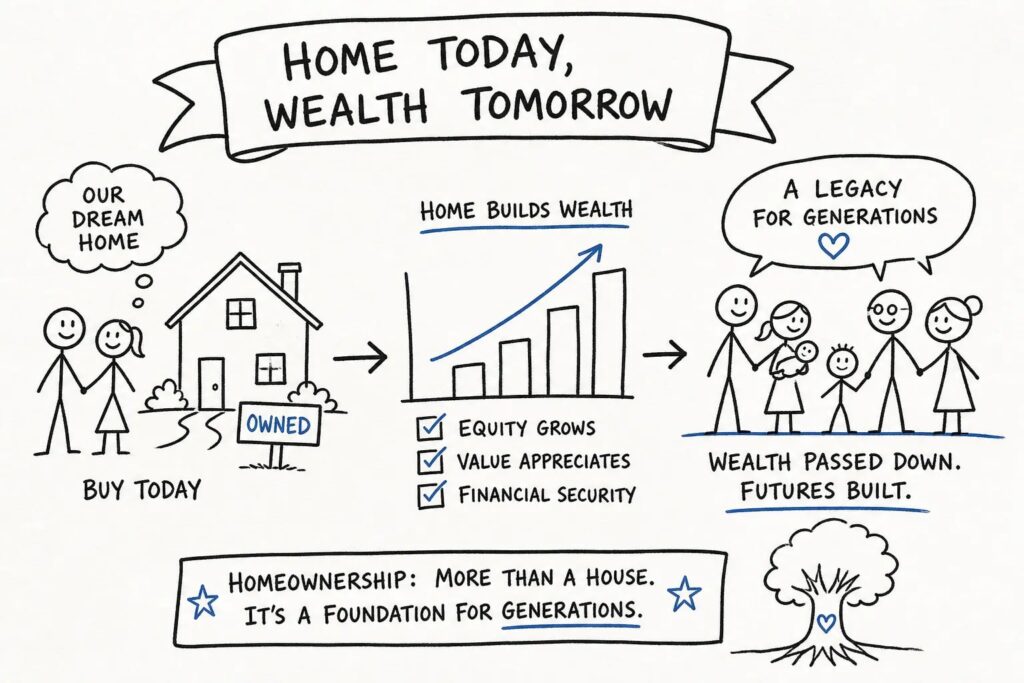
A generational wealth mortgage strategy can turn a home purchase into a multigenerational financial foundation, stopping instability from passing down the way poverty so often does. Research consistently shows that most families with lasting wealth didn’t just earn it, they inherited a head start, usually in the form of a home that was paid off, passed down, or leveraged to fund their children’s opportunities. That head start is what a mortgage-backed wealth strategy is really about: not getting rich from real estate, but using a home purchase to interrupt cycles of financial instability before they reach the next generation.
At Isabelle Mortgages, we work with first-generation buyers every week who are doing exactly this. They’re the first in their family to own in the U.S., and they’re building something their parents couldn’t. The process isn’t complicated, but it does require knowing how equity forms, how to grow it faster, how to use it wisely, and how to make sure it actually reaches your heirs. That’s what this article covers, start to finish.
Why the wealth gap starts at the front door
The numbers are stark. White non-Hispanic households hold a 74.4% homeownership rate compared to 45.3% for Black households and 48.5% for Hispanic households, according to Census Bureau data. That gap isn’t just about housing preference. It’s a compounding equity gap that widens with every passing decade. By age 55 and older, the average White household head holds $175,000 more in housing equity than the average Black household head and $145,000 more than the average Hispanic household head, figures documented in Urban Institute research on racial wealth disparities.
What makes this even more consequential is how central housing equity is to wealth for Black and Latino families. Housing equity represents 65.7% of net worth for the median Latino homeowner and 60.2% for the median Black homeowner, compared to 46.5% for the median White homeowner, per Urban Institute analysis. That means these communities have more riding on every single homeownership decision they make, from which loan they choose to how they hold title to whether they plan their estate at all.
The opportunity hidden inside that gap
The gap is a problem, but it’s also a signal. Every first-generation buyer who closes on a home is starting a new data point in their family’s financial history. That closing document doesn’t just transfer a deed; it transfers a trajectory. Studies on intergenerational wealth transfer show that families who entered homeownership two or three generations ago continue to benefit from that compounding advantage today, often without fully accounting for how it shapes their options.
Why homeownership creates wealth when renting cannot
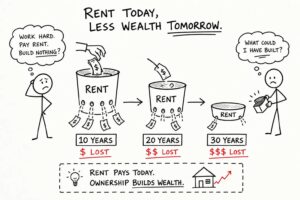
The core mechanism is straightforward. Rent builds a landlord’s equity; mortgage payments build yours. Even a modest home purchased today and held for 20 to 30 years creates a balance-sheet asset that can be inherited, leveraged, or both. Renting does not build housing equity, and research comparing median net worth between renters and owners reflects that difference consistently over time. Every month of ownership moves the needle in your direction, a principle that compounds significantly over a 30-year horizon.
How a generational wealth mortgage builds equity over time
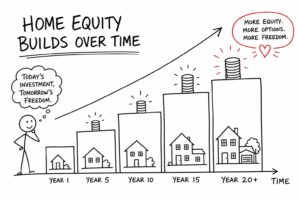
Most buyers focus on the monthly payment and completely miss the mechanics happening underneath it. A standard 30-year fixed mortgage is front-loaded with interest. In the early years, the majority of each payment covers interest, and only a small fraction reduces the principal balance. This is why equity feels like it’s barely growing in the first decade. The real acceleration happens in the back half of the loan, as the principal balance drops and more of each payment chips away at what you actually owe.
The two sources of equity: paydown and appreciation
Equity grows in two distinct ways: the loan balance shrinking through paydown, and the home’s market value rising through appreciation. Both matter, but only paydown is within your direct control. Appreciation is a bonus, not a guarantee, which is why the decisions you make around payments and loan structure matter more than betting on market timing.
What home equity actually represents on a family balance sheet
Think of equity as the dollar amount your family would walk away with if you sold the home today. A $400,000 home with a $150,000 remaining balance represents $250,000 in equity. That $250,000 can be inherited outright, borrowed against for investment, or converted into a down payment on the next property. It is a transferable asset, and for most middle-class families, it’s the largest one they’ll ever build.
Strategies that accelerate equity growth without refinancing
You don’t have to wait 30 years for equity to accumulate. Biweekly payments create the equivalent of 13 monthly payments per year instead of 12, because you’re making 26 half-payments annually. On a $300,000 loan at 6.5%, that structure alone can cut a 30-year mortgage by roughly six years and save over $88,000 in total interest, based on standard amortization calculations assuming the servicer applies each payment immediately to principal. That’s not a rounding error, that’s a year of college tuition or the seed money for a rental property.
Biweekly payments and extra principal contributions
The math is accessible, but one detail is critical: confirm with your loan servicer that extra payments are applied directly to principal, not held until a full payment accumulates. The CFPB advises borrowers to verify this in writing, since some servicers handle biweekly and extra payments differently, a difference that determines whether the strategy works as designed. Adding even $200 extra per month to your principal on top of biweekly payments compounds those savings further, shortening the timeline and reducing the interest base.
Down payment assistance as an equity head start
The faster you build equity, the sooner you escape the slow early phase of amortization. Down payment assistance programs give you a head start on day one. In New Jersey, the NJHMFA program allows first-time buyers to access up to $15,000 in assistance, with an additional $7,000 specifically for first-generation buyers. NYC’s HomeFirst program offers up to $100,000. Florida’s Hometown Heroes program offers up to $35,000 for qualifying public-service workers, and the City of Miami’s housing program extends up to $70,000 for income-eligible buyers. Program amounts and eligibility rules change regularly, so verify current terms directly with each program administrator. Starting with more equity at closing means you’re already ahead of the amortization curve from the first payment.
Using your first home as a launchpad, not a finish line
The most effective intergenerational wealth builders don’t stop at one home. Once the first property has enough equity, it can fund the down payment on a rental property or a larger primary residence. One well-made decision becomes the foundation for the next one. This is the compounding principle that Isabelle Mortgages builds its first-buyer guidance around, treating the first mortgage not as a transaction but as the opening move in a longer financial game.
Using home equity without giving away the legacy
Equity is an asset, but it’s also a temptation. HELOCs, home equity loans, and cash-out refinances all convert owned equity into borrowed debt. Each tool can serve a legitimate purpose, but using them carelessly is exactly how families lose the asset they spent years building. The line between strategic leverage and financial backslide is thinner than most people realize.
When a HELOC or cash-out refinance actually makes sense
The legitimate use cases are real but narrow. Funding a business investment with a clear return, making equity-preserving home improvements, or bridging a defined short-term gap can all justify drawing on equity. The rule of thumb is simple: the expected benefit must clearly outpace the borrowing cost, and the repayment plan must be concrete before the first dollar is drawn. Borrowing against your home to fund something speculative or undefined is not a strategy, it’s a risk you’re passing to your family.
The education funding tradeoff
Using a HELOC to fund a child’s college costs can offer lower interest rates than private student loans, but it converts home equity into a liability secured by your house. Federal student loans come with income-driven repayment, forbearance options, and sometimes forgiveness pathways, protections detailed in Department of Education guidance. Home equity products offer none of those safeguards. If you default on a HELOC, the consequence isn’t a damaged credit score, it’s foreclosure. The emotional appeal of helping your child avoid student debt is real, but the decision deserves the same sober analysis as any other major financial move.
The rule: protect the asset before you leverage it
Equity is most powerful when it compounds untouched. Every drawdown should be evaluated against the legacy it reduces, not just the short-term need it solves. That reframe shifts the question from “can I access this equity?” to “should I, and what does it cost my family if I do?” Those are very different questions, and only one of them leads to a generational wealth mortgage outcome.
Estate layer of a generational wealth mortgage: keeping home wealth in the family
Buying a home is the first step. Making sure it reaches your children and heirs requires a separate, deliberate act. Without intentional estate planning, a home can get stuck in probate, trigger unexpected taxes at the state level, or simply pass to the wrong person at the wrong time. None of those outcomes are inevitable, but avoiding them requires action while the owner is still alive.
Step-up in basis and why it protects heirs from capital gains tax
Under federal tax law, when a home is inherited, its taxable basis is stepped up to the fair market value at the date of death. Heirs are only taxed on appreciation that occurs after they inherit, not on decades of growth the original owner captured. On a home purchased for $150,000 and inherited at a value of $500,000, heirs owe capital gains tax on nothing if they sell at that value immediately. This is one of the most powerful wealth-preservation tools available to any homeowner, and most people have never heard of it.
Probate avoidance: trusts, TOD deeds, and joint ownership
A will alone does not avoid probate. Probate is a court-supervised transfer process that can be slow, public, and costly. A revocable living trust, a transfer-on-death deed, which is available in many states, or joint ownership with right of survivorship all allow a home to pass outside of court: faster, more privately, and without the procedural friction that can delay or diminish an inheritance. None of these eliminate taxes, but they eliminate the administrative bottleneck that slows the transfer. Both a revocable trust and a TOD deed generally preserve the step-up in basis benefit because the owner retained control until death, per IRS guidance on revocable transfers and basis rules.
The 2026 federal estate tax threshold and state-level rules
The federal estate tax exemption sits at approximately $15 million per person in 2026, per current IRS guidance, meaning most families won’t owe federal estate tax on a home regardless of how much it has appreciated. But state-level rules are a different story. State estate and inheritance taxes vary significantly by jurisdiction, Maryland is currently the only state that imposes both, according to state tax authority data, though these rules can and do change. The rules also depend on where the decedent lived and where the property sits. A local estate attorney or financial planner is worth the conversation for any family with significant home equity, particularly as property values in many markets continue to rise.
Starting this strategy without a family roadmap
Every strategy in this article assumes the buyer knows it exists. For first-generation homebuyers, those who are the first in their family to own in the U.S., there’s no parent to call for guidance, no family history to reference, and no one who learned these lessons the hard way and can pass them down. That knowledge gap is not a personal failure. It’s a structural disadvantage with real financial consequences.
Without generational knowledge, first-gen buyers often underestimate how much the mortgage decision itself shapes the wealth outcome. Which loan type to choose, what down payment to make, how to hold title, whether to set up biweekly payments, when to explore assistance programs, these choices get made at or before closing and then live with a family for 30 years. Isabelle Mortgages developed its first-buyer framework specifically for this gap: a wealth-oriented approach that walks buyers through the mortgage decision in the context of long-term equity building, down payment assistance identification, estate planning awareness, and investment potential.
The simplest first action is a conversation. Understanding what loan structure you’re entering, how your equity builds from day one, and what mechanisms you’ll need later to protect and pass it on, that conversation is the foundation of any serious generational wealth mortgage strategy. At Isabelle Mortgages, it’s the conversation we have before we talk about rates. Reach out to our team to start it, ideally before you sign anything.
The long game is the only game worth playing
Homeownership creates equity. Equity can be accelerated through disciplined payment strategies and smart use of assistance programs. It can be deployed wisely through leverage when the math genuinely supports it. And with the right estate plan in place, it can transfer intact to the generation that follows, stepped-up basis and all. All of this is within reach, but it rewards intentional decisions at every stage: from which loan you choose, to how you hold title, to whether you ever draw on what you’ve built.
A generational wealth mortgage is not a single product or program. It’s a way of approaching the entire homeownership journey with your family’s future in mind. The families who build lasting wealth are the ones who treat the first mortgage as a starting point, not an endpoint. It’s never too early to begin building with that intention, and for most, it’s not too late to start now.