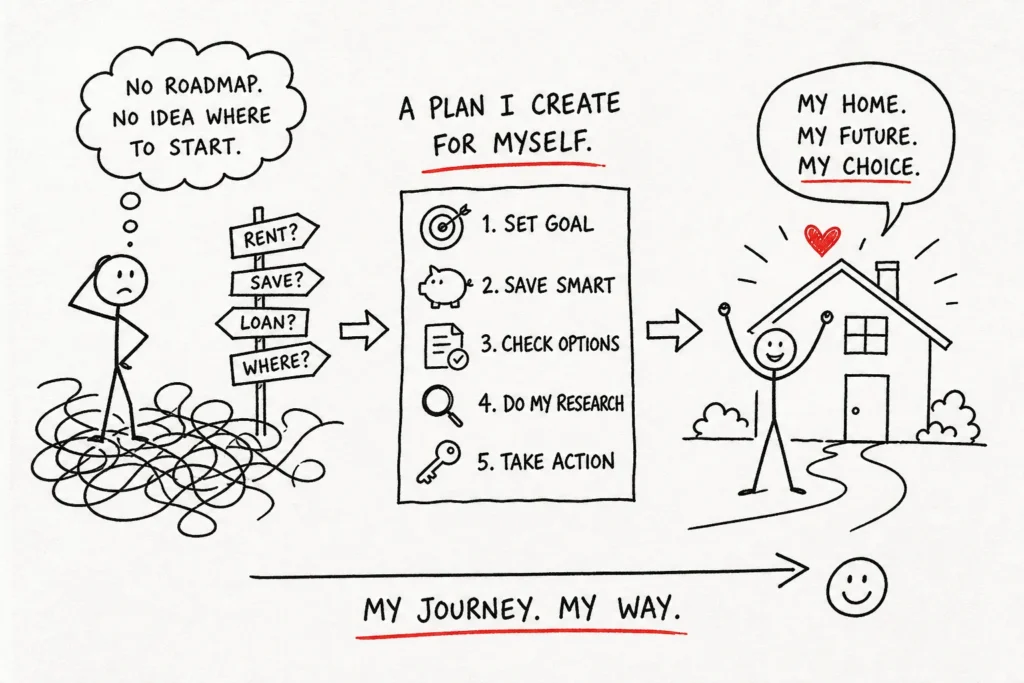
If you’re asking how do I start the homebuying process when no one in my family has done it before, you’re not alone, and you’re not behind. There’s no parent who can tell you what a good rate looks like, no aunt who remembers what she paid in closing costs, no cousin who can explain what DTI even means. That silence is real, and it has weight. But the silence isn’t evidence that you can’t do this. It’s a gap in inherited knowledge, and gaps can be filled.
Most of what feels overwhelming about buying your first home isn’t the process itself. It’s the vocabulary, the sequence, and the fear of making an expensive mistake that nobody warned you about. Once the steps are mapped out clearly, the anxiety shrinks fast. That’s exactly why the Gen-First Mortgage Method™ at Isabelle Mortgages was built: to replace the roadmap your family couldn’t hand you with something concrete, personalized, and actually usable.
By the end of this guide, you’ll know your first three actions, the numbers that matter most, which programs exist to help you, and what a realistic timeline looks like from start to close.
How do I start the homebuying process when no one in my family has done it before?
First-generation buyers often assume they’re starting at a disadvantage. The truth is closer to the opposite. You’re not carrying outdated advice about needing 20% down. You’re not borrowing fear from a family member’s bad experience with a lender in 1987. You’re approaching this with a clean slate, and that’s genuinely useful.
The anxiety most first-gen buyers feel isn’t about the mechanics of buying a home. It’s about the unknown. Once you understand what the process actually looks like, in sequence, the intimidation loses most of its power. Millions of buyers navigate this every year without a family roadmap, and they close on homes successfully.
What “starting from zero” actually means in practice
Most of the knowledge gap is really just unfamiliarity with terms and order of operations. The steps themselves aren’t complicated, they’re just unfamiliar. To see what that looks like concretely: calculating your debt-to-income ratio sounds technical, but it’s simply your total monthly debt payments divided by your gross monthly income. That one number, which takes five minutes to figure out, tells you which loan programs you qualify for. Learning the vocabulary and the sequence is exactly what a good mortgage professional helps you do. Treat the process like a structured project with defined phases rather than one giant overwhelming decision, and it becomes manageable.
How to buy a house for beginners: check your financial foundation first
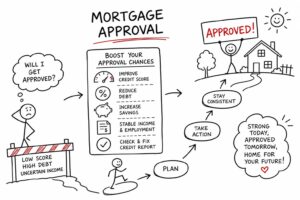
Before you look at a single listing or talk to a real estate agent, you need two numbers: your credit score and your debt-to-income ratio. These two figures determine which loan programs you qualify for and what your interest rate will look like. Pulling them costs nothing and takes less than an hour, but every decision you make going forward will be shaped by them.
What credit score you actually need in 2026
The numbers vary by loan type, and they’re more accessible than most first-gen buyers expect. For an FHA loan, the floor is 580 with 3.5% down, or 500 with 10% down. Conventional loan minimums vary by lender and guidelines continue to evolve, your lender can confirm the current requirements for your specific situation. VA and USDA loans generally look for 580 to 640 depending on the lender. A score of 740 or above unlocks the best rates across all loan types, but 580 to 620 still opens real doors, especially for first-time buyers using FHA. For a clear breakdown of what credit score you need to buy a home, read a lender-focused guide that explains typical minimums by loan type.
Don’t guess at your score. Pull your free credit report at AnnualCreditReport.com before your first lender conversation. You want to know exactly where you stand so nothing surprises you later.
How to calculate what you can realistically afford
Lenders generally want your total housing costs, including principal, interest, taxes, and insurance, to land between 31% and 40% of your gross monthly income. On a $6,000 per month gross income, that’s a housing budget of roughly $1,860 to $2,400. Your debt-to-income ratio takes a wider view: total monthly debt payments divided by gross monthly income. Most lenders want this below 43% to 45%. If yours is higher, focus on paying down existing balances before you apply. Even reducing one or two installment loans can shift your DTI enough to change which programs you qualify for.
Build your savings strategy around real targets, not guesses
The 20% down payment myth stops more first-gen buyers than almost anything else. It isn’t required, and most buyers don’t come anywhere close to it. According to NAR data from 2023 through 2025, the median down payment for first-time buyers has hovered around 8% to 9%. FHA loans require 3.5%. VA and USDA loans require zero down for eligible borrowers. Once you replace the myth with the actual number, saving for a home becomes a specific, trackable goal instead of an impossible horizon.
How much you actually need to bring to closing
On a $300,000 home, an FHA loan at 3.5% down means $10,500 out of pocket for the down payment. A conventional loan at 5% down puts you at $15,000. VA and USDA borrowers who qualify pay $0 down. But the down payment isn’t the only number. Closing costs typically run 2% to 5% of the loan amount, which means $6,000 to $15,000 on a $300,000 purchase. Many first-gen buyers are caught off guard by closing costs because nobody told them to budget for them. Your lender is required to give you a Loan Estimate within three business days of application, which breaks all of this down clearly.
Down payment assistance programs and grants that can close the gap
Down payment assistance programs are legitimate, widely available, and underused. They’re not loopholes. They’re programs specifically built to help buyers who need support with upfront costs. Florida’s Hometown Heroes program offers up to $35,000 for eligible buyers. Florida Assist provides up to $10,000 as a deferred second mortgage. Other states, including Texas, California, New York, and New Jersey, have their own income-based grants and forgivable second mortgage programs through state housing finance authorities. Veterans often receive exemptions from first-time buyer requirements in many of these programs. Start by exploring down payment assistance resources that summarize common options and eligibility requirements.
Start at your state’s housing finance authority website to see what’s available in your county. A knowledgeable lender will identify the programs you qualify for during the preapproval conversation, which is one more reason choosing the right lender matters so much.
Choose a lender who was built for this moment
Not every lender is equipped to guide someone who’s navigating this for the first time without family support. Some assume you already know the vocabulary, the sequence, and which questions to ask. The right lender teaches you all three without making you feel behind. This decision matters more than most first-gen buyers realize going in, and it deserves real attention.
What to look for when you have no family guidance to fall back on
What you need from a lender is different from what a buyer with experienced family members needs. You need plain-language explanations of every term, patience with questions, transparent timelines, and a lender who tells you what comes next before you have to ask. The difference between a transactional lender who processes your file and a true mortgage advisor who walks you through every decision is enormous, and you’ll feel it at every stage of the process.
How the Gen-First Mortgage Method™ replaces the roadmap your family couldn’t give you
Home Buying Guidelines: First-Gen Path to Mortgage Freedom at Isabelle Mortgages was built specifically for buyers who are the first in their family to navigate homeownership in the U.S. The method covers the full sequence: credit assessment, loan program selection, preapproval strategy, down payment planning, and closing preparation. Each phase is guided, explained, and personalized so you know exactly where you are and what comes next. Bilingual support in English and Spanish is built into the service because clear communication matters, and language shouldn’t be a barrier to one of the biggest financial decisions of your life.
This is the structured roadmap your family couldn’t hand you, available from your first conversation through the day you get your keys.
The mortgage preapproval process: a step-by-step walkthrough
Preapproval is the moment the process becomes concrete. It confirms your actual buying power, gives you a defined price range, and signals to sellers that you’re a serious buyer. Most preapproval letters are valid for 30 to 90 days, so timing your application to align with your search timeline matters.
Your homebuying checklist: documents to gather before your preapproval appointment
Having your documents ready before you sit down with a lender makes the process fast and smooth. Here’s what most lenders request:
- 30 days of pay stubs (or two years of tax returns if self-employed)
- Two years of W-2 statements
- Two months of bank statements (checking and savings)
- Government-issued ID and Social Security number
- Documentation of existing debts: student loans, car payments, credit cards
Self-employed buyers need additional items: business bank statements, a profit-and-loss statement, and in some cases a CPA letter. Gathering all of this in advance turns your preapproval appointment into a real conversation rather than a scramble.
How to compare loan offers without getting lost in the numbers
Every lender is required to give you a Loan Estimate within three business days of your application. When comparing offers, focus on the APR (not just the interest rate), the total loan cost over the life of the loan, your estimated monthly payment, and closing costs. Shopping two or three lenders is worth the effort. Multiple mortgage credit inquiries within a 45-day window count as a single hard pull on your credit, so comparing doesn’t hurt your score the way some buyers fear.
Find your agent and understand the path to closing
Once you’re preapproved, the next step is finding a buyer’s agent. Your agent is your negotiator and your guide through a legally complex transaction. The relationship deserves careful selection, especially when you’re navigating this without people in your corner who’ve done it before.
Questions to ask when interviewing an agent
Ask every candidate: How many buyers have you represented in my target price range this year? What’s your average list-to-sale ratio for the buyers you represent? How quickly do you move on offers in competitive markets? The answers tell you a lot. Red flags include an agent who only tells you what you want to hear, unfamiliarity with your target neighborhoods, a practice that primarily represents sellers, and no verifiable reviews or license history. Verify every agent’s license and vet their background through your state’s real estate commission database before signing anything.
What a realistic homebuying timeline looks like
For most first-time buyers in a competitive 2026 market, the full process from preapproval to closing runs four to six months. Preapproval takes one to two weeks. Active home search varies widely but often runs one to three months depending on inventory and price range. Once you’re under contract, expect one to two weeks for inspections and appraisal, two to three weeks for final underwriting, and then closing day. Timelines shift with market conditions, but having a rough framework removes the anxiety of not knowing where you are in the process.
A good lender and a good agent communicate proactively at every stage. At Isabelle Mortgages, clients receive consistent updates by text, email, or phone throughout the process, so nothing comes as a surprise.
Your next three steps start today
Starting the homebuying process without family guidance is genuinely hard. But it’s absolutely doable when the steps are clear, the professionals are the right fit, and you know what to expect at each phase. You don’t need someone in your family who’s done this before. You need the right team around you now.
Here’s where to start today: pull your free credit report, calculate your DTI using your gross monthly income and current debt payments, and schedule a conversation with a lender who understands your situation and can walk you through what comes next. Those three actions cost nothing and move you from wondering where to start to actually starting.
Homeownership isn’t just a house. For first-generation buyers, it’s the beginning of a financial foundation that can carry the next generation forward. That’s not a small thing. If you still find yourself asking how do I start the homebuying process when no one in my family has done it before, those three steps are your answer. When you’re ready to take them with a team built specifically for this moment, reach out to Isabelle Mortgages and ask about the Gen-First Mortgage Method™. The roadmap is ready when you are.