
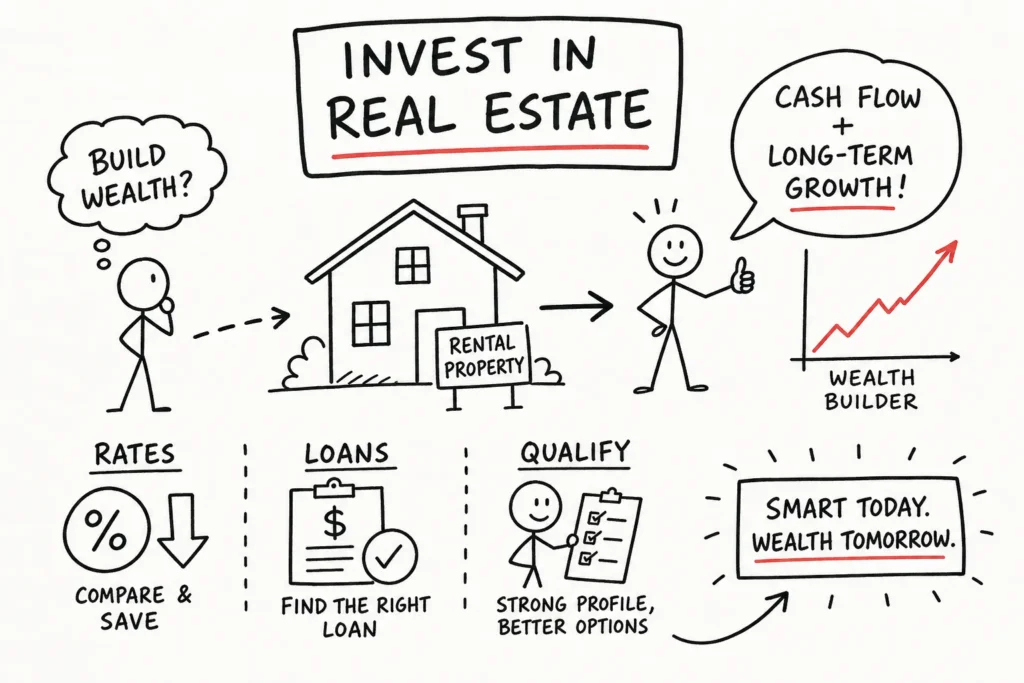
Rental property ownership is one of the most proven paths to long-term wealth in the United States. But the moment a first-time investor starts asking about financing, the process looks nothing like getting a mortgage for their own home. Investment mortgages carry different rates, stricter qualifications, and more upfront costs, and walking in unprepared is one of the most expensive mistakes a new landlord can make.
This guide covers the core questions first-time investors face before applying: what a rental property loan actually is, how current 2026 rates compare, which loan products fit which investor profiles, what lenders require to say yes, and what the real cost of entry looks like. If you want a mortgage advisor who specializes in this exact territory, Isabelle Mortgages works with first-time and experienced investors to match each deal to the right product before the application ever goes in.
What an investment mortgage is and how it differs from your home loan
An investment mortgage, also called a rental property loan or an investment property mortgage, is a loan used to purchase a property you do not intend to live in. From the lender’s perspective, this creates a fundamentally different risk profile than a primary residence loan. When you borrow to buy your own home, your income directly services the debt. When you borrow to buy a rental, repayment depends partly on whether a tenant shows up and pays rent every month: an income stream outside your direct control.
That elevated risk is why every term on an investment property loan is stricter. Lenders apply loan-level price adjustments (LLPAs) to these products, which translate directly into higher rates, larger required down payments, and tighter underwriting across the board. In practice, that means a borrower who qualifies comfortably for a primary residence loan may face a materially different experience when financing a rental.
Second home vs. investment property: they are not the same
First-time investors frequently confuse these two categories, and the distinction matters. A second home is a property you personally occupy for part of the year, like a vacation home. Because you have a personal stake in maintaining it, lenders offer better pricing on second-home loans than on pure investment properties. If you plan to rent the property year-round to tenants, lenders will classify it as an investment property regardless of what you call it. Misrepresenting a property’s intended use on a mortgage application is considered mortgage fraud, with serious legal consequences.
Investment mortgage rates in 2026: what to expect
As of July 2026, 30-year fixed rates for primary residences average between 6.49% and 6.59% (Freddie Mac and Bankrate data). Investment property loans carry a consistent premium above that baseline. Expect 30-year fixed investment mortgage rates to fall in the 7.0% to 7.6% range. Fifteen-year fixed options run roughly 6.3% to 7.0%, and ARMs for investment properties land around 7.1% to 7.6% depending on structure and lender. Specific lender quotes as of July 13, 2026, show a wide spread: some lenders come in near 6.1%, others near 7.1%, with many clustered between 6.25% and 6.625%.
No single national average exists for investment property rates the way Freddie Mac tracks primary residence rates. Your actual rate depends on your credit score, down payment size, property type, and loan product. These figures also shift weekly. The 30-year primary rate moved from 6.43% to 6.49% in a single week in early July 2026, meaning a week’s delay can shift your rate by six or more basis points on a locked product, which adds up across a 30-year term.
What pushes your rate higher (or pulls it lower)
Four factors drive your investment property rate. Credit score is the biggest lever: 700 or above gets you the best pricing, and anything below 680 triggers significant rate adjustments. Down payment size is the second: 20% is the entry point for most products, and 25% often unlocks meaningfully better terms. Property type plays a role too, with 2, 4 unit properties priced higher than single-family rentals. Finally, your loan type matters: DSCR loans carry higher rates than conventional investment loans for borrowers who qualify for both.
Loan types for rental property financing
There is no single standard investment mortgage product. Three primary loan categories exist for rental property financing, and choosing the wrong one can mean a denial, worse terms, or a product that simply does not fit how you plan to use the property.
Conventional investment loans: traditional underwriting, stricter standards
Conventional investment loans follow Fannie Mae and Freddie Mac guidelines. Lenders verify your personal income using W-2s, tax returns, and pay stubs. These products typically require a minimum 680, 720 credit score, 15, 25% down depending on property type (25% for 2, 4 units), and a personal debt-to-income (DTI) ratio below 45%. Fannie Mae’s baseline allows a 620 minimum credit score, but in practice most lenders price that scenario into high-rate territory. Conventional loans work well for investors with clean W-2 income and a limited number of financed properties. Once you own multiple rentals, qualification gets harder because every new mortgage payment increases your DTI calculation.
DSCR loans: qualify on the property’s income, not yours
DSCR stands for Debt Service Coverage Ratio. Instead of reviewing your personal income, the lender evaluates whether the property’s projected gross monthly rent covers its monthly debt obligation, principal, interest, taxes, insurance, and HOA, collectively referred to as PITIA. The calculation works like this: divide gross monthly rent by monthly PITIA. A DSCR of 1.0 means the rent exactly covers the debt; a DSCR of 1.25 means it covers the debt with 25% headroom. Most lenders require a ratio between 1.0 and 1.25 for approval.
DSCR loans are non-QM products, meaning they sit outside the standard qualified mortgage framework. They carry higher rates than conventional loans but eliminate the need for personal income documentation entirely. That makes them a popular choice for self-employed investors, landlords with complex tax returns, and anyone building a portfolio beyond the conventional loan property limit. Minimum DSCR thresholds vary by lender, some accept ratios as low as 0.75x while others hold firm at 1.0x, so shopping lenders on this product matters.
Portfolio and blanket loans: financing multiple properties at once
Portfolio loans are kept on the lender’s own books rather than sold to the secondary market, which gives lenders flexibility to customize underwriting. Blanket loans place multiple properties under a single mortgage with one monthly payment, simplifying management for investors who own five or more rentals. A key feature of blanket mortgages is the release clause, which lets you sell a single property in the portfolio without triggering repayment of the entire loan. These products are especially useful for investors who have hit the conventional loan property limit or need to extract equity across a growing portfolio in a single transaction.
What lenders require to approve an investment mortgage
Compared to primary residence loans, investment property mortgages require more of everything: more money down, stronger credit, more cash in reserve, and more documentation. Understanding the benchmarks before you apply keeps you from hitting avoidable walls mid-process.
Down payment and credit score benchmarks
Most conventional investment loans require 15, 20% down on single-family rentals and 25% or more on 2, 4 unit properties. DSCR loans typically require 20, 25% regardless of property type. On the credit side, 680 is the working minimum for most products. Fannie Mae guidelines require 700 or above for down payments under 25%, and most lenders enforce that standard. For comparison, a primary residence conventional loan can approve buyers at 620, and FHA goes lower still, but FHA financing cannot be used for pure investment properties.
Cash reserves, DTI, and documentation
Investment property borrowers must show 6, 12 months of liquid cash reserves covering the full PITI payment for that property. The logic is simple: if a tenant stops paying rent, the lender needs confidence you can cover the mortgage out of pocket. Borrowers with multiple rental properties face reserve requirements across all financed properties simultaneously, which can tie up significant capital. DTI caps typically sit at 43, 45% for investment loans, compared to up to 50% for primary residence loans.
Standard documentation includes two years of tax returns, two months of bank statements, two years of W-2s, and either a current lease or rental market comparables for the subject property. For DSCR loans, personal income documentation drops out entirely, but credit score, reserve requirements, and property documentation remain fully in play.
Fees and costs first-time investors underestimate
Investment property financing is more expensive upfront than most borrowers expect. Beyond the higher interest rate, layered fees compound the total cost of entry in ways that can surprise even financially prepared buyers.
Origination fees run 0.5, 3% of the loan amount. On a $300,000 rental property loan, that is $1,500 to $9,000 before any other costs. Closing costs add another 2, 5% of the purchase price, covering appraisal ($500, $800), title insurance ($800, $2,000), underwriting ($500, $1,200), and recording fees. The higher interest rate compounds across the life of the loan. On a $300,000 loan, the difference between a 6.5% primary residence rate and a 7.5% investment rate adds up to tens of thousands of dollars over 30 years.
DSCR loans frequently carry prepayment penalties for the first 3, 5 years, typically structured as a percentage of the remaining loan balance. This matters for investors who plan to refinance or sell within that window. Lenders also require cash reserve escrows at closing, typically 2, 6 months of PITI in a liquid, documented account. On a $300,000 DSCR loan, that reserve requirement alone can add $3,000, $4,000 that must be accessible on closing day.
Your pre-qualification checklist: where to start before you apply
Most investors who struggle through the loan process do so because they apply before they are ready. Getting four things in order before you contact a lender saves weeks and protects your credit from unnecessary hard inquiries.
- Know your credit score and work toward 700+ before applying. Pull your reports from all three bureaus, identify any errors or high-balance accounts dragging your score down, and give yourself 60, 90 days to improve your position before approaching a lender.
- Calculate your full cash requirement, not just the down payment. Budget 20, 25% of the purchase price for the down payment, plus 2, 5% for closing costs, plus 6, 12 months of PITI in liquid reserves. On a $300,000 property, that math looks roughly like this: $75,000 down (25%) + $9,000 closing costs (3%) + $7,500 or more in reserves, a realistic all-in figure that can exceed $90,000 before a single mortgage payment is made.
- Run a basic DSCR estimate yourself. Find comparable rental rates in the target market and divide by the estimated monthly PITIA for the loan amount you are seeking. If that ratio falls below 1.0, the property may not qualify for DSCR financing without a larger down payment.
- Gather your documentation before any lender asks: two years of tax returns, two months of bank statements, W-2s or 1099s, and any current lease agreements or rental comps for the target property.
Why working with the right mortgage advisor changes the outcome
Investment mortgage underwriting has more moving parts than a standard home loan. The wrong loan product, undisclosed rental intent, or insufficient reserves can cost you the deal entirely, or result in a rate that makes the numbers stop working. An experienced mortgage advisor evaluates your full profile before the application goes in, matching you to the right loan type based on your income structure, credit, property choice, and investment timeline.
At Isabelle Mortgages, that guidance is built into the process from day one. Whether you are a first-time rental buyer trying to understand DSCR versus conventional, a self-employed investor with 1099 income, or someone building a multi-property portfolio, the one-on-one approach means your deal gets structured correctly before it hits an underwriter’s desk. That kind of preparation is not a luxury. It is what separates a smooth closing from a frustrating denial.
The bottom line: preparation is your biggest advantage
Getting into a rental property with the right loan, at a rate that makes the numbers work, starts long before you find the property. Investment mortgages are available and accessible to investors who prepare. As of mid-2026, 30-year fixed rates for investment properties sit in the 7.0%, 7.6% range. DSCR loans open the door for investors who cannot qualify on personal income alone. Knowing the benchmarks, 680+ credit, 20, 25% down, 6, 12 months in reserves, before you start shopping is what prevents the costly surprises that derail first-time investors.
The financing side of real estate investing rewards preparation. Connect with a mortgage advisor who specializes in investment property financing to review your specific profile, identify the right loan product for your rental strategy, and get pre-qualified before you make an offer. Isabelle Mortgages offers exactly that kind of focused, one-on-one support from application to closing.
Frequently asked questions about investment mortgages
Can I use an FHA loan for a rental property?
No, not directly. FHA loans are reserved for owner-occupied primary residences. However, there is one exception: if you purchase a 2, 4 unit property, live in one unit, and rent out the others, FHA financing is permitted. That strategy, sometimes called “house hacking,” lets you use FHA’s lower down payment requirements (as little as 3.5%) while still generating rental income from the other units.
How does DSCR affect my interest rate?
Your DSCR ratio directly influences both your approval odds and your rate. A higher DSCR, say, 1.25 or above, signals to lenders that the property generates comfortable cash flow, which can translate to better pricing. A DSCR just at or below 1.0 increases lender risk, which typically pushes rates higher or triggers stricter reserve requirements. Some lenders tier their pricing explicitly by DSCR band, so improving a borderline ratio through a larger down payment can meaningfully reduce your rate.
What counts as cash reserves for an investment property loan?
Reserves must be liquid and verifiable. Acceptable sources typically include checking and savings accounts, money market accounts, and vested retirement funds (usually at 60, 70% of face value to account for early withdrawal penalties). Gift funds generally do not count toward investment property reserves. Home equity lines of credit, unsecured loans, and funds that cannot be documented with two months of statements are typically excluded. Always confirm with your lender what they will and will not count before you assume a figure is available.
How many investment properties can I finance with conventional loans?
Fannie Mae guidelines allow borrowers to hold up to 10 financed properties simultaneously, including their primary residence. Beyond that limit, or when DTI constraints make conventional qualification difficult, DSCR loans, portfolio loans, and blanket mortgages become the practical alternatives.
Is an investment mortgage harder to get if I am self-employed?
With a conventional loan, yes, lenders use two years of tax returns to verify self-employment income, and aggressive write-offs that reduce taxable income can make DTI calculations unfavorable. DSCR loans largely solve this problem by removing personal income verification from the equation. Your credit score, down payment, and the property’s rental income become the primary qualification factors, making DSCR a natural fit for self-employed investors and those with 1099-based income.