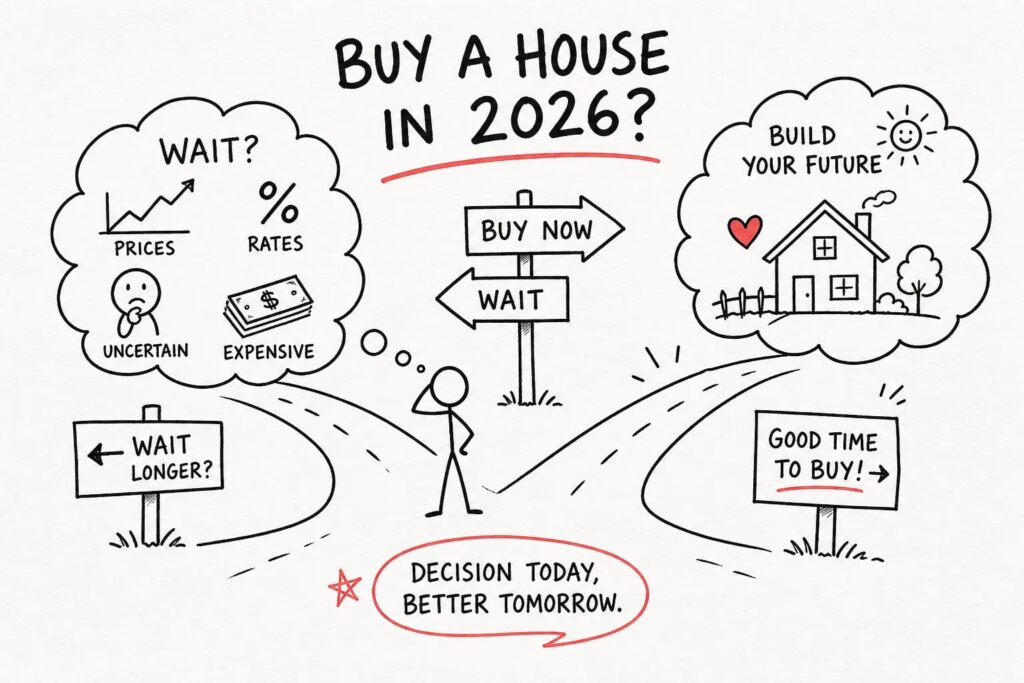
Is now a good time to buy a house in 2026? That question is harder to answer than it looks. Mortgage rates, according to Freddie Mac’s weekly survey, remain near their highest levels since 2022, 2023. Home prices haven’t fallen the way buyers hoped they would. And yet, thousands of people are closing on homes every week, building equity, and locking in a fixed housing cost before rents climb another year. If you’re caught between those two realities, you’re not alone. The question deserves a better answer than “it depends on your situation.”
This article gives you that better answer. At Isabelle Mortgages, we work with real buyers making this exact call every week, from first-generation families navigating the process for the first time, to investors evaluating cash flow in a shifting market, to move-up buyers trying to time two transactions at once. What we’ve learned is that the right answer isn’t driven by national headlines. It’s driven by three things: your local market conditions, your financial readiness, and your timeline. Walk through everything below and you’ll have a clear framework to decide.
Where the 2026 housing market actually stands
Mortgage rates: higher than last year, and what that costs you monthly
As of early October 2026, the 30-year fixed mortgage rate sits at approximately 7.46%, and the 15-year fixed is around 6.61%, based on lender survey data. A year ago, those same products were at 6.34% and 5.55% respectively. That gap matters in real dollars. On a $400,000 loan, the jump from 6.34% to 7.46% adds roughly $280 to $310 to your monthly principal and interest payment. That’s not a rounding error. It’s the cost of waiting a year in a rising-rate environment, and it’s the number every buyer needs to plan around honestly.
Rates did dip earlier in 2026, near February, before climbing again through the spring and sharply in late September and early October. Neither Fannie Mae nor Freddie Mac projects a return to 5% or below in the near term. Plan for the rate environment you’re in, not the one you hope arrives.
Home prices: modest national gains, but your market may look very different
The national median home-sale price is running between $395,000 and $409,000 depending on the month and data source, with year-over-year gains of roughly 2.1% to 2.6%. That sounds modest and stable, but the national number hides dramatic regional variation. San Francisco is up around 9% year-over-year. Pittsburgh is up over 9%. West Palm Beach is up 8.6%. Meanwhile, Seattle is down nearly 5%, San Jose is down around 4%, and Dallas-Fort Worth is posting negative year-over-year numbers too.
The lesson here is straightforward: national headlines are poor predictors of what’s happening in the specific market where you want to buy. Before you make any decision, you need to know what prices are doing in your target zip code, not in a composite of 300 metros.
Is now a good time to buy a house in your local market? Check the inventory first
National existing-home supply is around 3.9 to 4.5 months, but the more interesting story is what’s happening in Sun Belt and Florida markets. Miami sits at over 7 months of supply, with some data snapshots showing figures as high as 11 months depending on the dataset and date. Orlando is around 7.4 to 8.2 months. Tampa is near 7 to 7.9 months. Austin is approaching 6.5 months or more depending on the source. Any market above 6 months is technically a buyer’s market, and in those cities, buyers have real leverage right now: more homes to choose from, more room to negotiate on price and seller concessions, and far less pressure to waive inspections or bid blindly over asking price.
If you’re targeting one of these markets, you’re operating in a fundamentally different competitive environment than someone buying in a supply-constrained Northeast corridor city. That context changes the entire calculus.
The honest rent-vs-buy math at today’s rates
What buying a $400,000 home actually costs each month
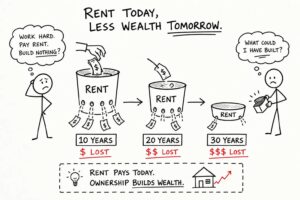
Consider this real example worked through with current numbers. On a $400,000 home with 20% down and a 30-year mortgage at 6.5%, your principal and interest payment is roughly $2,023 per month. Add property taxes at 1.1% annually ($367/month), homeowner’s insurance at 0.5% annually ($167/month), and a maintenance reserve at 1% annually ($333/month), and your total monthly ownership cost is approximately $2,890. If the comparable rental in that same market runs $2,400 per month, you’re paying about $490 more per month to own, before factoring in the opportunity cost of the $80,000 down payment sitting in equity rather than in investments.
The full picture matters. Too many buyers compare only the mortgage payment to rent. The honest comparison includes taxes, insurance, maintenance, and what that down payment could otherwise earn. Run the complete number before you decide.
The five-year vs. seven-year breakeven, and why your timeline matters most
Using the assumptions above (3% annual appreciation, 3% annual rent growth, 4% investment return on cash), five years of ownership often falls short of fully recouping transaction costs and forgone investment returns when compared to renting and investing the difference. The true crossover point tends to land closer to year six or seven. This is why timeline is the single most important personal variable in the rent-vs-buy decision.
A useful shortcut is the price-to-rent ratio. Take the home price and divide it by 12 months of comparable rent. At $400,000 and $2,400 per month, that ratio is about 13.9. Below roughly 15, buying becomes financially competitive by the five-to-seven year mark. Above 20, renting tends to win at both horizons. These thresholds reflect widely used buy-vs-rent calculator frameworks and national research on breakeven assumptions. Calculate this number for your specific market before going further, because local ratios vary enormously from city to city.
How to know if you’re personally ready to buy right now
The three financial checkpoints that lenders actually use
Credit score, debt-to-income ratio, and down payment are the three gatekeepers to loan approval. A score above 740 unlocks the best available rates. Scores between 620 and 679 still qualify for many loan programs, FHA guidelines allow scores as low as 580 with a 3.5% down payment in many cases, though individual lender overlays vary, but at meaningfully higher rates that compound over the life of the loan.
A debt-to-income ratio at or below 43% is the conventional cutoff, though some programs allow higher DTI with compensating factors. A down payment below 20% triggers private mortgage insurance, which adds to your monthly cost, though down payment assistance programs in states like California, Texas, Florida, and New York, including CalHFA Dream For All, TDHCA My First Texas Home, Florida Housing Finance Corporation programs, and SONYMA’s HomeFirst program, can significantly reduce this barrier for qualifying buyers. Eligibility rules and funding availability change frequently, so confirm current program status directly.
Knowing exactly where you stand on all three checkpoints before you start shopping is the foundation of a smart buying process. Guessing wastes time and can lead to disappointment at the offer stage.
Stability factors that matter as much as your credit score
Financial readiness isn’t just about qualifying for a loan. It’s about whether buying makes sense for your life right now. Employment stability, income consistency, and the likelihood of staying in the same area for at least five to seven years all factor into whether ownership works in your favor. If any of those are in flux, whether you’re considering a job change or relocation, or if your income is still growing and inconsistent, waiting is often the smarter financial move regardless of what rates or prices are doing.
One more check that’s often overlooked: your emergency fund. If closing costs and the down payment wipe out your reserves entirely, you’re starting homeownership in a financially fragile position. A maintenance emergency in month two shouldn’t derail your finances.
Which buyer profiles actually benefit from acting now
First-generation buyers: why the compounding math favors starting sooner
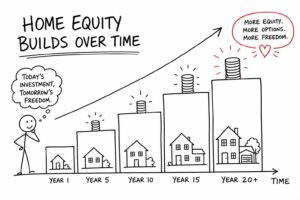
Research from the Pew Research Center and FHFA data on household wealth consistently shows that homeowners accumulate significantly more wealth over time than renters with comparable incomes. Every year of delayed homeownership is a year of equity not building and appreciation not compounding. First-generation buyers, those navigating a home purchase without family guidance or inherited equity, face a steeper starting line. But they also have the most to gain from entering the market early and staying in. The wealth gap between homeowners and renters narrows through buying and holding, not through waiting.
Buyers in this category especially benefit from working with a dedicated mortgage advisor who can identify programs a traditional bank will never bring up: FHA loans with lower down payment thresholds, state-level down payment assistance, and grant programs specific to first-generation buyers. The Gen-First Mortgage Method™ at Isabelle Mortgages is a proprietary advisory framework built specifically around this buyer profile. We don’t just process a loan application; we assess the full financial picture and map out the loan path that actually works for a first-gen buyer’s income type, credit history, and long-term goals.
Investors and move-up buyers: where the 2026 market creates real opportunity
In markets with seven-plus months of supply, particularly across Florida, Texas, and parts of the Southeast, buyers have genuine negotiating leverage that didn’t exist two years ago. Sellers are cutting prices, offering concessions, and sitting on the market longer. For real estate investors evaluating rental cash flow at current rates, the math requires careful underwriting, but softer purchase prices offset some of the rate drag. For move-up buyers who can sell in a competitive market and buy in a softer one, this type of inventory environment creates meaningful opportunity.
The key for investors is running the full cash flow analysis with current rates baked in, not projecting with rates from two years ago. The deals that work in today’s environment are different from what worked in 2021, and that’s fine. They still exist. You just need to find them with accurate numbers.
When waiting actually makes sense
If your DTI is strained at today’s rates, your down payment isn’t ready, or you’re likely to relocate within three to four years, waiting is the financially sound call. This isn’t pessimism. It’s the advisor perspective that serves buyers better than rushing into a loan that doesn’t fit. A buyer who stretches too thin today is more vulnerable to any shift in income, expenses, or market conditions. Use a waiting period to improve your credit score, reduce existing debt, and build your down payment. Arrive at the purchase with strength, not desperation.
What experts project for the next 12 months, and the real cost of waiting
What NAR, Fannie Mae, Freddie Mac, and other forecasters are projecting
The consensus across major forecasters, Fannie Mae, Freddie Mac, J.P. Morgan, and Case-Shiller economists, points in the same direction: national home prices will appreciate roughly 1% to 3% over the next 12 months, with most projections clustering near 1% to 2%. Fannie Mae’s September forecast shows price growth slowing from 2.3% in Q4 2026 to 1.3% in Q1 2027 and under 1% by mid-2027. J.P. Morgan and Case-Shiller economists project near-flat appreciation for 2026. No major forecaster is projecting a broad national price crash. Fannie Mae has 30-year rates sitting around 6.7% to 6.8% through most of 2027.
This is not a market on the verge of a dramatic correction. It’s a slow-growth market with elevated rates and gradually improving inventory. The gap between what buyers hoped for and what the market is delivering is real, but it’s not closing fast in either direction.
Why “I’ll wait for rates to drop” is a gamble, not a strategy
Historical patterns show that when rates fall even half a percentage point, buyer demand typically surges, available inventory tightens, and home prices rise to absorb the increased purchasing power flooding the market. The buyer who waits for a 6.5% rate and then competes against 15 other offers on the same property often pays more for the house than they saved on the rate. The arithmetic of waiting rarely pencils out the way buyers expect.
Refinancing when rates fall is always an option. Buying the house you missed is not. If you qualify today, buying now and refinancing later is a viable path. Waiting indefinitely for the perfect rate while prices and competition absorb any rate improvement is a cycle that keeps buyers on the sidelines longer than they intend to be.
Is now a good time to buy a house? A simple decision checklist
Five questions that cut through the noise
Work through these five questions honestly. They map directly to the variables that determine whether buying now is the right move for you personally.
- Do you plan to stay in this home or market for at least five to seven years? If the answer is no, or even “probably not,” the transaction costs alone make buying a losing proposition at current prices.
- Is your DTI comfortably below 43% at current rates with the home you’re targeting? Run the actual numbers with the current rate, not a rate you’re hoping for.
- Is your local market in buyer’s territory, with six-plus months of supply and room to negotiate? Your leverage depends entirely on local inventory, not national averages.
- Is your emergency fund intact after making the down payment and covering closing costs? Arriving at homeownership without reserves is a risk that shows up fast.
- Do you have professional guidance tailored to your specific financial profile, income type, and loan options? This matters more than most buyers realize, especially for self-employed buyers, first-generation buyers, and investors whose situations don’t fit a standard qualification template.
The right next step for your buyer profile
If you answered yes to most of those questions, the move is to get a full pre-approval, not a pre-qualification estimate, and understand exactly what you qualify for at current rates. A pre-approval tells you your real price range, surfaces any issues before you’re under contract, and signals to sellers that you’re a serious, prepared buyer in a market where many buyers are hesitating.
For first-generation buyers especially, a mortgage advisor who examines your income type, credit profile, assistance program eligibility, and loan options makes the difference between guessing and knowing. That’s what Isabelle Mortgages is built to deliver: not to rush anyone into a loan, but to give every buyer a clear, honest picture of where they stand and what the best path forward actually looks like. Reach out to our team and we’ll build that picture together.
The bottom line on buying a home in 2026
Whether it’s a good time to buy a house depends far less on national headlines than on three personal variables: your local market conditions, your financial readiness, and your timeline. Rates are elevated and that’s real. But buyer leverage in Florida, Texas, and across the Sun Belt is also real. Prices are growing slowly, and waiting carries its own costs in both forgone equity and the risk of buying into a more competitive market when rates eventually ease.
Buyers who meet the financial checkpoints, a stable DTI, a ready down payment, and a five-plus year plan, have a genuine case for moving forward. Those who don’t should use this period to close the gaps and arrive at the purchase from a position of strength. Either way, the first step is knowing exactly where you stand. Stop guessing and get the clarity you need to make a confident call.