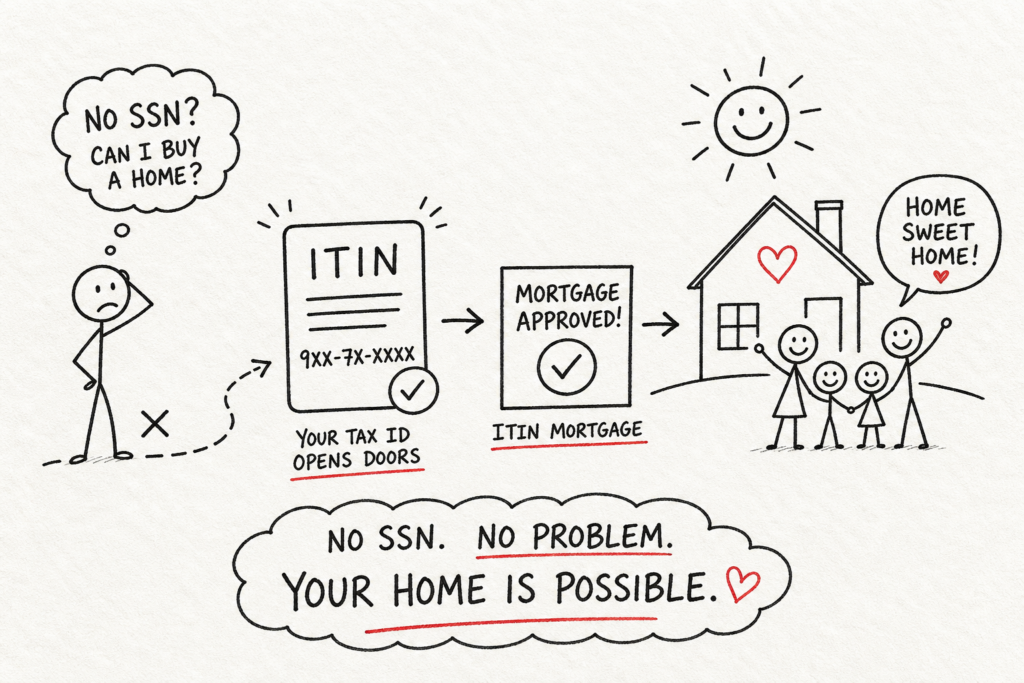
An ITIN mortgage loan makes it possible to buy a home in the United States without a Social Security Number. That’s not a loophole or a rumor; it’s a legitimate, legal path that thousands of ITIN holders use every year to become homeowners. The myth that only SSN holders can access the mortgage market has kept too many families on the sidelines for too long, and this guide exists to dismantle it completely.
An ITIN mortgage loan is a real product offered by real lenders, built specifically for people who file U.S. taxes using an Individual Taxpayer Identification Number. Whether you’re a non-permanent resident or a self-employed entrepreneur with U.S.-sourced income, this loan category was designed with you in mind. At Isabelle Mortgages, we’ve guided ITIN borrowers through this exact process in both English and Spanish, using our Gen-First Mortgage Method™ to make every step clear and manageable.
By the time you finish reading, you’ll know what an ITIN mortgage loan actually is, whether you qualify, exactly what documents to gather, what rates and costs to expect, which lenders to consider, and the specific steps to start your pre-approval. Here’s everything you need to know before your first conversation with a lender.
What an ITIN mortgage loan is (and why it exists)
An ITIN mortgage loan is a non-QM (non-qualified mortgage) product. That means it operates outside the rules that govern conventional loans backed by Fannie Mae or Freddie Mac, and it’s entirely separate from government programs like FHA, VA, or USDA. Those programs require a Social Security Number, so they’re off the table for ITIN holders. Non-QM ITIN loans fill that gap by allowing lenders to write their own underwriting guidelines and hold the loans in their own portfolio rather than selling them on the secondary market. For a practical overview of ITIN home loan options, see this guide to ITIN home loans.
This loan category was created for U.S. residents and tax filers who don’t hold an SSN: non-permanent residents, individuals with ITIN-based tax histories, and others with verifiable U.S.-sourced income. It is not the same as a Foreign National loan, which serves non-residents with no U.S. income or tax presence. If you live here, work here, and file taxes here using an ITIN, you’re the borrower this product was built for.
How it differs from conventional and FHA loans
Conventional loans are typically sold to government-sponsored entities (Fannie Mae and Freddie Mac) after closing and must follow their strict eligibility rules, including SSN requirements. FHA loans are FHA-insured and follow HUD guidelines that similarly require a Social Security Number. ITIN loans, by contrast, are typically held in portfolio by the originating lender. Because lenders keep these loans on their own books, they can set flexible income documentation standards, accept alternative credit, and skip the SSN requirement entirely. The trade-off is that lenders charge slightly higher rates to compensate for the additional long-term risk they’re absorbing.
Who these loans are actually designed for
The primary borrower profile is someone who has lived and worked in the U.S., files taxes with an ITIN, and has been building credit and financial history here over time. That includes salaried employees with ITIN-linked pay stubs, self-employed entrepreneurs with business bank statements, and mixed-income households where at least one borrower holds an ITIN. This is a growing segment of the non-QM mortgage market with multiple active lenders and defined program guidelines, not a niche product buried in fine print.
Do you qualify? The real eligibility criteria for an ITIN loan
Qualification for an ITIN mortgage is more straightforward than many people expect, but it does require preparation. Lenders assess the same core factors they examine in any loan: creditworthiness, income stability, assets, and property. The difference is in how they measure those factors when an SSN isn’t part of the picture.
Credit score, employment, and income thresholds
ITIN mortgage lender requirements vary, but most programs in 2026 look for a credit score somewhere in the 580 to 680 range as a starting point, with better rates available above 700. Some lenders set their minimums at 660, while others accept lower scores depending on the overall strength of the file. If you have no traditional FICO score because you’ve built your financial life outside the U.S. credit system, many lenders will accept 12 months of on-time rent payments, utility bills, and similar payment records as alternative credit. That accommodation opens the door for borrowers who have been financially responsible without ever holding a credit card.
On the income side, lenders want to see a 2-year history of stable employment or self-employment. Your debt-to-income ratio (DTI) can go up to 45 to 50 percent, which is more flexible than conventional lending. Self-employed borrowers are well-served here: instead of W-2s, you can qualify using 12 to 24 months of business bank statements, a profit and loss statement, and 1099s or business tax returns.
Down payment and cash reserves
Plan for a down payment of 10 to 20 percent, tied to your credit tier. Borrowers with stronger credit scores and income documentation can often qualify at 10 to 15 percent down, while lower credit profiles will require 20 percent or more. The logic is straightforward: more equity reduces the lender’s risk on a portfolio loan they hold long-term. One meaningful advantage: many ITIN programs require no PMI at 20 percent down. Conventional loans require private mortgage insurance below that threshold, which adds hundreds of dollars per month. At 20 percent down on a portfolio ITIN mortgage, that cost typically disappears entirely, confirm this with your specific lender. Most lenders also require 2 to 6 months of cash reserves after closing, so factor that into your savings target alongside the down payment and closing costs.
The document checklist: what to gather before you apply
Having your documents organized before you speak to a lender is one of the most effective things you can do to speed up the process and reduce stress. Lenders review your file in a logical sequence: identity first, then income, then assets. Building your file in that same order helps the process move without unnecessary back-and-forth.
Identity, ITIN verification, and residency proof
Your lender will need your IRS ITIN letter, either the CP565 (original assignment) or CP567 (revalidation). Pair that with a valid passport or government-issued photo ID that shows your name, date of birth, address, and expiration date. For proof of U.S. residency, gather two to three utility bills or a current lease agreement showing your address. One important note: lenders require originals or certified copies of identity documents, not photocopies. Having these ready before your first conversation signals to the lender that you’re organized and prepared, which matters.
Income documentation and bank statements
Your income documentation depends on how you earn. W-2 employees need 30 days of recent pay stubs plus two years of U.S. federal tax returns filed with your ITIN. Self-employed borrowers need 12 to 24 months of personal and business bank statements, a profit and loss statement, and any 1099s or business returns that support your income picture. For your down payment and reserves, gather two to three months of asset statements showing where the funds are coming from. If any of the down payment is a gift, you’ll need a gift letter from the donor confirming no repayment is expected.
Rates, costs, and ITIN mortgage loan underwriting differences
ITIN mortgages cost more than conventional loans, and you should go into this knowing exactly why. Because lenders hold these loans in portfolio and carry the long-term risk themselves, that risk is priced into the interest rate. The premium is real but manageable, and understanding it helps you negotiate and compare lenders effectively.
What to expect on interest rates compared to conventional loans
In 2026, conventional 30-year fixed rates are hovering in the 6.0 to 7.0 percent range. ITIN loans typically price at 0.5 to 1.5 percentage points above that baseline, putting most borrowers in the 7.0 to 8.0 percent range. On a $350,000 loan at 30-year fixed terms, a one-point rate difference translates to roughly $200 more per month, meaningful, but worth weighing against the alternative of continuing to rent. A stronger credit profile (700 or above), a 20 percent down payment, and documented stable income will all push your rate toward the lower end of that range. When comparing lenders, always look at the APR, not just the interest rate. The APR includes lender fees and gives you a true apples-to-apples comparison.
Loan terms, limits, and mortgage insurance rules
ITIN home loans are available in 15-year and 30-year fixed terms, with loan amounts reaching $1.25 million to $1.5 million depending on the lender and the borrower’s profile. Closing costs run 3 to 5 percent of the loan amount, so build that into your planning alongside the down payment and reserves. As noted above, borrowers who put down 20 percent or more typically avoid PMI entirely with portfolio ITIN programs. That’s a significant cost advantage worth targeting, even if it means saving for a few more months before applying.
ITIN mortgage lenders worth knowing in 2026
The ITIN lending market has grown considerably, and there are now several national programs worth evaluating. Not all of them offer the same level of communication, flexibility, or borrower support, especially for Spanish-speaking clients or those with non-traditional income.
National programs and what they offer
Here are five active national programs in 2026 that specifically serve ITIN borrowers. Use this as a starting point for comparison, not a ranking:
- Guild Mortgage: Purchase, rate/term, and cash-out refinance; credit scores from 660; loan amounts up to $1.25M; 15 percent minimum down payment.
- CrossCountry Mortgage (CCM Signature Expanded ITIN): Covers primary homes, second homes, and investment properties; 10 percent minimum down; full-doc and bank statement options.
- First National Bank of America: Purchase or refinance; no SSN required; accepts borrowers with no credit history; gift funds allowed; no prepayment penalties.
- Angel Oak Mortgage Solutions: 12 or 24-month bank statement income option; loan amounts up to $750,000 for purchase and rate/term refinance; primary residences only.
- Quontic (CDFI): Flexible qualification for primary residences and investment properties; community development focus.
Terms change frequently, and your specific scenario, credit score, income type, down payment, will determine which program actually fits. Verify current guidelines directly with each lender, as program details are subject to change.
Why a bilingual ITIN mortgage specialist changes the outcome
ITIN mortgage approval often doesn’t come down to the numbers alone. It comes down to how your income is documented and presented to underwriting. A lender who works with ITIN borrowers regularly knows how to structure a self-employed file, how to present alternative credit, and how to anticipate the questions an underwriter will ask before they ask them. That experience is the difference between a clear approval and a frustrating denial.
At Isabelle Mortgages, this is work we do every day. Our Gen-First Mortgage Method™ was built specifically for borrowers who are navigating the U.S. mortgage system without a family roadmap, and ITIN borrowers are very often in exactly that position. We offer bilingual service in English and Spanish, one-on-one guidance from application to closing, and direct experience presenting complex income files to non-QM underwriters. If you want a lender who treats your file as a person, not a transaction, that’s what we’re built for.
Your next steps: a practical path to pre-approval
Here’s how to move from this article to a pre-approval letter in four focused steps. The review process typically takes one to two weeks once your file is complete.
Steps 1 through 4: prepare, check, and gather
- Confirm your ITIN is current and valid. Log into IRS records or call the IRS to verify your ITIN hasn’t expired. Expired ITINs must be revalidated before a lender can use them for underwriting.
- Pull your credit and review it before a lender does. Aim for 600 or above. If gaps exist, missed payments, thin history, or errors, address them now rather than discovering them mid-application. For general guidance on credit scores and mortgage readiness, see this credit score for mortgage resource.
- Compile your document file using the checklist above. ITIN letter, tax returns, income documentation, ID, proof of residency, and asset statements. The more complete your file at submission, the faster the process moves.
- Have your savings positioned correctly. Target 15 to 20 percent for the down payment, plus 3 to 5 percent for closing costs, plus 2 to 6 months of mortgage payments in reserve. Those three buckets are what underwriting will verify.
What happens after you submit your application
After you submit, the lender moves into underwriting, which typically takes two to four weeks for ITIN loans. Non-QM underwriting is largely manual rather than automated, which means it takes more time than a standard conventional loan, but it also means a human being is reviewing your complete financial picture, not an algorithm looking for SSN-linked data points. You’ll receive a conditional approval first, with a list of any additional items needed, followed by a clear-to-close once those conditions are satisfied. Total time from application to closing typically runs 30 to 45 days.
When you’re ready to take that first step, reach out to Isabelle Mortgages for a personalized consultation. We’ll review your ITIN status, income documentation, and credit picture, and give you a clear read on where you stand before you invest more time in the process. No pressure, no surprises, just an honest look at your path forward.
Homeownership is not reserved for SSN holders
Not having a Social Security Number does not disqualify you from owning a home in the United States. It changes which loan product you use, not whether you can access the market at all. Thousands of ITIN holders close on homes every year through legitimate programs designed exactly for their situation.
Here’s what you now know: ITIN mortgage loans are non-QM portfolio products available from multiple national lenders in 2026. Qualifying requires a valid ITIN, 2 years of tax history, a credit score in the 580 to 680 range (or strong alternative credit), 10 to 20 percent down, and organized income documentation. Rates run slightly higher than conventional, but no PMI at 20 percent down offsets that gap meaningfully. With the right lender in your corner, the process is far more manageable than most people expect.
At Isabelle Mortgages, we believe buying your first home is more than a transaction. It’s how families build something that outlasts the mortgage itself. If you or someone you love holds an ITIN and wants to explore what homeownership looks like this year, contact us for a bilingual consultation. We’re here to walk you through every step, in the language that works best for you.