
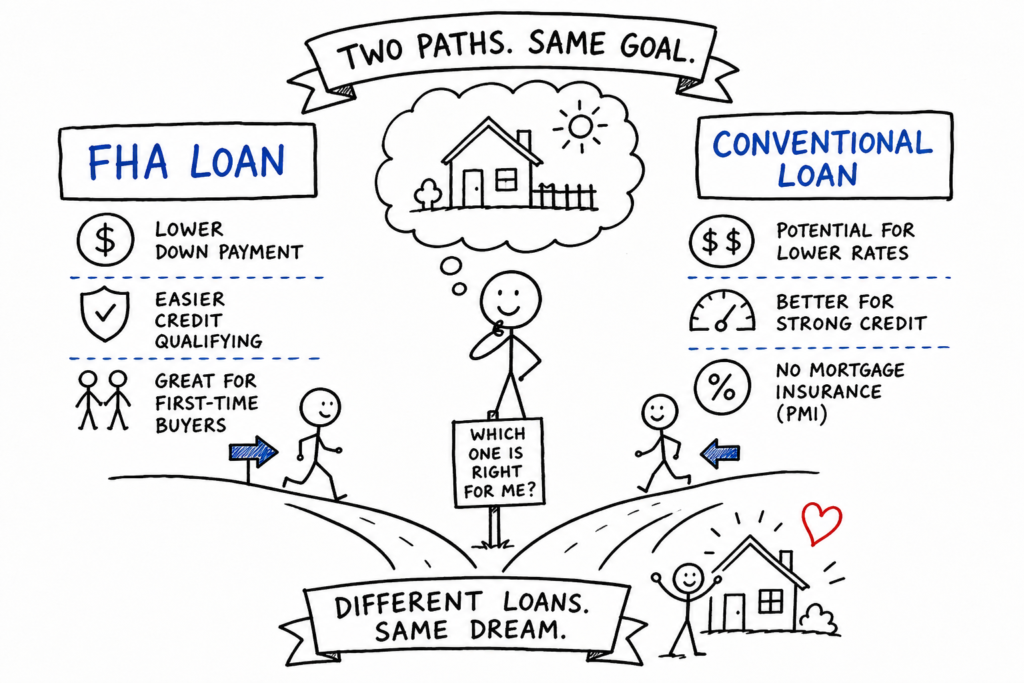
If you’ve been asking yourself “what is the difference between FHA and conventional loans,” you’re not alone. You’ve done your research, saved some money, and then a lender or real estate agent tells you to “just pick between FHA and conventional.” Simple enough, right? Except nobody explained what that actually means, and suddenly you’re staring at two loan types with different rules, different costs, and different long-term consequences.
The right choice comes down to four things: your credit score, how much you’ve saved for a down payment, the price of the home you’re targeting, and how long you plan to stay. Get clear on those four factors, and this decision stops feeling confusing. It becomes a straightforward match between your profile and the loan that fits it best.
At Isabelle Mortgages, the Gen-First Mortgage Method™ was built specifically to walk buyers through crossroads like this one, especially first-generation buyers navigating the mortgage process without family experience to lean on. By the time you finish reading, you’ll know which loan fits your situation and exactly what to do next.
What is the difference between FHA and conventional loans: core structural differences
FHA loans are government-backed, meaning they’re insured by the Federal Housing Administration. That insurance doesn’t protect you as the borrower; it protects the lender. If you default, the government covers the lender’s loss. Because lender risk is reduced, lenders can offer more flexible qualifying criteria to borrowers who might not meet the bar for a standard loan.
Conventional loans work differently. They’re privately funded and not government-insured, which means the lender carries the full risk of lending to you. Think of it this way: FHA is like having a co-signer behind you at the closing table, someone who reassures the lender if things go sideways. Conventional means going it alone, where your credit and financial profile have to stand on their own. That structural difference is the primary driver behind every major distinction between these two loan types, including rate pricing, insurance requirements, and underwriting flexibility.
What “government-backed” actually means for your approval odds
Because the FHA assumes the default risk, lenders can approve borrowers they might otherwise decline. Lower credit scores, smaller down payments, and higher debt-to-income ratios are all more manageable under FHA guidelines. According to HUD data, approximately 82% of FHA purchase loans in recent fiscal years went to first-time buyers, which is why FHA consistently serves as the entry point for first-time buyers, Home Buying Guidelines: First-Gen Path to Mortgage Freedom, and anyone still building their credit profile.
Where conventional loans fit in the market
Conventional loans follow guidelines set by Fannie Mae and Freddie Mac and represent the most widely used loan type in the U.S. “Conventional” doesn’t mean better; it means a different eligibility structure and a different cost model. For buyers with strong credit and solid savings, conventional often delivers lower total costs over time. For buyers still building those foundations, it’s a harder bar to clear.
Down payment requirements: what each loan actually demands
On a $300,000 home, a 3.5% FHA down payment is $10,500. A 5% conventional down payment is $15,000. That $4,500 difference is meaningful when you’re pulling together savings from scratch. Understanding what each loan actually requires, not just the headline percentages, helps you plan with real numbers.
FHA’s 3.5% rule and who qualifies for it
FHA ties your minimum down payment directly to your credit score. A 580 or higher FICO unlocks the 3.5% minimum. If your score falls between 500 and 579, FHA requires 10% down, on that same $300,000 home, that means $30,000 instead of $10,500. Below 500, FHA financing isn’t available. One major advantage: FHA allows gift funds from family members, employers, or down payment assistance programs to cover the entire 3.5%, with no requirement that you contribute personal funds. For more detail on typical amounts and scenarios, see this guide to FHA down payment requirements.
Conventional’s 3%, 20% range and the PMI trade-off
Conventional loans offer 3% down payment options through Fannie Mae’s HomeReady and Freddie Mac’s Home Possible programs, both designed for buyers at or below 80% of area median income with a minimum 620 credit score. Standard conventional products typically require 5%. The real prize comes at 20% down: no private mortgage insurance (PMI) at all, which eliminates an ongoing monthly cost that can run hundreds of dollars. For buyers who can reach that threshold, the long-term savings are significant. If you want to estimate current PMI costs for your credit profile and loan size, try this PMI calculator.
Credit score thresholds and the reality of lender overlays
The official minimums tell part of the story. What happens in practice is a different conversation. FHA officially accepts credit scores as low as 500, but most lenders apply what’s called an overlay, an internal policy that sets a stricter floor than the government requires. In practice, most FHA lenders want a 620 to 640 minimum, which means the 500 floor is technically available but rarely accessible without significant lender shopping. For the official published details on FHA credit behavior and qualifications, see the FHA’s own summary of FHA credit requirements.
A lender overlay is simply a private rule layered on top of the government guideline. A lender might follow FHA’s 500-floor rule on paper but choose not to approve anyone below 640. It’s legal, and it’s common. This is why shopping multiple lenders matters as much as knowing the official requirements.
What is the difference between FHA and conventional loans for credit score requirements
FHA’s official standard is 580 for 3.5% down and 500, 579 for 10% down. In practice, most lenders overlay at 620 to 640, making the 500, 579 range difficult to finance despite being technically eligible. If your score sits between 620 and 679, FHA often produces better rate pricing than conventional, because the government backing offsets the credit-risk pricing penalties that hit conventional borrowers hard in that range.
Conventional credit requirements and what 680+ unlocks
Conventional loans officially start at 620, but the practical floor at most lenders is 640 or higher due to overlays. The real advantages of conventional unlock at 680 and above: better rate tiers, lower PMI costs, and access to low-down-payment programs like HomeReady and Home Possible. At 700 and above, conventional delivers the lowest available pricing, and at 740 or higher, it consistently beats FHA on both rate and total cost.
Mortgage insurance: the cost that changes the long-term math
Here’s where most buyers’ thinking about FHA shifts. Yes, it’s easier to qualify for. But it comes with a mortgage insurance structure that’s more expensive over time for many borrowers, specifically because it doesn’t go away the way conventional PMI does.
FHA charges two layers of mortgage insurance. The upfront MIP (mortgage insurance premium) is 1.75% of the loan amount, charged at closing but financeable into the loan so you don’t pay it out of pocket. On a $300,000 loan, that’s $5,250 added to your balance. Then there’s the annual MIP, which ranges from 0.55% to 0.85% of the loan, divided into monthly payments. On a $300,000 loan at 0.55%, that’s roughly $137 per month added to your payment.
FHA’s upfront MIP and annual premium: what you’ll actually pay
Unlike conventional PMI, FHA’s annual MIP rate doesn’t vary with your credit score. A borrower with a 580 and a borrower with a 720 pay the same MIP rate. That standardization helps buyers with lower scores but removes the pricing advantage that better-credit borrowers get on conventional. More critically, FHA MIP lasts for the life of the loan in most cases. The only exception: if your down payment exceeds 10%, MIP can be canceled after 11 years.
Conventional PMI rules and the cancellation advantage
Conventional PMI is priced by credit score and LTV. At a 760+ FICO, PMI runs about 0.46% annually. At 620, 639, it can reach up to 1.50% annually. For borrowers with strong credit, conventional PMI costs less than FHA MIP and comes with a critical benefit: it’s legally cancellable. Once your equity reaches 20%, you can request removal. At 78% LTV with on-time payments, it drops off automatically. For buyers planning to build equity over time, the ability to eliminate PMI entirely is a major long-term cost advantage over FHA’s lifetime MIP structure.
2026 loan limits and interest rate differences by credit profile
Loan limits determine whether you can even use a particular loan type for your target property. In 2026, FHA’s floor sits at $541,287 for single-family homes in low-cost areas, with a ceiling of $1,249,125 in high-cost counties. In Florida specifically, Miami-Dade, Broward, and Palm Beach counties sit at $667,000 for single-family homes. Orange County (Orlando) is set at $564,250. The conforming loan baseline for conventional sits at $832,750 nationally. To confirm county-level ceilings and where FHA applies in your market, check current FHA loan limits.
How 2026 FHA and conforming limits affect your eligibility
If your loan amount exceeds the FHA limit for your county, FHA simply isn’t available and conventional becomes the path. Loans above the conforming baseline ($832,750) enter jumbo territory, which brings stricter requirements: typically 700 or above FICO, larger post-closing reserves, and fewer lender options. For buyers in markets like South Florida or coastal California, checking your specific county limit before choosing a loan type isn’t optional, it’s the first filter.
Rate comparison by credit profile in 2026
As of May 2026, national averages show 30-year FHA rates at approximately 6.24% versus conventional at 6.45% for moderate credit profiles. For borrowers in the 620, 680 range, FHA’s government backing keeps rates roughly 0.10% to 0.21% lower than conventional. For borrowers at 740 and above, the dynamic flips: conventional rates run 0.25% to 0.50% lower, and without lifetime MIP dragging on total cost, the conventional advantage compounds significantly over a 30-year term.
Which loan fits your situation, and what to do next
Neither loan is universally better, each one wins in specific situations. Matching your buyer profile to the right loan structure is what turns this comparison from abstract to actionable.
FHA is likely your match if these apply
Your credit score falls between 580 and 679, your down payment savings are under 10%, or you’re combining FHA with a down payment assistance program. FHA also makes sense for first-generation buyers who need maximum underwriting flexibility, particularly those with self-employment income or non-traditional documentation, FHA’s DTI guidelines allow up to 50% with compensating factors, giving more room to qualify. Keep in mind that because MIP lasts the life of the loan for most FHA borrowers, the lower entry barrier comes with a long-term cost. For buyers planning to stay in the home and build equity, that permanent MIP is worth comparing carefully against conventional’s cancellable PMI before committing.
Conventional likely fits better if these apply
Your score is 680 or above, you can reach 5% to 20% down, or your target home price is pushing toward or above local FHA loan limits. Conventional also wins for buyers who want to eliminate PMI within a few years through equity building, and for investors or buyers with stronger profiles who want the best rate pricing available. The long-term math strongly favors conventional for anyone who can clear the higher qualification bar.
Getting personalized guidance before you apply
For first-generation buyers navigating this process without family experience to lean on, and especially for buyers working through this in English and Spanish, no article replaces a real conversation with someone who knows your actual credit score, income documentation, and down payment reality. The difference between the wrong loan and the right one can mean tens of thousands of dollars over the life of the mortgage, when you factor in cumulative MIP versus PMI costs and rate differences across 30 years. At Isabelle Mortgages, the Gen-First Mortgage Method™ walks you through exactly this comparison using your specific numbers, with one-on-one guidance in English and Spanish, so you understand every step before you sign anything. If you’d like a guided checklist, see our Step by Step Guide to Confident Mortgage Planning for First Generation Homebuyers, Isabelle Mortgages.
Now that you understand what is the difference between FHA and conventional loans, the path forward is clearer than it probably felt at the start. Pull your credit score, calculate what you have available for a down payment, and check whether your target property falls within the 2026 FHA limits for your county. Those three steps will point you directly toward your answer.
This decision is more than paperwork. It’s the first step toward building the kind of financial foundation that changes what the next generation inherits. When you’re ready to talk through your numbers and make the right call for your family, Isabelle Mortgages is ready to have that conversation with you, and you can always explore more resources on our Blog, Isabelle Mortgages.