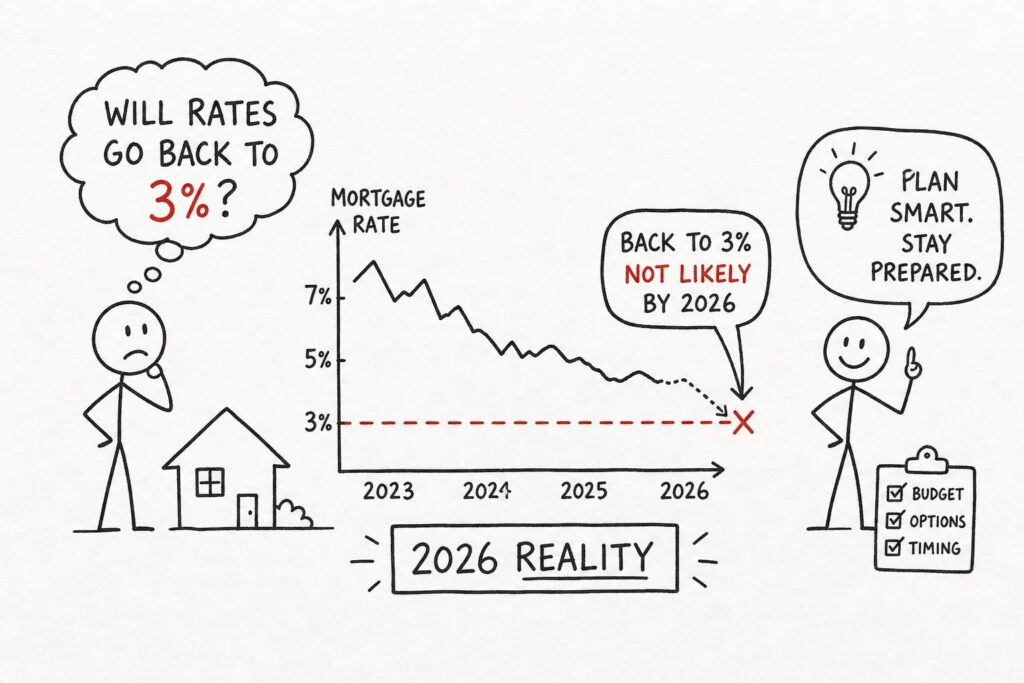
Will mortgage rates go back to 3 percent? That question is on more buyers’ minds than almost any other in 2026. The average 30-year fixed mortgage rate sits at 7.28% as of October 2026, and the gap between today and the pandemic-era lows feels both financially painful and frustratingly recent. The math is punishing: on a $400,000 loan, the difference between a 3% rate and a 7% rate is roughly $975 per month. That’s not a rounding error. That’s a car payment or a meaningful chunk of retirement savings, every single month. Whether you should wait for rates to fall, or act now and refinance later, depends on understanding what actually drives mortgage rates and what a return to 3% would require.
At Isabelle Mortgages, clients raise this question constantly. The honest answer isn’t a simple yes or no. It requires understanding where mortgage rates actually come from, what conditions created those historic lows, and what would realistically need to happen for them to return. This article gives you that clear-eyed analysis, along with practical steps buyers can take right now while the market is what it is.
Will mortgage rates go back to 3 percent? The quick answer and outlook
Based on current data and every major forecaster’s projections, mortgage rates returning to 3% within the foreseeable future is extremely unlikely, absent an economic crisis severe enough that most people wouldn’t want to live through it. The current baseline tells the story clearly. As of October 1, 2026, the average 30-year fixed rate is 7.28% (per Freddie Mac’s Primary Mortgage Market Survey), up from roughly 6.3% a year ago. That’s a significant climb in 12 months. But the common assumption is wrong: mortgage rates track the bond market, not the Fed’s overnight rate.
Treasury yield and mortgage rates: why it matters
Mortgage rates track the 10-year Treasury yield far more closely than the overnight federal funds rate. Right now, the 10-year yield sits at approximately 5.28% (per daily Treasury data), up from around 4.10% a year ago. The typical relationship: 30-year mortgage rates run about 1.7 to 2.0 percentage points above the 10-year yield. The current spread is right at the wider end of that historical range, about 200 basis points. That means mortgage rates are elevated not just because Treasury yields rose, but because the spread between them widened. For rates to fall meaningfully, both pieces need to move in the right direction at the same time.
How quickly rates climbed from 3%, and what that history tells us
The speed of the 2022 spike is worth revisiting. The 30-year fixed rate was approximately 3.2% in January 2022. By October 2022, it had crossed 7%. That’s a move of nearly 4 full percentage points in under 12 months. Getting back down took years, with rates briefly exceeding 8% in late 2023 before gradually retreating. Historical rate cycles all confirm the same pattern: rates spike fast, recover slowly. Data across the 1980s disinflation cycle, the early-2000s dot-com unwinding, and the 2008 financial crisis consistently shows that a complete high-to-low round trip takes roughly 3 to 6 years, and that’s when conditions cooperate.
What it would actually take to see 3% rates again
Returning to 3% mortgage rates isn’t a gradual-improvement story. It’s a crisis-scenario story. The math is specific, and it’s worth walking through.
The Fed funds rate math points toward near-zero territory
The current federal funds target range is 3.75% to 4.00%. For mortgage rates to approach 3%, the Fed would likely need to cut its policy rate toward the 0% to 1.5% range, not the more modest 2% to 2.5% range that a normal easing cycle produces. And even that wouldn’t be enough on its own. The 10-year Treasury yield would need to fall to approximately 1% to 1.5%, which means bond markets would need to be pricing in sustained economic weakness and very low inflation simultaneously. A “normal” rate-cutting cycle, all else equal, might bring 30-year mortgage rates into the 4.5% to 5.5% range. Not 3%.
The inflation, GDP, and unemployment math is equally demanding
Core PCE inflation currently sits at 3.0% year over year as of the most recent BEA release, a full percentage point above the Fed’s 2% target. For 3% mortgage rates to materialize, inflation would need to fall sustainably to around 1.5% to 2% or below. GDP would need to approach stagnation or contraction, with multiple quarters of near-zero or negative growth. Unemployment would likely need to rise toward 5.5% to 7%. On top of that, the spread between mortgage rates and Treasury yields would need to compress, which typically happens only when recession risk drives investors flooding into safe assets. Put plainly, the numbers don’t support it without a severe downturn, and a severe downturn is not what anyone is hoping for.
The uncomfortable truth about what 3% looked like the first time
Those 3% rates didn’t arrive in a healthy economy. They arrived alongside a global pandemic, emergency Fed intervention, mass purchases of Treasuries and mortgage-backed securities, and near-zero policy rates held for years. The 30-year fixed hit its record low of 2.65% in January 2021 precisely because of that extraordinary combination of factors. For rates to reach 3% again, something comparably severe would need to happen. Current forecasts don’t anticipate that scenario. And the economic trade-offs, the kind of GDP contraction and unemployment spike that history associates with such conditions, are not outcomes most buyers would choose if they fully understood what produced those rates the first time.
What credible forecasts are actually saying about mortgage rates
No major forecaster currently projects a return to 3% within the next five years. The Mortgage Bankers Association’s most recent outlook sees 30-year rates around 6.5% in 2027 and holding near that level through 2028. Fannie Mae’s Economic and Strategic Research Group projects roughly 6.7% for 2027. More optimistic bank-based models put the range at 6.1% to 6.3% by 2028. The consensus sits comfortably between 6.1% and 6.8% over the next two years, barring a significant economic disruption nobody is currently forecasting.
Why the realistic outlook is “lower, not low”
A standard easing cycle, where inflation cools, the Fed cuts rates gradually, and the economy avoids recession, might bring 30-year mortgage rates into the mid-to-high 4% range over one to three years. That would still be a meaningful improvement from today’s 7.28%. But it’s a completely different conversation from 3%. The useful mental recalibration is this: 5% might be the “good news” rate for this cycle, and that should reframe how buyers think about timing. Waiting for 3% is very likely waiting for a scenario nobody actually wants to live through.
What the historical timing of rate cycles actually teaches us
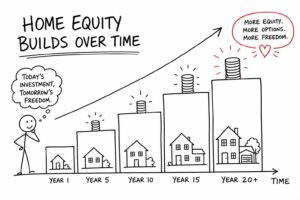
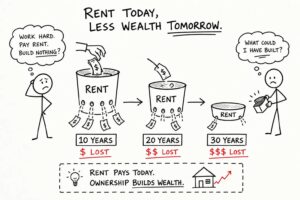
Data across the 1980s, the 2000s, and the 2008 crisis consistently shows that complete rate cycles from high to low and back have taken 3 to 6 years. The fastest declines occurred during acute crisis events like 2008 and the COVID recession. A standard monetary easing cycle compresses rates, but not all the way back to emergency lows. Every month a buyer spends waiting for rates to reach a level that requires a recession to produce is a month of equity-building that doesn’t happen, and rent payments that deliver zero long-term return.
Refinance vs. wait for lower rates: the practical strategies available now
No strategy creates a genuine 3% rate in today’s market, with one narrow exception covered below. But several approaches can meaningfully reduce your payment or position you well for when rates do improve.
Temporary buydowns and seller concessions
A 2-1 temporary buydown on a 7% loan drops the first-year rate equivalent to 5% and the second-year equivalent to 6%, before reverting to the note rate. On a $400,000 loan, the total subsidy runs approximately $18,100, most often negotiated from the seller or builder as a concession. This strategy works best in buyer-friendly markets where sellers are motivated to close. One critical rule: always qualify at the full note rate. The reduced early payment is cash-flow relief, not a permanent rate change, and your payment will step up when the buydown period expires.
ARMs, discount points, and assumable loans
A 5/1 or 7/1 ARM currently runs roughly 55 basis points below the 30-year fixed, which translates to about $100 to $250 per month in savings on a $400,000 loan. That’s useful, but it’s not transformative, and the rate resets after the initial period. Permanent discount points require careful break-even math: one point on a $400,000 loan costs $4,000 and reduces the rate by roughly 0.25%, saving about $65 per month. Break-even lands around 62 months. Points make sense only if you plan to keep the loan long enough to recoup the upfront cost.
Assumable mortgages are relatively uncommon in listings but can deliver genuine sub-3% rates when available. Eligible buyers who find a seller with an existing FHA or VA loan at a 3% rate can take over that loan at the original rate. The obstacle is real: if the home is priced at $400,000 and the remaining balance is $280,000, you need roughly $120,000 in cash or secondary financing to cover the equity gap.
Add assumption fees of up to $1,800 and a processing timeline of 30 to 90 days, and the path becomes narrow, but for the right buyer with the right financial profile, it’s the only genuine path to a 3% rate in today’s market. It’s worth asking about specifically when evaluating FHA or VA listings.
Why the best mortgage decision doesn’t depend on rate timing
The question of whether mortgage rates will go back to 3 percent is worth asking. But it shouldn’t be the only question driving your decision. Because the answer, based on everything the data shows, is almost certainly no, at least not without conditions that would be damaging a lot of other parts of your financial life at the same time.
The real cost of waiting for the perfect rate
Every month you wait, home prices may adjust in either direction, and wealth-building is deferred. Research comparing historical home price appreciation and rent-versus-buy outcomes consistently shows that timing the market on rate alone is a losing strategy for most buyers. The approach many buyers use successfully: purchase at today’s rate, then refinance when rates improve into the 5% range or below. The math on “buy now at 7%, refinance at 5% in two years” often outperforms “rent two more years and buy at 5%,” especially in markets with steady appreciation. The right answer depends entirely on your financial situation, your timeline, and your goals, and that specificity is exactly what makes a skilled mortgage advisor worth more in a high-rate environment than in an easy 3% world.
How Isabelle Mortgages helps you find the best available option right now
The Gen-First Mortgage Method™ at Isabelle Mortgages was built for exactly this kind of environment, not assuming the market will cooperate, but building a strategy around where rates actually are, using the tools actually available. Whether the right move for you is a seller-funded temporary buydown, an ARM with a planned refinance window, permanent points that pencil out given your timeline, or tracking down an assumable loan at a rate most buyers overlook, those decisions require someone who knows how to analyze your specific financial profile. Isabelle and her team provide one-on-one guidance from first conversation through closing, with transparent communication and bilingual support at every step. When you’re ready to move from rate-watching to strategy, reach out to Isabelle Mortgages, the conversation is specific to you, not a generic rate sheet.
The bottom line on 3% mortgage rates
Will mortgage rates go back to 3 percent? Based on everything the data shows, not without a major economic disruption that no credible forecast currently anticipates. Those rates were exceptional, a product of crisis-level conditions that required emergency intervention on a global scale. Waiting for their return means waiting for circumstances that most buyers, if they understood what produced them the first time, would not want to see again.
The smarter question is: what is the best mortgage strategy available to you right now, in this market, given your actual financial situation? Buyers who stay on the sidelines waiting for a perfect rate often pay a steeper price in lost equity and deferred wealth-building than they would have paid with a higher-rate loan. The path to generational wealth doesn’t require a 3% rate. It requires the right strategy and the right advisor, and the clarity to act when conditions are right for you, not just when the headline number looks familiar.