Many aspiring homebuyers start without clear down payment saving goals. They hear “20% down” somewhere, multiply it against a home price they found online, and start depositing money into a checking account with no real plan. Months later, they realize they’ve been saving toward the wrong target, in the wrong account, without accounting for closing costs, reserves, or the fact that they may qualify for a loan requiring far less cash upfront. That’s a frustrating and avoidable detour.
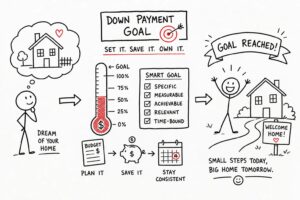
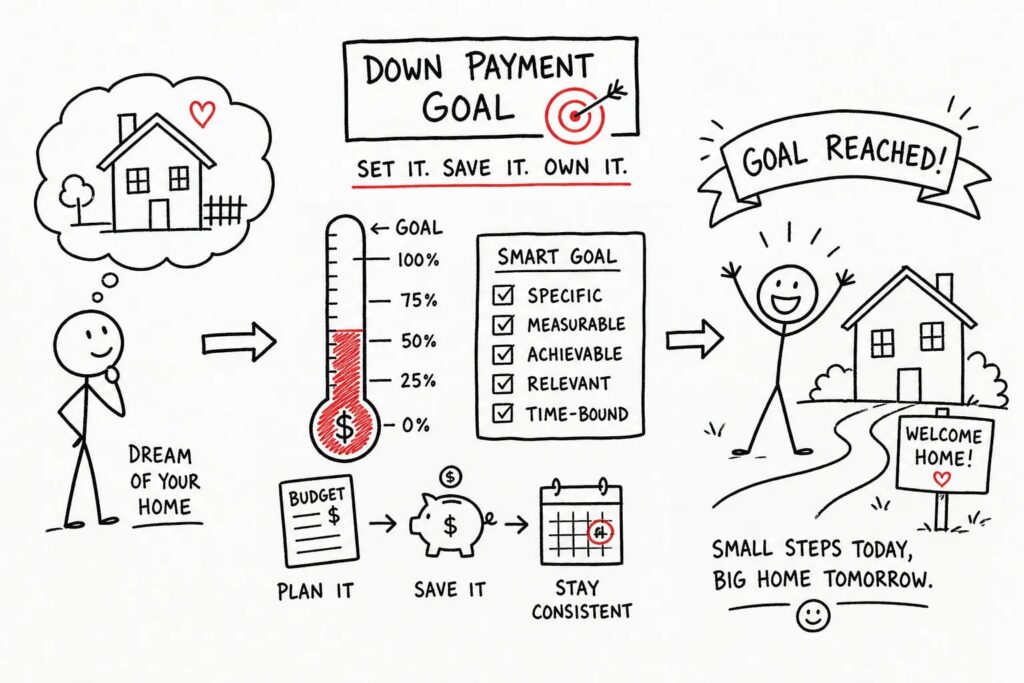
This article gives you a six-step framework to build down payment saving goals around your actual numbers: your loan type, your income, your market, and your timeline. You’ll walk away knowing your real savings target, how to calculate a monthly contribution that gets you there, where to hold the money, and how to reach your goal faster using tactics and assistance programs most buyers never explore.
Talk to a mortgage professional before you pick a savings number
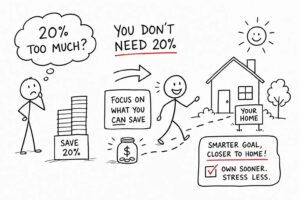
The most common and costly mistake buyers make is choosing a savings target before they know what their loan actually requires. Your savings goal depends on your loan type, credit score, income, and local home prices. A generic percentage from a personal finance article doesn’t account for any of those factors.
Why your savings target is unique to your financial profile
Consider two buyers looking at the same $400,000 home. A buyer who qualifies for a VA loan needs $0 down and only needs to cover closing costs and reserves. A buyer using a conventional loan with a 720 credit score might target 10%. A buyer using an FHA loan targets 3.5% down. The savings goals for these three buyers are dramatically different. Until you know which loan types you qualify for, you’re saving without a destination.
How Isabelle Mortgages helps you set the right target from day one
A conversation with a mortgage professional should be the starting point of your savings plan, not something you do after you’ve already saved up. At Isabelle Mortgages, the first consultation reviews your credit, income, and target market to identify the loan types you qualify for and the real cash-to-close you need. Working through those numbers early can help you avoid months of overshooting or undershooting your target, giving you a concrete figure to work toward from the start.
What to ask in your first mortgage consultation
Come to your first mortgage consultation prepared with a few key questions: What loan types do I qualify for? What is the minimum down payment for each loan type? What are the total estimated closing costs for a home in my target price range? The answers become the foundation of your entire down payment savings plan. Every decision that follows flows from those numbers, so getting them right at the start keeps the rest of the process on solid ground.
What your down payment percentage really means for your monthly budget
Once you know your loan options, you need to understand what each down payment percentage actually costs you, both upfront and every month. This is where buyers make their second major mistake: they focus on how much they need to save without considering how the down payment amount changes the monthly payment they’ll carry for the next 30 years.
Down payment minimums by loan type
The four main loan types each carry different minimums. Conventional loans require as little as 3% down, and FHA loans require 3.5% with a credit score of 580 or higher (or 10% for scores between 500 and 579). VA loans require 0% for eligible borrowers, and USDA loans also offer 0% down for qualifying rural properties. The key distinction worth keeping in mind: minimum and optimal are two different things, and choosing between them is a financial decision, not just a savings challenge.
How your down payment percentage changes your monthly payment
Using a $400,000 home with a 30-year conventional fixed loan at 6.5%, here is how the numbers break down. At 5% down ($20,000), your principal and interest plus PMI runs approximately $2,560 to $2,719 per month. At 20% down ($80,000), your principal and interest drops to approximately $2,023 per month with no PMI at all. That’s a difference of roughly $500 to $700 every single month. The trade-off a buyer must weigh is whether waiting longer to save the larger down payment is worth the monthly payment savings over the life of the loan.
PMI and when it goes away
PMI on a conventional loan typically costs between 0.2% and 2.25% of the loan balance annually depending on your credit score and loan-to-value ratio. Borrowers with scores above 760 may pay as little as 0.20% to 0.40% annually, while borrowers in the 640 to 659 range can pay 0.80% to 1.75%. The good news: PMI on a conventional loan can be canceled once the loan reaches 80% of the home’s original value.
FHA mortgage insurance follows different rules entirely. With less than 10% down, FHA’s annual mortgage insurance premium lasts for the full life of the loan. Put 10% or more down on an FHA loan, and it ends after 11 years. That distinction matters significantly when you’re deciding between FHA and conventional, and it connects directly to how you plan your total savings target.
How to calculate your total savings target (beyond just the down payment)
Most buyers calculate the down payment and stop. The real cash-to-close number is higher, often substantially higher, and arriving at closing with only the down payment amount means arriving underprepared. Lenders and title companies expect more than just the down payment from you on closing day.
The four components of your real savings target
Your true savings goal has four parts: the down payment itself; closing costs, which typically run 2% to 5% of the purchase price; a cash reserve your lender may require you to have available after closing; and practical costs including inspection fees, moving expenses, and any immediate repairs or improvements the home needs. On a $425,000 home using a 5% down payment strategy, the realistic total cash target is approximately $30,000 to $45,000, not just the $21,250 down payment figure. Plan for the full number.
Regional benchmarks to set a realistic home price target
Regional median prices vary widely across the country. In 2026, the South median sits around $380,000, the Midwest around $340,800, the Northeast around $547,200, and the West around $637,900. A practical planning formula: take your target region’s median price, apply your down payment percentage, then add 3% to 4% for closing costs. That sum is your starting planning number. For precision, get a local figure from a mortgage professional who knows your specific market.
A simple down payment savings plan worksheet
Fill in four numbers: your target home price, your down payment percentage, your estimated closing cost percentage (use 3% as a baseline), and your reserve target. Apply the last three to the first and add the results. The sum is your total savings goal. That single figure is what drives your savings plan. Buyers saving for a house across different price points will land in very different places here, which is exactly why working from your own numbers matters more than following any rule of thumb.
Build your down payment saving goals around income and expenses
With a total savings target in hand, the next step is matching that number to a realistic monthly contribution. This is where the framework becomes personal, and where honest math matters more than optimistic assumptions.
How to calculate your monthly savings capacity
Start with your monthly take-home pay after taxes. Subtract your fixed monthly obligations: rent, utilities, insurance, and loan payments. Then subtract your average variable spending on groceries, transportation, and entertainment. The remainder is your ceiling for monthly savings. Most buyers discover their real savings capacity is different, sometimes very different, from what they imagined before doing this exercise. Work from the real number, not the hopeful one.
Sample savings timelines by savings rate
Contribution size has a dramatic effect on how long saving for a house actually takes. If your total savings target is $35,000 and you save $500 per month, the timeline is 70 months, nearly six years. At $800 per month, the timeline drops to 44 months. At $1,200 per month, you arrive in roughly 29 months. Every $100 per month increase meaningfully shortens the timeline. Parking those funds in a competitive high-yield savings account shaves additional months off by letting your balance work alongside your contributions.
Setting milestone checkpoints
Break your savings goal into quarterly checkpoints rather than staring at one large number the entire time. A $36,000 goal over 36 months is $1,000 per month, but framed as a quarterly target, it’s $3,000 per quarter. Quarterly reviews also let you adjust if your income increases, an expense drops, or you receive a windfall. The plan should flex with your life, not lock you into a rigid path that breaks under the first unexpected change.
Where to keep your down payment funds while you save
A down payment is not an investment. It’s a short-to-medium-term cash goal, which means the priority is safety and liquidity over aggressive returns. That said, the right account earns meaningfully more than a standard checking account and gives your balance a real boost over a two-to-four-year timeline.
High-yield savings accounts and money market accounts
Competitive high-yield savings accounts in October 2026 are paying roughly 4.00% to 4.50% APY, while money market accounts run around 3.00% to 4.00% APY. Both offer full liquidity, FDIC insurance, and no lock-in period. For most buyers with a two-to-four year savings timeline, a high-yield savings account is the default right choice. Money market accounts are worth considering if you want debit or check-writing access to the funds without doing a transfer each time.
When a CD makes sense for part of your funds
A 1-year CD in October 2026 pays approximately 4.00% to 4.83% APY at competitive institutions and locks in that rate for the full term. If you know you won’t need a portion of your savings for at least 12 months, laddering some of it into a CD captures a slightly higher fixed yield. The key caveat: early withdrawal penalties apply, so only commit money you genuinely won’t need before the CD matures. Don’t lock up funds that might be needed for an earlier-than-expected closing.
What to avoid with your down payment savings
Keep your down payment funds out of the stock market, including index funds. Market volatility can wipe out years of savings contributions at exactly the wrong moment. A 20% market correction the month before you’re ready to make an offer is a risk a high-yield savings account avoids entirely. The goal of these funds is preservation, not growth. Treat them accordingly.
Tactics to reach your down payment saving goals faster
A solid plan runs on discipline, but the right strategies can compress the timeline without requiring a dramatic lifestyle overhaul. The moves below redirect money before it ever gets spent, which is where most savings momentum is actually lost.
High-impact moves that accelerate your down payment savings plan
Automating transfers to your savings account on payday is the single most effective habit change available to buyers saving for a house. The money never enters your spending account, which removes the temptation entirely and outperforms every budgeting app and manual tracking system. Beyond automation, redirect annual windfalls directly to your savings goal. Tax refunds, work bonuses, and cash gifts should go straight to the house fund, not into discretionary spending. Finally, audit your recurring subscriptions and redirect any cuts immediately to savings. Taken together, these moves can add several thousand dollars per year for many households without touching their day-to-day lifestyle.
Income side: increasing contributions without just cutting spending
Freelance work, overtime, or a part-time weekend role can create a dedicated savings income stream that accelerates your timeline without requiring you to cut anything from your current life. To illustrate with a straightforward example: if your total savings target is $35,000 over three years and you add $500 per month in side income directed entirely to savings, the math shortens your timeline by roughly ten to twelve months. The rule that works: earmark any income increase rather than absorbing it into lifestyle creep. If your salary increases by $300 per month, that $300 goes to the house fund before it becomes a habit to spend it.
Down payment assistance programs worth knowing
Many buyers who think they need to save the full amount are eligible for meaningful help. Federal programs like Fannie Mae HomeReady allow as little as 3% down for income-qualified buyers. State-level forgivable second mortgages commonly offer 2% to 5% of the purchase price. Local programs can be even more significant: Houston’s homebuyer assistance program offers up to $50,000 as a no-interest forgivable loan for eligible buyers. In Florida, Orange County offers up to $70,000 for very-low-income buyers, and Palm Beach County reports assistance reaching up to $100,000 through SHIP programs.
Before you assume you need to fund the entire down payment yourself, ask your mortgage professional which programs apply to your income, credit score, and target location. That conversation with Isabelle Mortgages is often where buyers discover they’re closer to homeownership than they thought.
Your six-step framework, applied
Setting down payment saving goals isn’t a willpower challenge. It’s a math problem, and the math becomes straightforward the moment you have the right inputs. The sequence is: talk to a mortgage professional first to find your actual savings target, choose your down payment percentage based on loan type and monthly payment impact, calculate total cash to close including closing costs and reserves, build a realistic monthly savings plan based on your true income and expenses, park funds in a high-yield account appropriate for your timeline, and use acceleration tactics and assistance programs to compress the timeline.
Buyers who skip step one and start saving before they know their loan options risk wasting significant time chasing the wrong number. Buyers who work through the full framework often find they can reach their down payment saving goals faster than expected, particularly when assistance programs enter the picture. Research on average homebuyer timelines shows that access to the right loan information and local assistance can meaningfully close that gap. The difference frequently comes down to one early conversation with a knowledgeable mortgage professional.
If you’re ready to build real, personalized down payment saving goals and stop guessing at the number, reach out to the Isabelle Mortgages team for a free consultation. A mortgage professional can walk through your loan options, review your financial profile, and help you identify your true savings target. That’s a practical and low-commitment place to start.