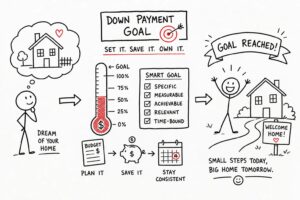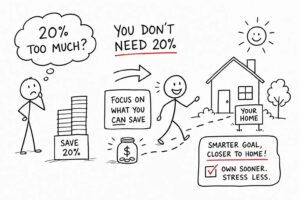
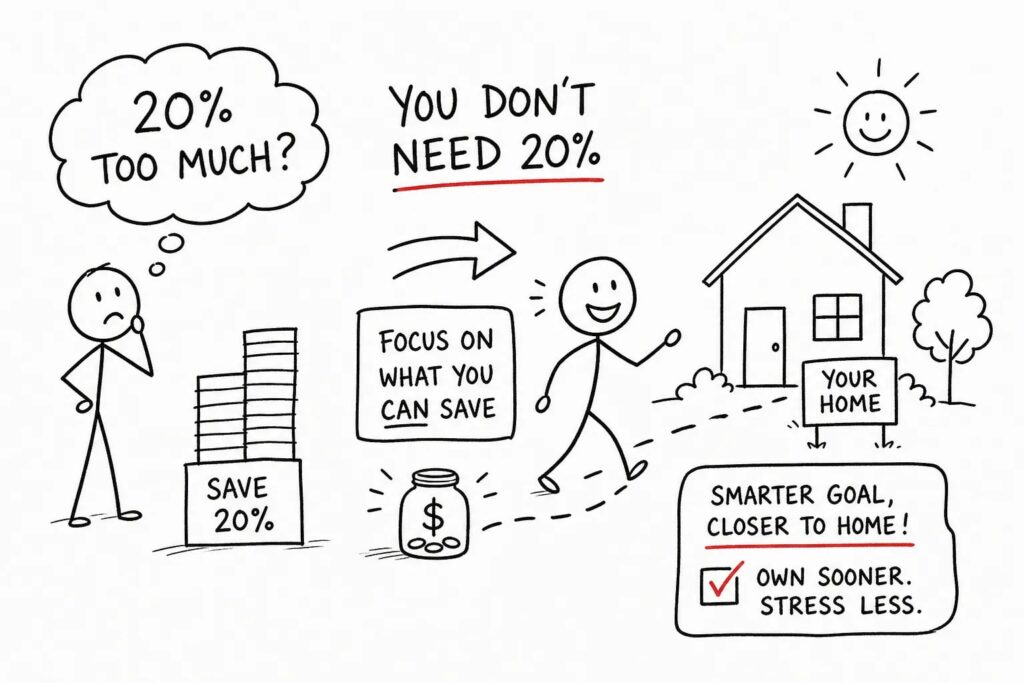
If you’re wondering how much to save for a down payment, the answer is almost certainly less than you think. The 20% figure has kept more buyers on the sidelines than market conditions alone, but that number isn’t a requirement. It’s a PMI threshold. Buyers spend years postponing homeownership, convinced they need to save tens of thousands of dollars before they can even apply, while home prices in their target markets keep rising. The legal minimum down payment on a home loan can be as low as 0% for certain buyers and 3% to 3.5% for most conventional and FHA borrowers. That gap between the myth and the actual requirement represents years of buying power that too many first-time and first-generation buyers leave on the table.
This guide gives you four concrete things: your actual minimum down payment based on the loan type you qualify for, a real dollar target based on where you’re buying, a smart place to keep your savings while you build toward that goal, and a monthly savings plan you can start this week. No judgment about where your savings stand, no guilt about not having 20%, and no generic advice that ignores your actual situation. Here’s what that actually looks like for your situation.
The Real Minimums: What Each Loan Type Actually Requires
The 20% threshold isn’t a rule lenders invented to make homebuying harder. It’s the specific point at which private mortgage insurance (PMI) is no longer required on a conventional loan. Cross that line and PMI goes away; stay below it and you pay PMI until your equity catches up. That’s the entire story behind the “20% rule.” It’s important to note that your actual approval odds and loan terms depend on additional factors, credit score, debt-to-income ratio, and lender overlays, so program minimums are a floor, not a guarantee.
Conventional Loans Start at 3% for Eligible Buyers
Conventional loans through programs like Fannie Mae’s HomeReady and Freddie Mac’s Home Possible require as little as 3% down for primary-residence purchases. Most borrowers who go this route put down 5% to 10%, and a 620 credit score is the widely used baseline for conventional underwriting. Anything below 20% down on a conventional loan triggers PMI, which adds a monthly cost to your payment until you reach 20% equity in the home.
FHA Loans Are Built for Lower Credit Scores and Smaller Savings
FHA loans require 3.5% down with a credit score of 580 or higher, and 10% down for borrowers with scores between 500 and 579. The FHA program applies more flexible debt-to-income (DTI) standards than conventional loans, which makes it one of the most common paths for first-time homebuyers. One important distinction: FHA mortgage insurance doesn’t automatically cancel the way conventional PMI does. For FHA loans originated after June 2013 with less than 10% down, that insurance premium stays for the life of the loan. Borrowers who put down 10% or more can see mortgage insurance canceled after 11 years. Refinancing into a conventional loan is the most common exit strategy for buyers who want to eliminate it sooner.
VA and USDA Loans: Zero Down for Those Who Qualify
VA loans require 0% down for eligible service members and veterans, and USDA loans offer 0% down for buyers purchasing in eligible rural areas within household income limits. Neither program is entirely cash-free, though. Closing costs, prepaid items like homeowner’s insurance, and any gap between the appraisal and purchase price all require upfront funds. Lenders also add their own credit score and DTI requirements on top of these program minimums, so a 0% down program doesn’t mean approval is automatic.
How Much to Save for a Down Payment, Real Dollar Targets by Region
Percentages are easy to ignore. Dollars are harder to dismiss. Using Q2 2026 median existing single-family home prices from the National Association of Realtors, here’s what the numbers actually look like across the country.
What the Numbers Look Like Across U.S. Regions
The NAR Q2 2026 regional medians break down as follows: $340,800 in the Midwest, $380,000 in the South, $434,900 nationally, $547,200 in the Northeast, and $637,900 in the West. These are your anchors. Your down payment target isn’t “3% of some abstract home price”, it’s a specific dollar amount tied to a specific market.
Translating Down Payment Percentages Into Actual Dollars
On a $380,000 home in the South, a 3% down payment is $11,400 and a 5% down payment is $19,000. On the national median of $435,000, 3% is $13,050 and 5% is $21,750. On a $640,000 home in the West, 3% is $19,200 and 5% is $32,000. These are real savings targets, not abstract percentages you’ll figure out someday. Pick the number that matches your market and your loan type, and that becomes your goal.
Where First-Time Buyers Actually Land
According to Realtor.com and NAR buyer-profile data, the median down payment across all U.S. buyers in Q2 2026 was $27,100, or 13.7% of the purchase price. First-time buyers typically put down closer to 10%. The vast majority of buyers closing on homes right now are not putting down 20%, and they are still getting approved, getting keys, and building equity. You don’t need to be the exception to that pattern, you need to know where you fit within it.
What PMI Actually Costs and When It Ends
PMI isn’t a punishment. It’s a cost you pay in exchange for buying a home sooner with less money down, and it ends once your equity gets high enough. Understanding what it costs removes the fear and lets you make a rational decision about whether a smaller down payment makes sense for your situation.
How Much PMI Adds to Your Monthly Payment
PMI on a conventional loan typically runs 0.5% to 1.5% of the loan amount annually, which works out to roughly $30 to $70 per month for every $100,000 borrowed. On a $360,000 loan (10% down on a $400,000 home), that’s approximately $120 to $275 added to your monthly payment. Compare that to a 20% down payment on the same home: you’d borrow $320,000 with no PMI, but you’d need $80,000 upfront instead of $40,000. For many buyers, paying PMI for a few years while building equity can be a more practical financial path than waiting several more years to save a larger down payment, though the right answer depends on your local market, income trajectory, and opportunity cost of waiting.
How and When PMI Can Be Removed
On a conventional loan, you can request PMI cancellation once you reach 20% equity, and the lender is required by federal law to automatically cancel it when your loan balance drops to 78% of the original purchase price, as long as your payments are current. Buyers who put 10% down and benefit from home price appreciation in their market often hit that equity threshold faster than the standard amortization schedule suggests. FHA mortgage insurance operates differently and doesn’t follow the same automatic cancellation rules, one reason the choice between FHA and conventional matters beyond the down payment percentage alone.
Matching the Right Loan to Your Financial Profile
There is no universally “best” loan. The right loan is the one that fits your credit score, income type, DTI ratio, and savings level, and getting that match wrong can cost you time, money, and sometimes the home itself.
Credit Score and DTI Shape Your Real Options
A 620 or higher credit score generally opens the door to conventional loan programs, while scores below 620 typically point toward FHA. Conventional lenders generally look for a DTI under 43% to 45%, while FHA allows more flexibility when you have compensating factors like strong reserves or a larger down payment. Self-employed buyers and those with 1099 income or business bank statements need a lender who understands alternative documentation, because standard qualifying paths often exclude them without good reason. The program minimum and the lender’s overlay are two different things, and knowing both matters before you apply.
How the Gen-First Mortgage Method™ Helps You Find the Right Fit
At Isabelle Mortgages, the Gen-First Mortgage Method™ was developed specifically for buyers who don’t have a family blueprint for this process. Rather than applying to any loan and hoping for approval, you work through a structured review of your credit profile and income documentation, then your savings capacity, to identify the program that actually fits. For first-generation homebuyers, entrepreneurs, or anyone navigating the mortgage process without a roadmap, this kind of one-on-one guidance is designed to prevent costly missteps before they happen. The goal isn’t just to get you approved, it’s to match you with the loan structure that supports the long-term wealth you’re trying to build.
Where to Keep Your Down Payment While You Save
Keeping your down payment savings in a standard checking account is often a costly choice buyers don’t realize they’re making. At a national average savings rate of just 0.37%, that money is losing ground to inflation every month while earning almost nothing. There are better options that keep your money protected, accessible, and actually earning while you save.
High-Yield Savings Accounts for Timelines Under Two Years
FDIC-insured high-yield savings accounts (HYSAs) are currently yielding 4.0% to 4.5% APY as of October 2026, compared to that national average of 0.37%. Rates vary by institution and can change, so it’s worth comparing current offers. For buyers planning to purchase within the next 12 to 24 months, a HYSA is the straightforward recommendation: your principal is protected, funds are accessible within a few business days, and you’re earning something meaningful while you build toward your goal. Keep your emergency fund in a separate account so your down payment savings stay intact and accurately tracked.
CDs and Treasury Bills for the 1-to-3-Year Horizon
Short-term CDs are yielding up to about 4.5% APY, and Treasury bills are running roughly 3.5% to 3.9% depending on maturity. If you have a clear purchase timeline, a CD ladder or T-bill ladder can lock in rates while releasing funds in predictable increments as each term matures. One important caution: early withdrawal penalties on bank CDs typically run three to six months of interest, and Series I bonds cannot be redeemed at all within the first 12 months. Neither is appropriate if there’s any chance you’ll need the funds before the restriction period ends.
How Much to Save for a Down Payment: Your Month-by-Month Plan
Everything above is only useful if it translates into a number you can act on. Here’s how to work backward from your target to a monthly savings goal you can automate starting today.
Working Backward From Your Target to a Monthly Number
Take a buyer targeting a $380,000 home in the South with 5% down. The down payment is $19,000. Add estimated closing costs of 2% to 3% ($7,600 to $11,400), and the total cash needed is roughly $26,600 to $30,400. Divided by timeline: 12 months means saving approximately $2,200 to $2,550 per month; 24 months means approximately $1,100 to $1,275 per month. That’s the math. The only variables are the home price, the down payment percentage, and the timeline you choose.
The 6, 12, and 24-Month Breakdown
These three scenarios illustrate how the numbers stack up at different savings paces:
6-month aggressive saver (Midwest, $340,800, 3% down): $10,200 for the down payment plus roughly $8,500 in closing costs totals about $18,700, which requires saving approximately $3,100 per month.
12-month saver (national median, $435,000, 5% down): $21,750 plus closing costs totals roughly $30,000 to $35,000, which works out to $2,500 to $3,000 per month.
24-month saver (Northeast, $547,200, 5% down): $27,360 plus closing costs totals around $38,000 to $44,000, which breaks down to roughly $1,600 to $1,850 per month.
These are real, achievable numbers. They aren’t easy, but they aren’t abstract either.
Automating the Savings Process
Set up an automatic transfer to your HYSA or CD on the same day every month, ideally the day your paycheck hits. Treat the down payment transfer like a fixed bill rather than a discretionary choice, because the moment it becomes optional, it becomes irregular. There’s one more detail worth noting: lenders commonly review two to three months of bank statements during the underwriting process. Consistent, steady deposits look far cleaner than a single large transfer right before you apply, so building the habit of regular contributions also builds the paper trail your lender will need to see.
Your Next Step Starts Here
The 20% myth keeps more buyers waiting than the market itself does. The actual minimum down payment in 2026 starts at 0% for eligible VA and USDA borrowers and 3% to 3.5% for conventional and FHA loans. Figuring out how much to save for a down payment comes down to three inputs: the loan program you qualify for, the median price in your target market, and the monthly savings capacity you’re working with. That combination produces a real, solvable number, not a vague goal you keep pushing further into the future.
Use the framework in this guide to calculate your own down payment target and build your savings timeline. If you want to pair that savings target with the right loan program before you even open a savings account, that’s exactly the conversation to have with Isabelle Mortgages. The earlier you identify the right loan match, the more focused your savings plan becomes, and the less time you spend building toward the wrong number. Reach out to the team at Isabelle Mortgages to start that conversation today.