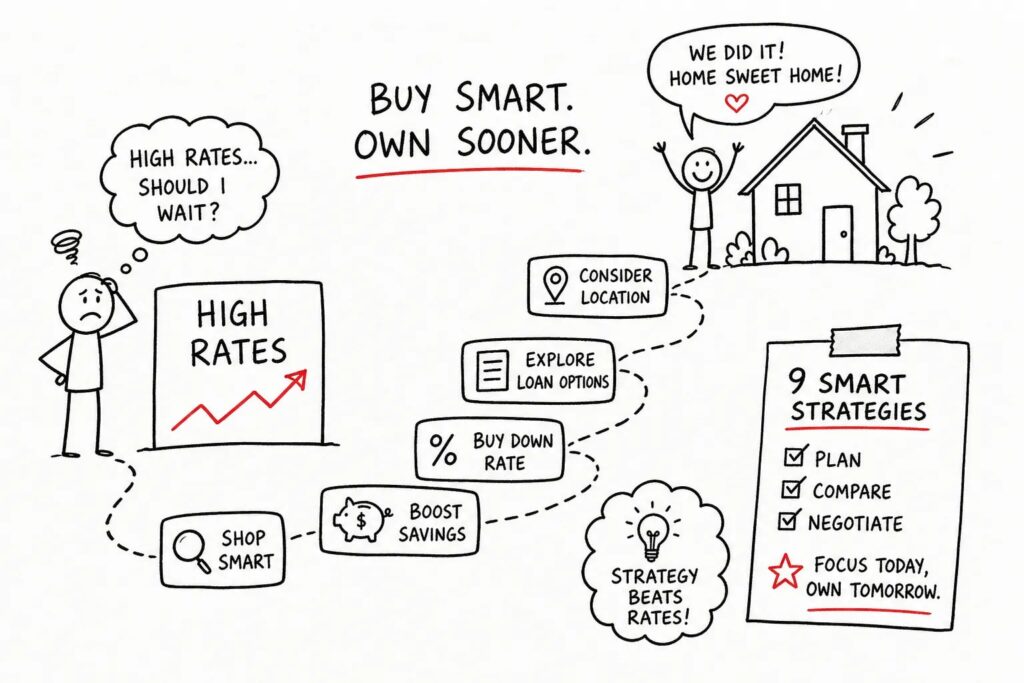
The 30-year fixed mortgage rate sits at 7.28% as of October 2026 (per Freddie Mac’s weekly national average), and plenty of buyers have already talked themselves out of the market before running a single number. That’s a mistake the buyers actually closing deals are not making. If you’re wondering how to buy a home with high rates, the answer isn’t to wait, it’s to use specific strategies right now to reduce your effective borrowing cost, choose the right loan product, and close on a home that fits your financial picture.
This guide covers six of those strategies: rate buydowns, ARM selection, loan program choices, seller concessions, and lender shopping. These are not theoretical ideas. At Isabelle Mortgages, this is the actual framework used to help clients find a workable path when the numbers feel discouraging at first glance. Buying a home with high interest rates is harder than it was in 2021, but it’s absolutely achievable with the right approach. Use a mortgage affordability calculator to run your own numbers before your first lender call, knowing your baseline makes every conversation more productive.
1. Why waiting for rates to drop is a costly gamble
Every month a buyer waits is a month they hand money to a landlord. If your rent is $2,000 per month and you wait twelve months hoping rates improve, that’s $24,000 out the door with zero equity built, zero appreciation captured, and no guarantee rates move in your favor. According to S&P Case-Shiller national home price data, prices across most metros have not declined enough to offset that holding cost, and buyers who purchased a year ago are already building equity.
The strategy that consistently holds up is called “marry the home, date the rate.” You buy the home now, qualify at today’s rate, and refinance when rates cycle lower. Historically, rate cycles do turn, though past declines are no guarantee of future movement. The key is structuring the purchase so you’re not overextended: buy below your maximum approval, keep your credit strong after closing, and choose a loan with no prepayment penalty. A refinance later only helps if the original loan didn’t stretch you thin. Plan for the rate you have, and treat the future refinance as a bonus, not a requirement.
2. How to buy a home with high rates using rate buydowns
Permanent discount points
A permanent discount point costs 1% of the loan amount and typically reduces a 30-year fixed rate by about 0.25 percentage points. On a $400,000 loan, one point runs $4,000 and saves roughly $65 to $70 per month. The break-even on that investment lands around 5 to 6 years, which makes permanent points a smart move for buyers who plan to stay put and don’t expect to refinance quickly. For buyers with a shorter time horizon, a temporary buydown usually delivers more value per dollar.
Temporary buydowns
A 2-1 buydown works like this: on a $400,000 loan at a 7.28% note rate, the buyer pays an effective rate of 5.28% in year one and 6.28% in year two, then moves to the full rate in year three. The subsidy costs approximately $8,000 to $10,000 in total. Here’s the part most buyers miss: sellers may fund the entire buydown cost, not the buyer. The seller contributes the credit at closing, the funds go into an escrow account, and the lender applies them to subsidize the early payments. The buyer gets two years of meaningful payment relief without writing a larger check.
One important detail: lenders qualify buyers at the full note rate even with a 2-1 buydown in place. The buyer must demonstrate they can afford the year-three payment. For a buyer at the edge of their qualification range, that distinction matters, it affects the income or debt-to-income ratio required to close. This protects everyone and means the buydown isn’t a workaround for a loan you can’t actually afford. It’s a cash-flow tool for buyers who already qualify.
3. Adjustable-rate mortgages: lower initial rate, manageable if you know the rules
A 5/1 ARM is currently pricing around 6.13% while a comparable 30-year fixed example rate runs approximately 6.60%, translating to roughly $128 per month in savings on a $400,000 loan during the initial period. (The national 30-year average of 7.28% produces even greater savings against the ARM, run both scenarios with your lender to see the full picture.) A 5/1 ARM means the rate is fixed for five years and adjusts annually after that. A 5/6 ARM adjusts every six months after the initial period. Both products make sense in the right situation, and both carry real risk if chosen without a plan.
An ARM works well for buyers who expect to sell or refinance within the fixed period, can afford the fully capped payment if rates rise at every reset, and are not counting on a future refinance to avoid payment stress. A simple test: ask your lender for the maximum possible first-reset payment under the periodic cap. If that number fits your budget without straining, the ARM is defensible. If it creates a serious problem, a fixed rate is the safer choice even at the higher initial cost. That math often favors certainty.
Before committing to an ARM, ask your lender these questions:
- What is the fully indexed rate today, meaning the current index plus the lender’s margin?
- What is the maximum payment at the first reset under the periodic cap?
- What happens to my payment if rates rise by 2% at each adjustment?
If you can absorb the worst-case scenario comfortably, the ARM makes sense. If you can’t, it doesn’t. There’s no middle ground worth betting on.
4. Loan programs that stretch your buying power in a high-rate market
VA loans remain one of the strongest tools available for eligible veterans and active-duty service members. The program offers zero down payment, no monthly mortgage insurance, and competitive rates. In a high-rate environment, eliminating the down payment requirement preserves cash that can be redirected toward a permanent buydown or used to reduce closing costs. USDA Guaranteed loans offer the same zero-down benefit for buyers purchasing in qualifying rural and suburban areas, with income limits that apply at the household level. If you qualify for either program, check those boxes before comparing any other option.
For buyers who don’t qualify for VA or USDA, the FHA versus conventional question matters. FHA allows 3.5% down with a 580 credit score and uses flexible debt-to-income underwriting, which helps buyers with non-traditional income or credit histories that don’t fit a standard mold. Conventional 97 programs like HomeReady and HomeOne allow 3% down with cancelable private mortgage insurance and no upfront insurance premium, which makes them cheaper long-term for buyers with solid credit who plan to build equity quickly. The right answer depends on your credit score, loan size, and how long you plan to stay in the home.
Down payment assistance is another underused resource. Consider the following options available in Florida:
- FL Assist: Up to $10,000 for qualifying buyers through the Florida Housing Finance Corporation
- Hometown Heroes Housing Program: Up to $35,000 for eligible community workforce buyers
- HFA Preferred PLUS: Layered assistance for income-qualifying borrowers
Program funding and eligibility change, verify current availability with an approved lender. Some national lenders also offer grants up to $7,500 for closing costs and $10,000 for down payment in participating states. Ask every lender you speak with for two Loan Estimates: one with lender credits covering closing costs, and one with a lower rate using points. The comparison reveals which structure actually saves you more money over your expected time in the home.
5. How to buy a home with high rates using seller concessions
Sellers can contribute toward closing costs, discount points, prepaid expenses, and buydown funds within program limits. For conventional loans, seller concession limits are tiered by down payment: up to 3% of the purchase price with less than 10% down, up to 6% with 10% to 24.99% down, and up to 9% with 25% or more down. FHA allows up to 6% regardless of down payment. These contributions are written as credits in the contract and do not change the agreed purchase price, which protects the seller’s recorded equity, though lenders will still confirm the appraised value supports the purchase price.
In the current market, buyers have more negotiating leverage than recent years have offered, based on rising inventory and longer days-on-market trends in many metros. Instead of asking for a straight price reduction, ask the seller to fund a 2-1 buydown or contribute toward permanent discount points. To illustrate: a $10,000 seller concession applied to a rate buydown on a $400,000 loan at 7.28% can reduce the monthly payment by more than a $10,000 price cut would at the same rate, because the buydown directly reduces the interest cost. For the seller, a concession can feel less painful than dropping the list price, which protects their position for future comps in the neighborhood. Both sides can win when the concession is structured around rate relief rather than just a lower sale price.
A clean contract language approach: “Seller to contribute up to $______ toward buyer’s lender-approved temporary or permanent interest-rate buydown, including eligible discount points and allowable closing costs, subject to loan-program limits.” Get the lender’s written buydown quote before finalizing that number so the credit matches the actual cost of the structure you’ve designed.
6. Shopping lenders and why the right advisor changes everything
Most buyers approach lenders unprepared, which leads to surface-level quotes and missed opportunities. Before your first call, have these numbers ready: your credit score range, monthly gross income including any 1099 or business income, existing monthly debts, estimated down payment, and target purchase price. A prepared buyer gets a real quote. An unprepared buyer gets a ballpark that leads nowhere useful.
When you speak with any lender, ask these specific questions: What is your fully indexed ARM rate today, and what are the caps? Can the seller fund a temporary buydown on this loan type? What lender credits are available, and what rate does taking those credits require? Do you work with any down payment assistance programs in my state? The quality of the answers tells you whether you’re talking to someone who understands how to build a strategy or someone who is simply reading from a rate sheet.
At Isabelle Mortgages, the approach isn’t to hand you a rate and wish you luck. The Gen-First Mortgage Method™ is a structured framework built specifically for high-rate environments like this one, layering the right loan program with seller concessions, buydowns, lender credits, and assistance programs to build a monthly payment that actually fits your life. Whether you’re self-employed with 1099 income, buying your first home as the first in your family to do so, or expanding a real estate portfolio, the work is the same: find the path, run the math, and move forward with clarity.
The bottom line: how to buy a home with high rates in 2026
Buying a home with high rates is harder than it was three years ago. But the buyers closing deals in 2026 aren’t extraordinary. They’re using tools that most people don’t know exist: 2-1 buydowns funded by sellers, ARM products with honest break-even math, zero-down programs that preserve cash, and down payment assistance that reduces the barrier to entry. Most of these strategies work independently of where rates go next, though some, like permanent points, perform best when you plan to hold the loan long enough to reach break-even.
The buyers who struggle in this market are the ones sitting on the sideline writing rent checks, convinced that next year will be easier. The buyers who move forward are the ones who ran the numbers, asked the right questions, and found an advisor who knew how to put it all together. If you want to know exactly how to buy a home with high rates on your specific budget, schedule a call with Isabelle Mortgages. Share your numbers and get a clear picture of what’s possible for you right now.