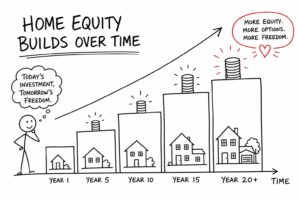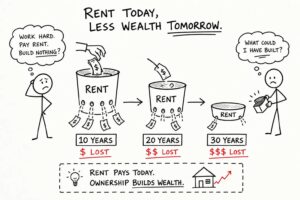
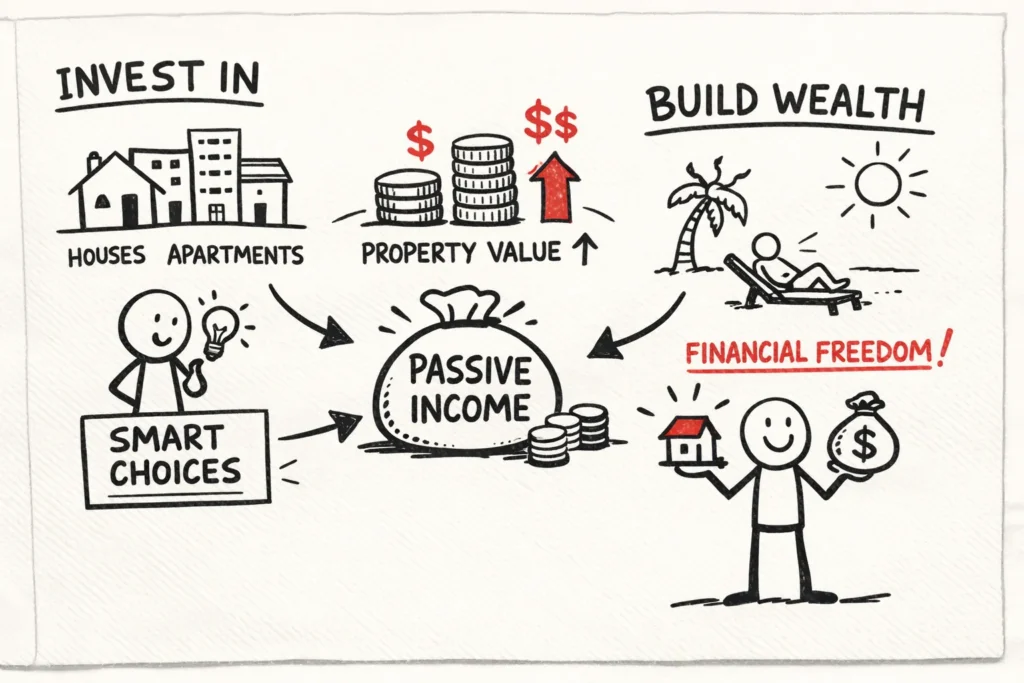
Many people view buying a home as a lifestyle decision. The investors who retire early figured out it’s also their most powerful financial tool. Real estate doesn’t just store value. It builds equity every month, appreciates steadily in the background, and can generate rental income that offsets or covers the mortgage while the asset grows. Building wealth through real estate is less about timing the market and more about choosing the right strategy for your situation.
At Isabelle Mortgages, clients don’t simply close loans and walk away. From the first conversation, the focus is on structuring financing that supports a long-term property wealth plan, not just a single purchase. That mindset shift is what separates homeowners from investors.
Why real estate outperforms most long-term investments
Real estate builds wealth through equity, appreciation, and cash flow working simultaneously. Every mortgage payment increases your ownership stake. According to FHFA data, U.S. home values have appreciated roughly 4, 6% annually over the long term, and leveraged rental property investors have historically seen annualized returns averaging 8, 12% over 20-year holds, depending on market conditions, financing structure, and vacancy rates. Rental income turns a fixed asset into one that pays you while it grows.
Leverage is what makes direct property ownership so powerful. A $50,000 down payment on a $250,000 rental generates returns on the full property value, not just your initial investment. That’s why direct ownership often outperforms unleveraged vehicles like REITs over time. Your $50,000 earns appreciation on $250,000, a return profile that’s difficult to replicate in most other asset classes without taking on margin risk.
Three strategies to build wealth through real estate
House hacking: live for less, build equity faster
House hacking is one of the most accessible entry points into real estate investing. You purchase a 2, 4 unit multifamily property, live in one unit, and rent out the rest. With FHA financing available at 3.5% down for owner-occupied multifamily, the rental income from the other units can offset or eliminate your monthly mortgage payment entirely. In strong rental markets, documented case studies show investors reducing their net housing costs by 50, 84%, sometimes covering their housing expense almost entirely while building equity.
This strategy doesn’t just cut your living expenses. It positions you to refinance in a few years, access that equity, and repeat the process with a second property. That compounding cycle is how everyday buyers build portfolios without large starting capital.
Buy-and-hold rentals: the long game that pays off
Buy-and-hold is the most straightforward path to building wealth with rental properties. You acquire a single-family or small multifamily property, place tenants, and let appreciation and loan paydown drive returns over time. Conventional investment loans typically require 15, 25% down and a 620+ credit score, with target markets selected for strong rental demand. Experienced investors typically aim for 8, 15% annualized returns, with patience doing more work than active management.
The key discipline here is not overthinking the entry point. Appreciation and mortgage paydown compound over years, not months. A property that cash-flows modestly today looks very different on a 10-year balance sheet.
Using home equity to build wealth through your next purchase
Once you’ve built equity in a primary residence, a cash-out refinance or HELOC lets you access it without touching savings. Lenders typically allow up to 80% of home value minus the existing loan balance, meaning $80,000 in built equity can become a down payment on an investment property. The rental income from that property then covers the added debt service, and the cycle continues.
This is one of the most underused tools available to property owners. Many homeowners sit on substantial equity without realizing it functions as working capital for the next acquisition. Recognizing that moment, often when a refinance conversation reveals how much equity has quietly accumulated, is frequently what prompts the shift from homeowner to investor.
What returns should you realistically expect?
Matching your strategy to your goals requires honest return benchmarks. Leveraged rental properties have historically delivered 8, 12% annualized returns, with multifamily cash-on-cash returns running 6, 10%. Real estate syndications for accredited investors target 12, 20% IRR over a 5, 7 year hold. Unleveraged core real estate sits closer to 4, 5%. These aren’t guarantees, but they provide a realistic framework for setting expectations before you commit capital.
Tax advantages can meaningfully compound these numbers. Residential rental property depreciates over 27.5 years, creating paper losses that offset rental income even when cash flow is positive. The mortgage interest deduction, 1031 exchanges to defer capital gains, and the pass-through QBI deduction for eligible rental income can all reduce your effective tax burden. For eligible investors, tax benefits can materially improve after-tax returns beyond what the gross yield alone suggests, though outcomes depend on your individual tax situation and whether losses are treated as passive or active.
Getting your financing foundation right
Your loan structure shapes every outcome downstream. Conventional investment loans typically require 15, 25% down and a 620+ credit score, and carry rates roughly 0.5% higher than primary residence loans. FHA multifamily loans let owner-occupants purchase 2, 4 unit properties at 3.5% down, making house hacking accessible to first-time buyers. VA loans offer 0% down for eligible borrowers on owner-occupied multifamily. DSCR loans are well-suited for self-employed borrowers or full-time investors: approval is based on the property’s income-generating ability rather than personal W-2 income, with qualifying ratios typically starting at 1.0 and credit score requirements that vary by lender, commonly in the 550, 660 range, with 620+ generally qualifying for stronger terms.
The right lender doesn’t just find you a rate. They help you structure the loan with an eye toward your second and third purchase, not just closing day. That’s the foundation of the Gen-First Mortgage Method™ at Isabelle Mortgages: a proprietary framework built around generational wealth through property, where each loan decision is mapped against the equity position and borrowing capacity it creates for the future. It’s the difference between a transaction and a strategy.
Your first step starts here
Building wealth through real estate doesn’t require perfect timing or a large starting balance. It requires choosing one strategy that fits your current income, credit, and goals, and getting the financing structure right from the start. Whether you begin with house hacking on an FHA loan, a buy-and-hold rental using conventional financing, or tapping home equity for a second acquisition, the path becomes clear once you have a plan.
The difference between investors who build lasting wealth and those who don’t usually comes down to the quality of the strategy and the team guiding it. The right mortgage partner structures your first loan with your fourth in mind. If you’re ready to map your property wealth strategy, reach out to Isabelle Mortgages for a one-on-one conversation. The earlier you start the plan, the more compounding works in your favor.