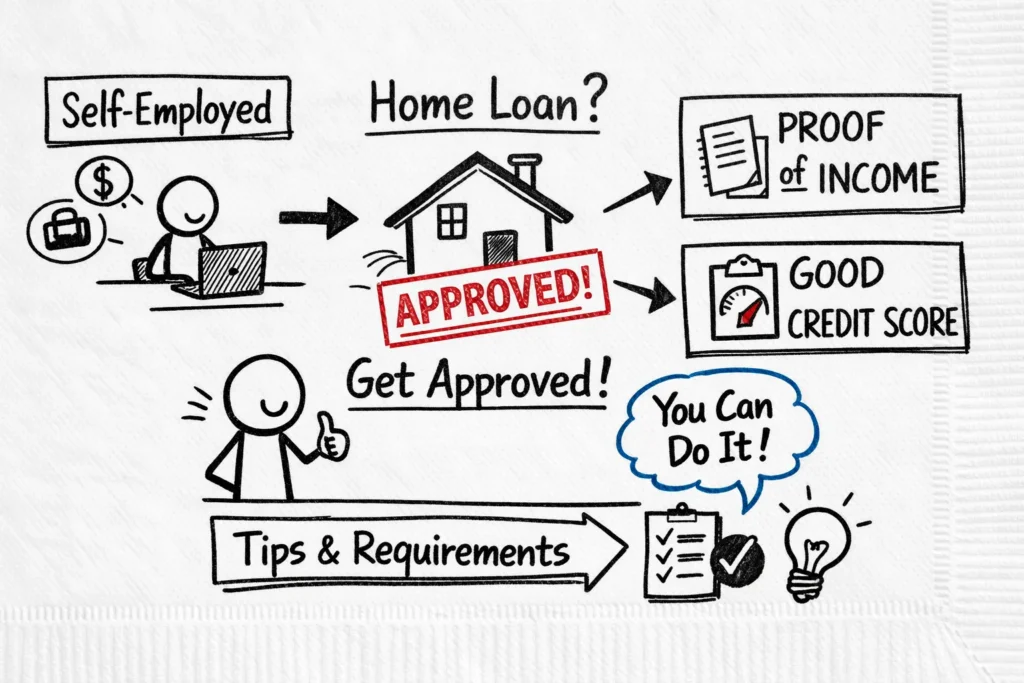
You run a real business, earn real income, and pay real bills. But when you walk into a traditional lender’s office, the process often feels like it was built for someone else entirely. That’s because it was. Most mortgage approval systems are designed around W-2 employees with predictable paychecks, and self-employed borrowers get filtered out before the conversation even starts. If you’re pursuing a self employed home loan, understanding how the system works, and how to position yourself within it, is the difference between a stalled application and a clear path to closing.
The good news is that qualifying for a home loan as a self-employed buyer is absolutely possible. It requires understanding the specific rules that apply to you, choosing the right loan type, and preparing your documentation before you apply. At Isabelle Mortgages, we’ve guided freelancers, 1099 contractors, and business owners through this process with personalized, one-on-one support, and we’ve seen what actually works. Here’s what you need to know to approach this process with confidence: why lenders evaluate your income differently, which loan types fit your situation, what documents to prepare, and how to strengthen your application before you submit it.
Why lenders treat self-employed income differently
Lenders aren’t trying to penalize you for running your own business. They’re required by federal guidelines to verify that your income is stable and likely to continue, and that’s harder to confirm when earnings fluctuate month to month or when business deductions significantly reduce what shows up on your tax returns. The problem isn’t your income, it’s how your income appears on paper. For details on how underwriters evaluate documentation for business owners, see guidance on underwriting factors and documentation for self-employed borrowers.
How income averaging affects your qualifying amount
For most loan types, lenders average your net income across the last two years of federal tax returns to arrive at a monthly qualifying figure. If your income grew from $80,000 in year one to $83,000 in year two, your average comes to $81,500 annually, or roughly $6,792 per month. That’s straightforward enough. But if your income declined between years, lenders will typically use only the lower year’s figure, or they may disqualify the income altogether if the drop is significant enough to suggest instability.
Lenders can also add back certain non-cash deductions like depreciation, which can increase your qualifying figure. For example, if your Schedule E shows $8,000 in depreciation, that amount may be added back to your net income before calculating your DTI. A CPA who understands mortgage underwriting can help you identify those add-backs before you apply.
The debt-to-income ratio challenge for business owners
Your debt-to-income ratio (DTI) is your total monthly debt obligations divided by your gross monthly income. For conventional loans, Fannie Mae and Freddie Mac guidelines generally allow DTIs up to 45% through manual underwriting, with automated underwriting systems sometimes permitting up to 50% depending on compensating factors. The challenge for self-employed borrowers is that maximizing legitimate business deductions, which is smart tax strategy, reduces your reported taxable income, which is the number lenders use to calculate DTI. Lower reported income means a higher DTI ratio, which can push you out of qualification range even when your actual cash flow is healthy. Some non-QM programs accept DTIs up to 55, 60% when other factors in your profile are strong, making them worth exploring if conventional thresholds are out of reach. For the formal DTI framework that underwriters reference, review Fannie Mae’s debt-to-income ratio guidance.
How to qualify for a self employed home loan: loan types compared
The key distinction between your options comes down to one question: does the loan require traditional tax return documentation, or does it allow alternative income verification? Both paths can work. The right choice depends on how your income appears on your returns.
Conventional and government-backed loans (FHA and VA)
Conventional loans require a 620+ credit score, two years of tax returns, and a DTI generally within conventional guidelines. They’re accessible if your deductions don’t heavily reduce your reported net income. FHA loans lower the barrier further, requiring a 580+ credit score and just 3.5% down, with more flexible underwriting overall. VA loans offer 0% down for eligible veterans, with no DTI minimum set by the VA itself, though individual lenders apply their own standards.
These loan types suit self-employed borrowers whose tax returns accurately reflect solid, consistent income. If your write-offs make your taxable income look significantly lower than your actual cash flow, you may need to look at alternative options, which is where non-QM and bank-statement programs come in. For a practical overview of conventional loan requirements and guidelines, see this guide to conventional loan guidelines.
Self employed home loan alternatives: bank-statement and non-QM programs
Bank-statement loans allow qualification without relying on tax returns. Many programs in this category don’t require tax returns at all, though policies vary by lender. Instead, lenders review 12, 24 months of personal or business bank deposits, then calculate qualifying income at roughly 50, 75% of the monthly average to account for business expenses, though some programs use expense factors that result in qualifying income up to 80% of deposits depending on the lender’s methodology. This approach suits borrowers with strong cash flow but low reported taxable income, a common profile among freelancers and independent contractors exploring gig-economy mortgage options. Broader non-QM programs also include 1099-based loans, profit and loss (P&L)-only programs, and asset-depletion options for borrowers with significant savings. For additional perspective on home loans designed for independent earners, see resources on home loans for the self-employed.
The trade-off is cost. Non-QM and bank-statement loans typically carry rates around 3, 4% above conventional rates, and down payment expectations run from 10, 20%. Think of these products as a strategic tool, not a fallback. For the right borrower profile, they’re often the fastest and most realistic path to approval.
Self employed home loan documentation checklist
Your goal with documentation is to give the lender a clear, consistent picture of your income across multiple sources. Gaps, inconsistencies, or missing paperwork are the most common reasons self-employed applications stall in underwriting.
The core paperwork: tax returns, 1099s, and profit/loss statements
Two years of personal federal tax returns are the baseline for conventional, FHA, and VA loans, part of meeting standard self-employed mortgage requirements. If you operate as an S-corp or partnership, your lender will also want business returns and any applicable K-1 schedules. 1099 forms document contractor and freelance income, and many lenders now offer 1099-specific programs that use those forms directly for qualification. Profit and loss statements give lenders a real-time view of your business health, particularly useful if you’re applying mid-year when the current year’s returns aren’t yet available. CPA-prepared P&Ls are generally preferred by lenders over self-prepared ones, as they carry more credibility in underwriting and can strengthen how your application is assessed.
When bank statements tell a better story
If your tax returns show low net income due to legitimate business deductions, 12, 24 months of bank statements can demonstrate what’s actually moving through your accounts. Lenders calculate qualifying income by averaging eligible deposits at 50, 75% of the total, excluding personal transfers, gifts, loans, and one-time deposits. Consistency matters: a declining deposit trend over the last three to six months can raise flags even if the longer average looks strong.
Most lenders requiring bank statements will also ask for a CPA letter confirming the business is active and operating, along with a business license. Prepare these in advance so they don’t slow down your file.
Steps to improve your approval odds before you apply
Many borrowers who qualify on their first attempt aren’t necessarily the ones with the highest incomes. They tend to be the ones who spent 6, 12 months preparing before submitting an application, a preparation window that gives income documentation time to stabilize and financial profiles time to strengthen. These steps are worth taking before you even reach out to a lender.
Build your credit profile and cash reserves
A 620 credit score gets you in the door for conventional loans, but a score above 740 unlocks meaningfully better rates and terms. Pay down revolving balances to keep your credit utilization below 30%, a threshold widely cited in mortgage underwriting guidance, and avoid opening new credit lines in the months before you apply. On reserves, self-employed borrowers applying for conventional loans typically need at least 2, 6 months of mortgage payments in liquid accounts after closing costs and down payment are covered, while non-QM lenders often require six months or more. Strong cash reserves signal financial stability and reduce the lender’s perceived risk, which carries real weight when your income documentation is complex.
Reduce your DTI and tighten your records
Pay down or pay off installment debt before applying. Avoid taking on new business loans or personal credit lines in the 12 months before your application, since both increase your monthly obligations and raise your DTI. Keep business and personal finances completely separate, and make sure your income is documented consistently across your bank statements, tax returns, and any P&L statements you provide. Discrepancies between what you report on your taxes and what flows through your bank account are one of the most common underwriting red flags, and they’re entirely avoidable with good recordkeeping.
The right lender makes the process work
Getting a self employed home loan isn’t about finding someone willing to bend the rules. It’s about matching the right loan type to your income picture, arriving with documentation that holds up in underwriting, and working with someone who speaks the language of self-employment.
At Isabelle Mortgages, that’s exactly what we do. Through our Gen-First Mortgage Method™, we’ve helped self-employed clients, 1099 earners, and small business owners navigate both traditional and non-QM loan paths with personalized guidance from application to closing. We walk through your specific income picture with you, identify the best loan structure for your situation, and stay present at every step, because a mortgage for self-employed borrowers requires more than a checklist.
If you’re self-employed and ready to move toward homeownership, reach out to Isabelle Mortgages today. A single conversation can show you exactly where you stand and what steps to take next.